Question
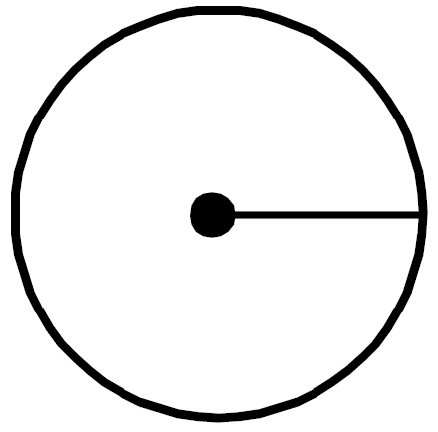
Consider a circular ring of radius r, uniformly charged with linear charge density $\lambda.$ Find the electric potential at a point on the axis at a distance x from the centre of the ring. Using this expression for the potential, find the electric field at this point.

Answer


Radius = r

So, $2\pi\text{r}=$ Circumference

Charge density $=\lambda$

Total charge $=2\pi\text{r}\times\lambda$

Electric potential $=\frac{\text{Kq}}{\text{r}}$

$=\frac{1}{4\pi\in_0}\times\frac{2\pi\text{r}\lambda}{\big(\text{x}^2+\text{r}2\big)^{\frac{1}{2}}}$

$=\frac{\text{r}\lambda}{2\in_0\big(\text{x}^2+\text{r}^2\big)^{\frac{1}{2}}}$
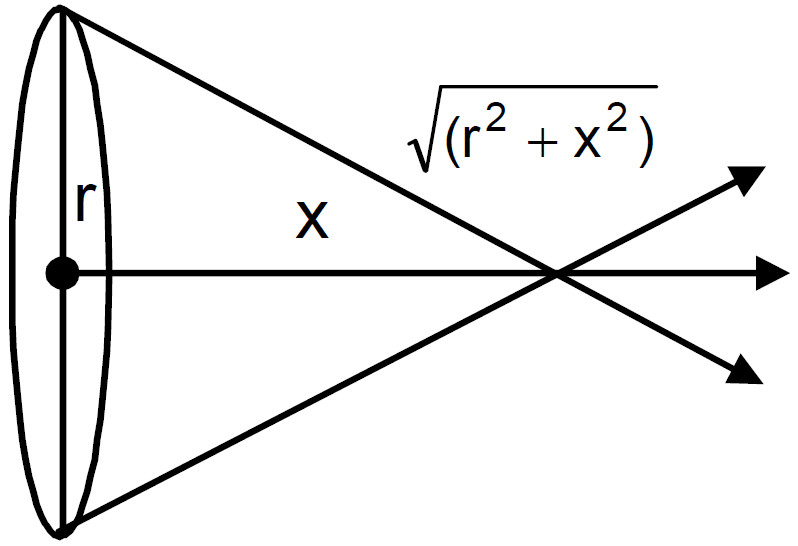
So, Electric field $=\frac{\text{V}}{\text{r}}\cos\theta$

$=\frac{\text{r}\lambda}{2\in_0\big(\text{x}^2+\text{r}^2\big)^{\frac{1}{2}}}\times\frac{\text{x}}{\big(\text{x}^2+\text{r}^2\big)^{\frac{1}{2}}}$

$=\frac{\text{r}\lambda\text{x}}{2\in_0\big(\text{x}^2+\text{r}^2\big)^{\frac{3}{2}}}$
Need a full question paper?

Generate a complete, print-ready paper with questions like this in minutes — across 16+ boards, with answer keys.

Start Generating Free

Similar questions

When a circuit element ‘X’ is connected across an a.c. source, a current of $\sqrt{2}\text{A}$ flows through it and this current is in phase with the applied voltage. When another element ‘Y’ is connected across the same a.c. source, the same current flows in the circuit but it leads the voltage by $\frac{\pi}{2}$ radians.
  1. Name the circuit element X and Y.
  2. Find the current that flows in the circuit when the series combination of X and Y is connected across the same a.c. voltage.
  3. Net impedance.
A uniform rod pivoted at its upper end hangs vertically. It is displaced through an angle of 60° and then released. Find the magnitude of the force acting on a particle of mass dm at the tip of the rod when the rod makes an angle of 37° with the vertical.
A bar magnet of magnetic moment m and moment of inertia I (about centre, perpendicular to length) is cut into two equal pieces, perpendicular to length. Let T be the period of oscillations of the original magnet about an axis through the mid point, perpendicular to length, in a magnetic field B. What would be the similar period T' for each piece?
A glass vessel measures exactly 10cm × 10cm × 10cm at 0°C. It is filled completely with mercury at this temperature. When the temperature is raised to 10°C, 1.6cm3 of mercury overflows. Calculate the coefficient of volume expansion of mercury. Coefficient of linear expansion of glass = 6.5 × 10⁻⁶ °C.
Two metal spheres, one of radius R and the other of radius 2R, both have same surface charge density $\sigma$. They are brought in contact and separated. What will be new surface charge densities on them?
Three equal masses m are placed at the three corners of an equilateral triangle of side a. Find the force exerted by this system on another particle of mass m placed at,
  1. The mid-point of a side,
  2. At the centre of the triangle.
Two particles, each with mass m are placed at a separation d in a uniform magnetic field B, as shown in the figure. They have opposite charges of equal magnitude q. At time t = 0, the particles are projected towards each other, each with a speed v. Suppose the Coulomb force between the charges is switched off.
  1. Find the maximum value vm of the projection speed, so that the two particles do not collide.
  2. What would be the minimum and maximum separation between the particles if $\text{v}=\text{v}_{\text{m}}\sqrt{2}?$
  3. At what instant will a collision occur between the particles if v = 2vm?
  4. Suppose v = 2vm and the collision between the particles is completely inelastic. Describe the motion after the collision.

The flux of magnetic field through a closed conducting loop changes with time according to the equation, $\phi=\text{at}^2+\text{bt}+\text{c}.$
  1. Write the SI units of a, band c.
  2. If the magnitudes of a, b and c are 0.20, 0.40 and 0.60 respectively, find the induced emf at t = 2s.
A converging lens of focal length 15cm and a converging mirror of focal length 10cm are placed 50cm apart. If a pin of length 2.0cm is placed 30cm from the lens farther away from the mirror, where will the final image form and what will be the size of the final image?