MCQ
Consider a neutral conducting sphere. A positive point charge is placed outside the sphere. The net charge on the sphere is then,
  • A
    negative and distributed uniformly over the surface of the sphere
  • B
    negative and appears only at the point on the sphere closest to the point charge
  • C
    negative and distributed non-uniformly over the entire surface of the sphere
  • zero

Answer

Correct option: D.
zero
d

Need a full question paper?

Generate a complete, print-ready paper with questions like this in minutes — across 16+ boards, with answer keys.

Start Generating Free

Similar questions

$A$ light ray is incident on a transparent sphere of index $= \sqrt 2 $ , at an angle of incidence $= 45^o$. What is the deviation of $a$ tiny fraction of the ray, which enters the sphere, undergoes two internal reflections, and then refracts out into air ?......$^o$
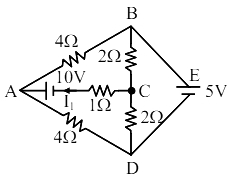
The current flowing through the $1 \Omega$ resistor is $\frac{\mathrm{n}}{10} \ A. $ The value of $n$ is. . . . . . .
A triode is operated in the linear region of its characteristics. If the plate voltage is slightly increased, the dynamic plate resistance will:
Positive electric flux indicates that electric lines of force are directed:
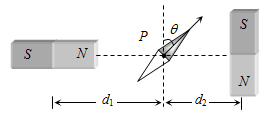
Two magnets A and B are identical and these are arranged as shown in the figure. Their length is negligible in comparison to the separation between them. A magnetic needle is placed between the magnets at point P which gets deflected through an angle θ under the influence of magnets. The ratio of distance $d_1$ and $d_2$ will be
For Young's double slit experiment, two statements are given below :

Statement $I:$ If screen is moved away from the plane of slits, angular separation of the fringes remains constant.

Statement $II:$ If the monochromatic source is replaced by another monochromatic source of larger wavelength, the angular separation of fringes decreases.

In the light of the above statements, choose the correct answer from the options given below :

Ray diverging from a point source from a wave front that is
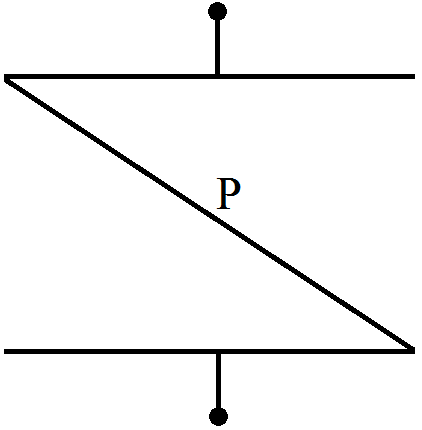
A thin metal plate P is inserted between the plates of a parallel$-$plate capacitor of capacitance $C$ in such a way that its edges touch the two plates $($figure$)$. The capacitance now becomes:
In a transistor
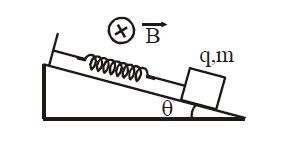
A small block of mass $m$, having charge $q$ is placed on frictionless inclined plane making an angle  $\theta$ with the horizontal. There exists a uniform magnetic field $B$ parallel to the inclined plane but  perpendicular to the length of spring. If $m$ is slightly pulled on the inclined in downward direction and released, the time period of oscillation will be (assume that the block does not leave contact with the plane)