MCQ
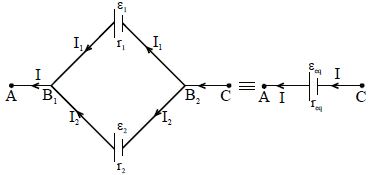
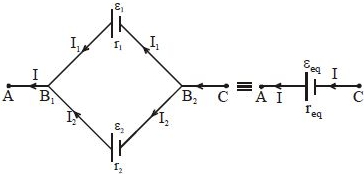
Consider a parallel combination of the cellsshown in the figure.The potential difference in between $B_1$ and $B_2$ is
  • ${\rm{V  =  }}{\varepsilon _{eq}} - I{r_{eq}}$
  • B
    ${\rm{V  =  }}{\varepsilon _2} - I{r_2}$
  • C
    ${\rm{V  =  }}{2\varepsilon _{eq}} - I{r_{eq}}$
  • D
    ${\rm{V  =  }}{\varepsilon _1} - 2I{r_1}$

Answer

Correct option: A.
${\rm{V  =  }}{\varepsilon _{eq}} - I{r_{eq}}$
a
$\mathrm{I}=\mathrm{I}_{1}+\mathrm{I}_{2}$

$I_{1}=\frac{\varepsilon_{2}-V}{r_{1}} \Rightarrow I_{2}=\frac{\varepsilon_{2}-V}{r_{2}}$

Combining the last three equations

$\mathrm{I}=\mathrm{I}_{1}+\mathrm{I}_{2}=\frac{\varepsilon_{1}-\mathrm{V}}{\mathrm{r}_{1}}+\frac{\varepsilon_{2}-\mathrm{V}}{\mathrm{r}_{2}}$

$=\left(\frac{\varepsilon_{1}}{\mathrm{r}_{1}}+\frac{\varepsilon_{2}}{\mathrm{r}_{2}}\right)-\mathrm{V}\left(\frac{1}{\mathrm{r}_{1}}+\frac{1}{\mathrm{r}_{2}}\right)$

Hence, $\mathrm{V}$ is given by, $\mathrm{V}=\frac{\varepsilon_{1} \mathrm{r}_{2}+\varepsilon_{2} \mathrm{r}_{1}}{\mathrm{r}_{1}+\mathrm{r}_{2}}-\mathrm{I} \frac{\mathrm{r}_{1} \mathrm{r}_{2}}{\mathrm{r}_{1}+\mathrm{r}_{2}}$

If we want to replace the combination by a single cell, between $\mathrm{B}_{1}$ and $\mathrm{B}_{2}$ of emf $\varepsilon_{\mathrm{eq}}$ and internal resistance $\mathrm{r}_{\mathrm{eq}},$

we would have $\mathrm{V}=\varepsilon_{\mathrm{eq}}-\mathrm{Ir}_{\mathrm{eq}}$
Need a full question paper?

Generate a complete, print-ready paper with questions like this in minutes — across 16+ boards, with answer keys.

Start Generating Free

Similar questions

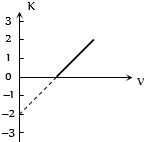
Figure represents a graph of kinetic energy $(K)$ of photoelectrons (in $eV$) and frequency $(v)$ for a metal used as cathode in photoelectric experiment. The work function of metal is ............. $eV$
The wavelength of $X-$rays is of the order of
Magnetic force required to demagnetize the material:
Match List - $I$ with List - $II.$

List - $I$ List - $II$
$(a)$ Source of microwave frequency $(i)$ Radioactive decay on nucleus
$(b)$ Source of infrared frequency $(ii)$ Magnetron
$(c)$ Source of Gamma Rays $(iii)$ Inner shell electrons
$(d)$ Source of $X-$rays $(iv)$ Vibration of atoms and molecules
    $(v)$ $LASER$
  $(vi)$ $RC$ circuit

Choose the correct answer from the options given below :

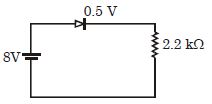
In the circuit, if the forward voltage drop for the diode is $0.5\, V$, the current will be.......$mA$
The distance between a proton and electron both having a charge $1.6 \times 10^{-19}$ coulomb, of a hydrogen atom is $10^{-10}$ metre. The value of intensity of electric field produced on electron due to proton will be
A sphere of radius $1\,cm$ has potential of $8000\,V$, then energy density near its surface will be
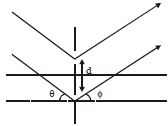
In the given figure light is incident at an angle $\theta$ with the normal to a plane containing two slits of separation $d$. Select the expression that correctly describes the positions of the interference maxima in terms of the incoming angle $\theta$ and outgoing angle $\phi$.
The essential distinction between X-rays and γ - rays is that
In a circuit for finding the resistance of a galvanometer by half deflection method, a  $6\,V$  battery and a high resistance of  $11\,k\Omega $  are used. The figure of merit of the galvanometer $60\,\mu A/$  division. In the absence of shunt resistance, the galvanometer produces a deflection of  $\theta = 9$  divisions when current flows in the circuit. The value of the shunt resistance that can cause the deflection of $\theta /2 ,$  is closest to ..................  $\Omega$