Question
Consider a particle moving in simple harmonic motion according to the equation $\text{x}=2.0\cos(50\pi\text{t}+\tan^{-1}0.75)$ where x is in centimetre and t in second. The motion is started at $t = 0$.
  1. When does the particle come to rest for the first time?
  2. When does the acceleration have its maximum magnitude for the first time?
  3. When does the particle come to rest for the second time?
Answer

  1. $\text{x}=2.0\cos(50\pi\text{t}+\tan^{-1}0.75)$
$=2.0\cos(50\pi\text{t}+0.643)$
$\text{v}=\frac{\text{dx}}{\text{dt}}=-100\sin(50\pi\text{t}+0.643)$
$\Rightarrow\sin(50\pi\text{t}+0.643)=0$
As the particle comes to rest for the $1^{st}$ time
$\Rightarrow50\pi\text{t}+0.643=\pi$
$\Rightarrow\text{t}=1.6\times10^{-2}\sec.$
  1. Acceleration $\text{a}=\frac{\text{dv}}{\text{dt}}=-100\pi\times50\pi\cos(50\pi\text{t}+0.643)$
For maximum acceleration $\cos(50\pi\text{t}+0.643)=-1\cos\pi$ (max) (so a is max)
$\Rightarrow\text{t}=1.6\times10^{-2}\sec.$​​​​​​​
  1. When the particle comes to rest for second time,
$50\pi\text{t}+0.643=2\pi$
$\Rightarrow\text{t}=3.6\times10^{-2}\text{s}.$

Need a full question paper?

Generate a complete, print-ready paper with questions like this in minutes — across 16+ boards, with answer keys.

Start Generating Free

Similar questions

A suitcase kept on a shop's rack is measured 50cm × 25cm × 10cm by the shop's owner. A traveller takes this suitcase in a train moving with velocity 0.6c.
If the suitcase is placed with its length along the train's velocity, find the dimensions measured by:
  1. The traveller and.
  2. A ground observer.
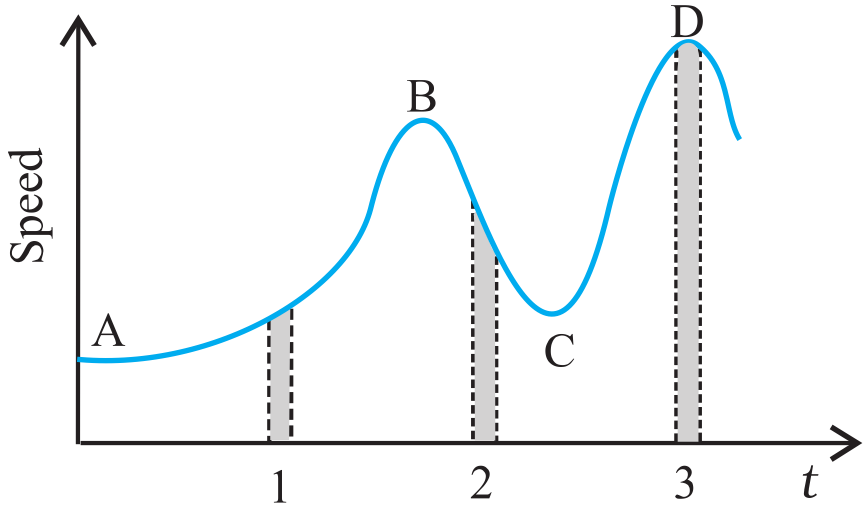
Gives a speed-time graph of a particle in motion along a constant direction. Three equal intervals of time are shown. In which interval is the average acceleration greatest in magnitude? In which interval is the average speed greatest? Choosing the positive direction as the constant direction of motion, give the signs of v and a in the three intervals. What are the accelerations at the points A, B, C and D?
A box weighing 2000N is to be slowly slid through 20m on a straight track having friction coefficient 0.2 with the box.
  1. Find the work done by the person pulling the box with a chain at an angle $\theta $ with the horizontal.
  2. Find the work when the person has chosen a value of $\theta $ which ensures him the minimum magnitude of the force.
$(n - 1)$ equal point masses each of mass m are placed at the vertices of a regular n-polygon. The vacant vertex has a position vector a with respect to the centre of the polygon. Find the position vector of centre of mass.
A block is resting on a piston which is moving vertically with a simple harmonic motion of period 1sec. At what amplitude of motion will the block and the piston seperate? What is the maximum velocity of the piston at this amplitude?
A beam of monochromatic light of wavelength $\lambda$ ejects photoelectrons from a cesium surface $\big(\Phi=1.9\text{eV}\big).$ These photoelectrons are made to collide with hydrogen atoms in ground state. Find the maximum value of $\lambda$ for which (a) hydrogen atoms may be ionized, (b) hydrogen atoms may get excited from the ground state to the first excited state and (c) the excited hydrogen atoms may emit visible light.
$\mathrm{Fe}^{+}$ions are accelerated through a potential difference of 500 V and are injected normally into a homogeneous magnetic field B of strength 20.0mT. Find the radius of the circular paths followed by the isotopes with mass numbers 57 and 58 . Take the mass of an ion $=\mathrm{A}\left(1.6 \times 10^{-27}\right) \mathrm{kg}$, where A is the mass number.
An aircraft is flying at a height of 3400m above the ground. If the angle subtended at a ground observation point by the aircraft positions 10.0s apart is 30°, what is the speed of the aircraft?
What do you understand by friction force? Write the laws of friction.
The initial pressure and volume of a given mass of a gas $\Big(\frac{\text{C}_\text{P}}{\text{C}_\text{V}}=\gamma\Big)$ are $P_0$ and $V_0$. The gas can exchange heat with the surrounding.
  1. It is slowly compressed to a volume $\frac{\text{V}_0}{2}$ and then suddenly compressed to $\frac{\text{V}_0}{4}.$ Find the final pressure.
  2. If the gas is suddenly compressed from the volume $V_0$ to $\frac{\text{V}_0}{2}$ and then slowly compressed to $\frac{\text{V}_0}{4},$ what will be the final pressure?