MCQ
Consider a rectangular sheet of solid material of length $\ell=9 cm$ and width $d =4 cm$. The coefficient of linear expansion is $\alpha=3.1 \times 10^{-5} K^{-1}$ at room temperature and one atmospheric pressure. The mass of sheet $m =0.1 kg$ and the specific heat capacity $C _{ v }=900 J kg ^{-1} K^{-1}$. If the amount of heat supplied to the material is $8.1 \times 10^2 J$ then change in area of the rectangular sheet is :-
  • $2.0 \times 10^{-6} m^2$
  • B
    $3.0 \times 10^{-7} m^2$
  • C
    $6.0 \times 10^{-7} m^2$
  • D
    $4.0 \times 10^{-7} m^2$

Answer

Correct option: A.
$2.0 \times 10^{-6} m^2$
(A) $2.0 \times 10^{-6} m^2$
$
\begin{array}{l}
\Delta Q=ms \Delta T \\
8.1 \times 10^2=0.1 \times 900 \times \Delta T \\
\Delta A=A_0 2 \alpha \Delta T=2.0 \times 10^{-6} m^2
\end{array}
$

Need a full question paper?

Generate a complete, print-ready paper with questions like this in minutes — across 16+ boards, with answer keys.

Start Generating Free

Similar questions

If the dimensions of a physical quantity are given by $M^aL^bT^c$ ,then physical quantity will be 
A rocket has a mass of $100 \,kg$. $90\%$ of this is fuel. It ejects fuel vapours at the rate of $1 \,kg/sec$ with a velocity of $500\, m/sec$ relative to the rocket. It is supposed that the rocket is outside the gravitational field. The initial upthrust on the rocket when it just starts moving upwards  is ......... $N$
A magnetic needle of negligible breadth and thickness compared to its length, oscillates in a horizontal plane with a period $T$. The period of oscillation of each part obtained on breaking the magnet into $n$ equal parts perpendicular to the length is
The positive feedback is required by an amplifier to act an oscillator. The feedback here means ...........
A body of mass m having an initial velocity $v$, makes head on collision with a stationary body of mass $M$. After the collision, the body of mass $m$ comes to rest and only the body having mass $M$ moves. This will happen only when
A film of water is formed between two straight parallel wires of length $10\,cm$ each separated by $0.5\, cm$. If their separation is increased by $1\, mm$ while still maintaining their parallelism, how much work will have to be done (Surface tension of water = $7.2 \times {10^{ - 2}}\,N/m)$
A stone of mass $0.25\; kg$ tied to the end of a string is whirled round in a circle of radius $1.5 \;m$ with a speed of $40\; rev./min$ in a hortzontal plane. What is the tenston in the string? What is the maximum speed in $m/s $ with which the stone can be whirled around if the string can withstand a maximum tension of $200\; N ?$
One end of a horizontal thick copper wire of length $2 L$ and radius $2 R$ is welded to an end of another horizontal thin copper wire of length $L$ and radius $R$. When the arrangement is stretched by a applying forces at two ends, the ratio of the elongation in the thin wire to that in the thick wire is :
A liquid mixture of volume $V$, has two liquids as its ingredients with densities $\alpha$ and $\beta$. If density of the mixture is $\sigma$, then mass of the first liquid in mixture is ............
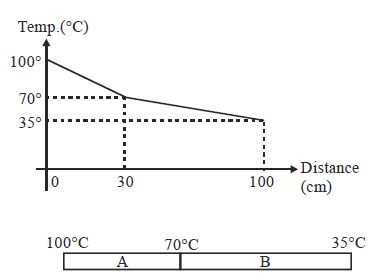
Two different rods $A$ and $B$ are kept as shown in figure. The variation of temperature of different cross sections is plotted in a graph shown in figure. The ratio of thermal conductivities of $A$ and $B$ is