MCQ
Consider a sample of a pure beta-active material:
  • A
    All the beta particles emitted have the same energy.
  • B
    The beta particles originally exist inside the nucleus and are ejected at the time of beta decay.
  • C
    The antineutrino emitted in a beta decay has zero mass and hence zero momentum.
  • D
    The active nucleus changes to one of its isobars after the beta decay.

Answer

  1. The active nucleus changes to one of its isobars after the beta decay.

Explanation:

In a beta decay, either a neutron is converted to a proton or a proton is converted to a neutron such that the mass number does not change. Also, the number of the nucleons present in the nucleus remains the same. Thus, the active nucleus gets converted to one of its isobars after beta decay.

Need a full question paper?

Generate a complete, print-ready paper with questions like this in minutes — across 16+ boards, with answer keys.

Start Generating Free

Similar questions

In a PNP transistor working as a common-base amplifier, current gain is 0.96 and emitter current is 7.2 mA. The base current is

(a) 0.4 mA

(b) 0.2 mA

(c) 0.29 mA

(d) 0.35 mA

Which of the following statement is true

(a)   has 78 neutrons

(b)  

(c)  

(d)  

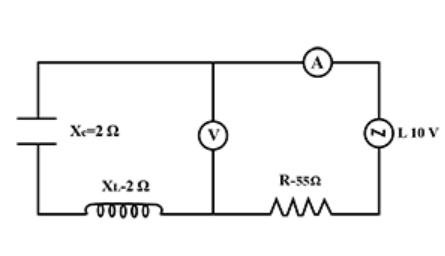
In the given figure as shown, the reading of the ammeter in ampere is.
Image
A proton and an electron are accelerated by the same potential difference. Let $\lambda_\text{e}$ and $\lambda_\text{p}$ denote the de Broglie wavelengths of the electron and the proton respectively.

  1. $\lambda_\text{e}=\lambda_\text{p}.$

  2. $\lambda_\text{e}<\lambda_\text{p}.$

  3. $\lambda _\text{e}>\lambda_\text{p}.$

  4. The relation between $\lambda_\text{e}$, and $\lambda_\text{p}$ depends on the accelerating potential difference.

When petrol drops from a vehicle fall over rain water on road surface, colours are seen because of:
Diode can work as:

The capacitance of a metallic sphere will be 1μF, if its radius is nearly

(a) 9 km  

(b) 10 m

(c) 1.11 m

(d) 1.11 cm

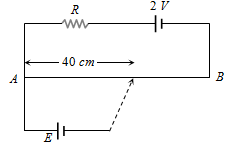
AB is a potentiometer wire of length 100 cm and its resistance is 10 ohms.  It is connected in series with a resistance R = 40 ohms and a battery of e.m.f. 2 V and negligible internal resistance.  If a source of unknown e.m.f. E is balanced by 40 cm length of the potentiometer wire, the value of E is

(a) 0.8 V 

(b) 1.6 V

(c) 0.08 V 

(d) 0.16 V

In the Boolean algebra, the following one is wrong:

X-rays which can penetrate through longer distances in substance are called

(a) Soft X-rays

(b) Continuous X-rays

(c) Hard X-rays

(d) None of the above