MCQ
Consider a uniform electric field in the $\hat{\text{Z}}$ direction. The potential is a constant:
- AIn all space.
- BFor any x for a given z.
- CFor any y for a given z.
- DOn the x-y plane for a given z.
We know, the electric field intensity E and electric potential V are
$\text{E}=-\frac{\text{dV}}{\text{dr}}$
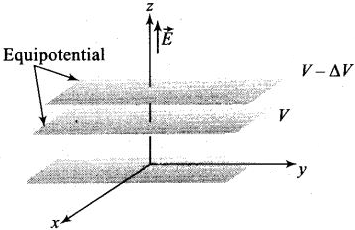
Electric potential decreases inf the direction of electric field. The direction of electric field is always perpendicular to one equipotential surface maintained at high electrostatic potential to other equipotential surface maintained at low electrostatic potential.
The electric field in z-direction suggest that equipotential surfaces are in x-y plane. Therefore the potential is a constant for any x for a given z, for any y for a given z and on the x-y plane for a given z.
Generate a complete, print-ready paper with questions like this in minutes — across 16+ boards, with answer keys.
Two wires of the same material are given. The first wire is twice as long as the second and has twice the diameter of the second. The resistance of the first will be
|
(a) Twice of the second |
(b) Half of the second |
|
(c) Equal to the second |
(d) Four times of the second |
Which state of triply ionised Baryllium ( has the same orbital radius as that of the ground state of hydrogen
|
(a) n = 4 |
(b) n = 3 |
(c) n = 2 | (d) n = 1 |
In helium nucleus, there are
|
(a) 2 protons and 2 electrons |
(b) 2 neutrons, 2 protons and 2 electrons |
|
(c) 2 protons and 2 neutrons |
(d) 2 positrons and 2 protons |
Energy conversion in a photoelectric cell takes place from
|
(a) Chemical to electrical |
(b) Magnetic to electrical |
|
(c) Optical to electrical |
(d) Mechanical to electrical |