MCQ
Consider a vector $\overrightarrow F = 4\hat i - 3\hat j.$ Another vector that is perpendicular to $\overrightarrow F $ is
  • A
    $4\hat i + 3\hat j$
  • B
    $6\hat i$
  • $7\hat k$
  • D
    $3\hat i - 4\hat j$

Answer

Correct option: C.
$7\hat k$
c
(c) Force $F$ lie in the $x-y$ plane so a vector along $Z-$axis will be perpendicular to $F$.

Need a full question paper?

Generate a complete, print-ready paper with questions like this in minutes — across 16+ boards, with answer keys.
Start Generating Free

Similar questions

The surface area of a solid cylinder of radius $2.0\ cm$ and height $A \ cm$ is equal to $1.5 \times 10^4(mm)^2$. Here, $A$ refers to:
A $1 \;kg$ stationary bomb is exploded in three parts having mass $1: 1: 3$ respectively. Parts having same mass move in perpendicular direction with velocity $30\; ms ^{-1}$, then the velocity of bigger part will be
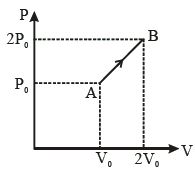
The $P-V$ diagram of $2\,g$ of helium gas for a certain process $A$ $\to$ $B$ is shown in the figure. What is the heat given to the gas during the process $A$ $\to$ $B$?
A particle starts with an initial velocity of $10.0\,ms ^{-1}$ along $x$-direction and accelerates uniformly at the rate of $2.0\,ms ^{-2}$. The time taken by the particle to reach the velocity of $60.0\,ms ^{-1}$ is $.......\,s$
Magnetic effect of current is discovered by:
When will the efficiency of Carnot engine be high?
A railway line is taken round a circular arc of radius $1000\ m$ , and is banked by raising the outer rail $h$ $m$ above the inner rail. If the lateral force on the inner rail when a train travels round the curve at $10\ ms^{-1}$ is equal to the lateral force on the outer rail when the train's speed is $20\ ms^{-1}$ . The value of $4g\ tan\theta $ is equal to : (The distance between the rails is $1.5\ m$ )
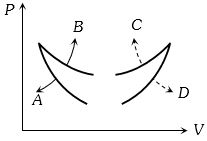
Four curves $A, B, C$ and $D$ are drawn in the adjoining figure for a given amount of gas. The curves which represent adiabatic and isothermal changes are
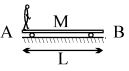
The figure shows a man of mass $m$ standing at the end $A$ of a trolley of mass $M$ placed at rest on a smooth horizontal surface. The man starts moving towards the end $B$ with a velocity $u_{rel}$ with respect to the trolley. The length of the trolley is $L$. The distance moved by the man with respect to ground is
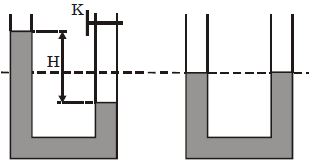
A $U$ -tube of small and uniform cross section contains water of total length $4H$. The height difference between the water columns on the left and on the right is $H$ when the valve $K$ is closed. The valve is suddenly open, and water is flowing from left to right. Ignore friction. The speed of water when the heights of the left and the right water columns are the same, is :-