Question
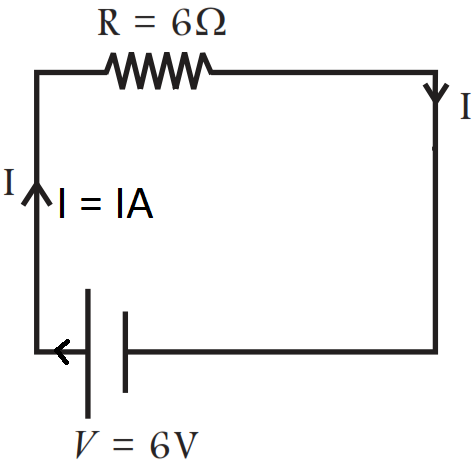
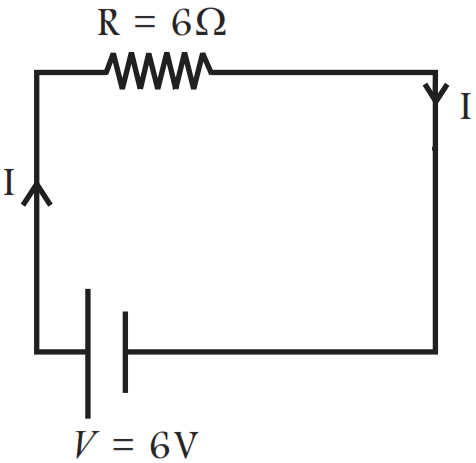
Consider circuit in Fig. How much energy is absorbed by electrons from the initial state of no current (ignore thermal motion) to the state of drift velocity?
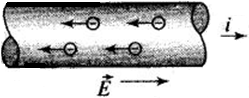
Answer

Key concept: Relation between current and drift velocity is given by $I = ne Av_d,$
where vd is the drift speed of electrons and n is the number density of electrons.

According to the Ohm's law current in the circuit

$\text{I}=\frac{\text{V}}{\text{R}}$
$\text{I}=\frac{6\text{V}}{6\Omega}=1\text{A}$
But, $\text{I}=\text{neAv}_\text{d}$
or $\text{v}_\text{d}=\frac{\text{I}}{\text{neA}}$
On substituting the value,
For n = number of electrons/volume $= 10^{29}/m^3$
length of circuit = 10cm, cross-section $= A = (1mm)^2$
$\text{v}_\text{d}=\frac{1}{10^{29}\times16\times10^{-19}\times10^{-6}}$
$=\frac{1}{1.6}\times10^{-4}\text{m/s}$
Therefore, the energy absorbed in the form of KE is given by
Total KE = KE of 1 electron × on. of electrons
$\text{KE}=\frac{1}{2}\text{m}_\text{e}\text{v}_\text{d}^2\times\text{nAl}$
$=\frac{1}{2}\times9.1\times10^{31}\times\frac{1}{2.56}\times10^{-8}\times{10}^{29}\times{10}^{-6}\times10^{-1}$
$=2\times10^{-17}\text{J}$

Need a full question paper?

Generate a complete, print-ready paper with questions like this in minutes — across 16+ boards, with answer keys.
Start Generating Free

Similar questions

A series LCR circuit with L = 0.12H, C = 480nF, R = 23Ω is connected to a 230V variable frequency supply.
  1. What is the source frequency for which current amplitude is maximum. Obtain this maximum value.
  2. What is the source frequency for which average power absorbed by the circuit is maximum. Obtain the value of this maximum power.
  3. For which frequencies of the source is the power transferred to the circuit half the power at resonant frequency? What is the current amplitude at these frequencies?
  4. What is the Q-factor of the given circuit?
A tightly-wound, long solenoid is kept with its axis parallel to a large metal sheet carrying a surface current. The surface current through a width dl of the sheet is Kdl and the number of turns per unit length of the solenoid is n. The magnetic field near the centre of the solenoid is found to be zero.
  1. Find the current in the solenoid.
  2. If the solenoid is rotated to make its axis perpendicular to the metal sheet, what would be the magnitude of the magnetic field near its centre ?
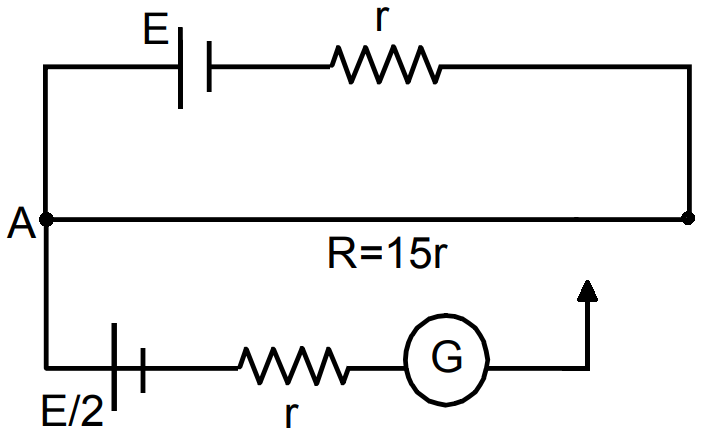
Consider the potentiometer circuit as arranged in the figure. The potentiometer wire is 600cm long. (a) At what distance from the point A should the jockey touch the wire to get zero deflection in the galvanometer? (b) If the jockey touches the wire at a distance of 560cm from A, what will be the current in the galvanometer?
A copper wire of radius 0.1mm and resistance $1\text{k}\Omega$ is connected across a power supply of 20V.
(a) How many electrons are transferred per second between the supply and the wire at one end? (b) Write down the current density in the wire.
The wavelengths of $\text{K}_\alpha$ and $\text{L}_\alpha$ X-rays of a material are 21.3pm and 141pm respectively. Find the wavelength of $\text{K}_\beta$ X-ray of the material.
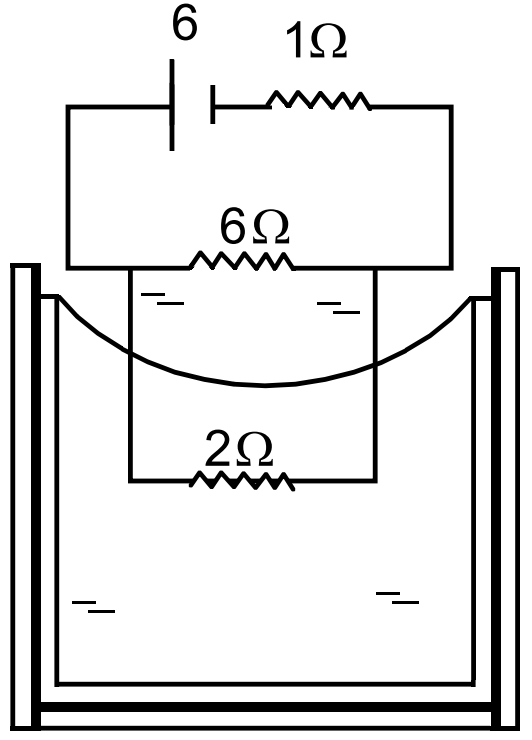
The 2.0Ω resistor shown in the figure is dipped into a calorimeter containing water. The heat capacity of the calorimeter together with water is $2000JK-^1.$
  1. If the circuit is active for 15 minutes, what would be the rise in the temperature of the water?
  2. Suppose the 6.0Ω resistor gets burnt. What would be the rise in the temperature of the water in the next 15 minutes?

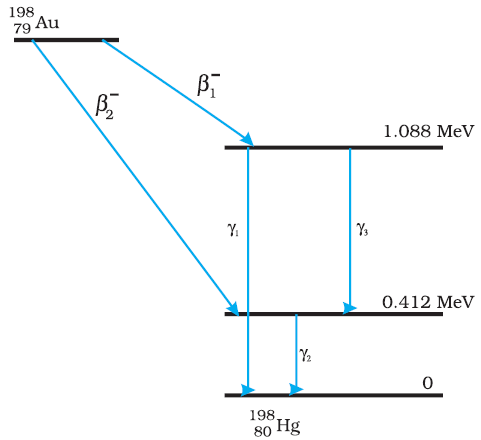
Obtain the maximum kinetic energy of $\beta$-particles, and the radiation frequencies of $\gamma$ decays in the decay scheme shown in Fig. 13.6. You are given that:
$\text{m}(^{198}\text{Au})=197.968233\text{ u}$
$\text{m}(^{198}\text{Hg})=197.9667602\text{ u}$
Two wires carrying equal currents i each, are placed perpendicular to each other, just avoiding a contact. If one wire is held fixed and the other is free to move under magnetic forces, what kind of motion will result?
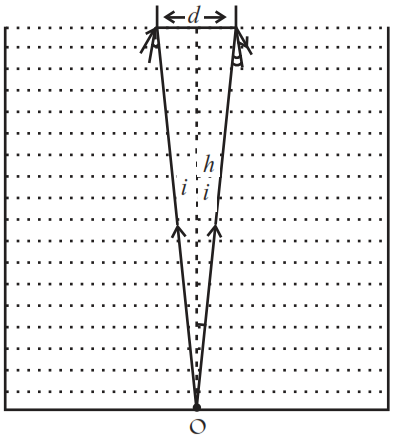
A jar of height h is filled with a transparent liquid of refractive index μ (Fig). At the centre of the jar on the bottom surface is a dot. Find the minimum diameter of a disc, such that when placed on the top surface symmetrically about the centre, the dot is invisible.
Is it possible that in a Coolidge tube characteristic $\text{L}_\alpha$ X-rays are emitted but not $\text{K}_\alpha$ X-rays?