Question
Two wires carrying equal currents i each, are placed perpendicular to each other, just avoiding a contact. If one wire is held fixed and the other is free to move under magnetic forces, what kind of motion will result?

Answer

The magnetic force on a wire carrying an electric current i is $\overrightarrow{\text{F}}=\text{i}.\big(\overrightarrow{\text{l}}\times\overrightarrow{\text{B}}\big),$ where l is the length of the wire and B is the magnetic field acting on it. Suppose we have one wire in the horizontal direction (fixed) and other wire in the vertical direction (free to move). If the horizontal wire is carrying current from right to left is held fixed perpendicular to the vertical wire, which is free to move, the upper portion of the free wire will tend to move in the left direction and the lower portion of the wire will tend to move in the right direction, according to Fleming's left hand rule, as the magnetic field acting on the wire due to the fixed wire will point into the plane of paper above the wire and come out of the paper below the horizontal wire and the current will flow in upward direction in the free wire. Thus, the free wire will tend to become parallel to the fixed wire so as to experience maximum attractive force.

Need a full question paper?

Generate a complete, print-ready paper with questions like this in minutes — across 16+ boards, with answer keys.
Start Generating Free

Similar questions

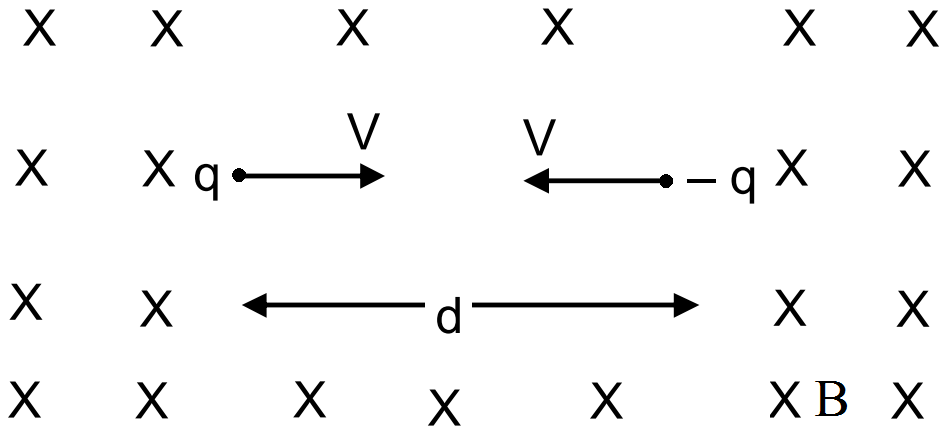
Two particles, each with mass m are placed at a separation d in a uniform magnetic field B, as shown in the figure. They have opposite charges of equal magnitude q. At time t = 0, the particles are projected towards each other, each with a speed v. Suppose the Coulomb force between the charges is switched off.
  1. Find the maximum value $v_m$ of the projection speed, so that the two particles do not collide.
  2. What would be the minimum and maximum separation between the particles if $\text{v}=\text{v}_{\text{m}}\sqrt{2}?$
  3. At what instant will a collision occur between the particles if $v = 2v_m?$
  4. Suppose $v = 2v_m$ and the collision between the particles is completely inelastic. Describe the motion after the collision.
The conductivity of an intrinsic samiconductor depends on temperature as $\sigma=\sigma_0\text{ e}^{\frac{-\Delta\text{E}}{2\text{kT}}}$ where $\sigma_0$ is a constant. Find the temperature at which the conductivity pf an intrinsic germanium semiconductor will be double of its value at T = 300K. Assume that the gap for germanium is 0.650eV and remains constant as the temperature is increased.
Derive the electric field generated due to the dipole at any point located on the equatorial plane of the electric dipole. Draw the necessary diagram.
A student is studying a book placed near the edge of a circular table of radius R. A point source of light is suspended directly above the centre of the table. What should be the height of the source above the table so as to produce maximum illuminance at the position of the book?
Consider an excited hydrogen atom in state n moving with a velocity u(ν << c). It emits a photon in the direction of its motion and changes its state to a lower state m. Apply momentum and energy conservation principles to calculate the frequency ν of the emitted radiation. Compare this with the frequency $ν_0$ emitted if the atom were at rest.
An X-OR gate has following truth table:
A B Y
0 0 0
0 1 1
1 0 1
1 1 0
It is represented by following logic relation $\text{Y}=\bar{\text{A}}.\text{B}+\text{A}.\bar{\text{B}}$ Build this gate using AND, OR and NOT gates.
A small object is placed at the centre of the bottom of a cylindrical vessel of radius 3cm and height 4cm filled completely with water. Consider the ray leaving the vessel through a corner. Suppose this ray and the ray along the axis of the vessel are used to trace the image. Find the apparent depth of the image and the ratio of real depth to the apparent depth under the assumptions taken. Refractive index of water = 1.33
An electron is projected horizontally with a kinetic energy of 10keV. A magnetic field of strength $1.0 \times 10^{-7}T$ exists in the vertically upward direction.
  1. Will the electron deflect towards the right or left of its motion?
  2. Calculate the sideways deflection of the electron while travelling through 1m. Make appropriate approximations.
A man with normal near point (25 cm) reads a book with small print using a magnifying glass: a thin convex lens of focal length 5 cm.
  1. What is the closest and the farthest distance at which he should keep the lens from the page so that he can read the book when viewing through the magnifying glass?
  2. What is the maximum and the minimum angular magnification (magnifying power) possible using the above simple microscope?
  1. Using Ampere's circuital law, obtain the expression for the magnetic field due to a long solenoid at a point inside the solenoid on its axis.
  2. In what respect is a toroid different from a solenoid? Draw and compare the pattern of the magnetic field lines in the two cases.
  3. How is the magnetic field inside a given solenoid made strong?