Question

Consider the circuit arrangement shown in Fig (a) for studying input and output characteristics of npn transistor in CE configuration.
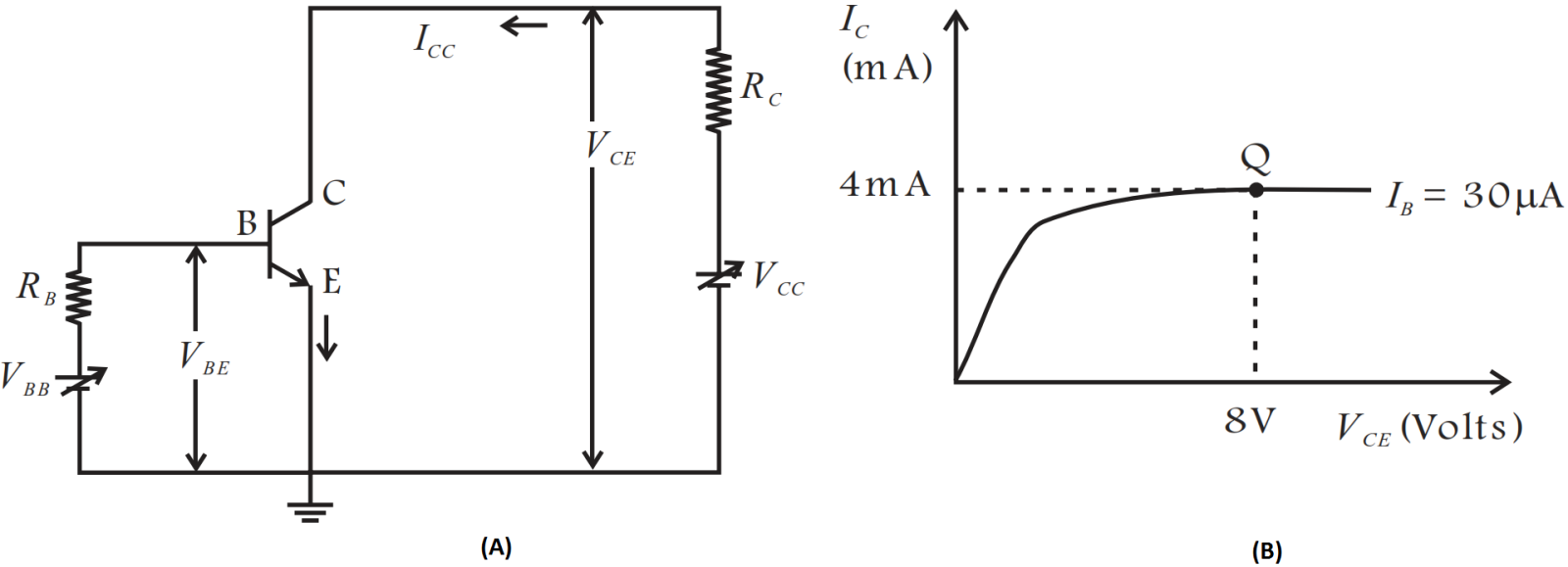
Select the values of $R_B$ and $R_C$ for a transistor whose $V_{BE} = 0.7V,$ so that the transistor is operating at point Q as shown in the characteristics shown in Fig. (b).
Given that the input impedance of the transistor is very small and $V_{CC} = V_{BB} = 16V,$ also find the voltage gain and power gain of circuit making appropriate assumptions.
Answer

According to the problem, at point Q, from graph
$V_{BE} = 0.7V, V_{CC} = V_{BB} = 16V$ and $V_{CE} = 8V. IC = 4mA = 4 \times 10^{-3}A$
$\text{I}_\text{B}=30\mu\text{A}=30\times10^{-6}\text{A}$
Since, $V_{CC} = I_CR_C + V_{CE} $
$\text{R}_\text{C}=\frac{\text{V}_\text{CC}-\text{V}_\text{CE}}{\text{I}_\text{C}}=\frac{16-8}{4\times10^{-3}}=\frac{8\times1000}{4}=2\text{k}\Omega$
Similarly, $V_{BB} - I_BR_B + V_{BE}$
$\text{R}_\text{B}=\frac{\text{V}_\text{BB}-\text{V}_\text{BE}}{\text{I}_\text{B}}=\frac{16-0.7}{30\times10^{-6}}$
$=510\times10^3\Omega=510\text{k}\Omega$ Current gain,
$\beta=\frac{\text{I}_\text{C}}{\text{I}_\text{B}}=\frac{4\times10^{-3}}{30\times10^{-6}}=133.3$
Voltage gain $=\beta\frac{\text{R}_\text{C}}{\text{R}_\text{B}}=\frac{133\times2\times10^3}{510\times10^3}=0.52$
$\text{Power gain}=\beta\times\text{Voltage gain}=133\times0.52=69$

Need a full question paper?

Generate a complete, print-ready paper with questions like this in minutes — across 16+ boards, with answer keys.

Start Generating Free

Similar questions

A biconvex thick lens is constructed with glass $(\mu=1.50)$ Each of the surfaces has a radius of 10cm and the thickness at the middle is 5cm. Locate the image of an object placed far away from the lens.
$i.$ Define the capacitance of a capacitor. Obtain the expression for the capacitance of a parallel plate capacitor in vacuum in terms of plate area A and separation $d$ between the plates.
$ii.$ A slab of material of dielectric constant $k$ has the same area as the plates of a parallel plate $\frac{3 d}{4}$ capacitor but has a thickness -. Find the ratio of the capacitance with dielectric inside it to its capacitance without the dielectric.
An unsymmetrical double convex thin lens forms the image of a point object on its axis. Will the position of the image change if the lens is reversed?
A particle of charge $2.0 \times 10^{-8}C$ and mass $2.0 \times 10^{-10}g$ is projected with a speed of $2.0 \times 10^3m/s^{-1}$ in a region with a uniform magnetic field of 0.10T. The velocity is perpendicular to the field. Find the radius of the circle formed by the particle and also the time period.
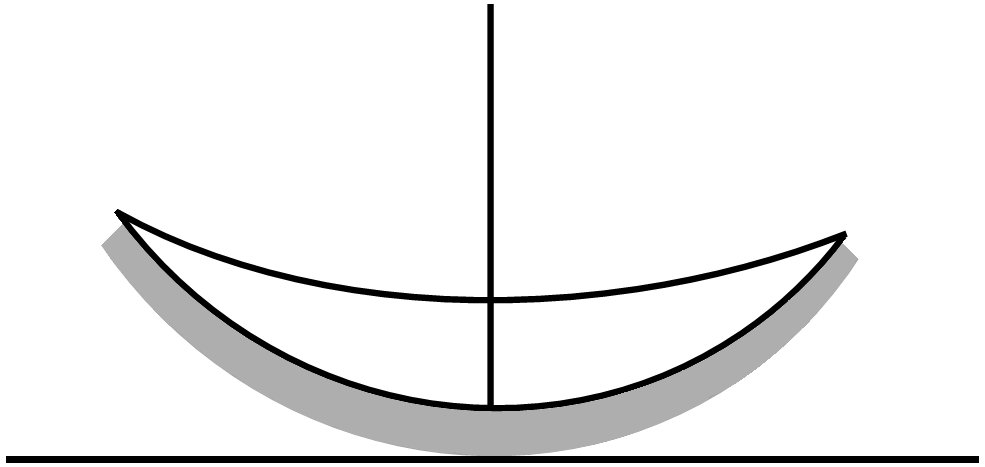
The convex surface of a thin concavo-convex lens of glass of refractive index 1.5 has a radius of curvature 20cm. The concave surface has a radius of curvature 60cm. The convex side is silvered and placed on a horizontal surface as shown in figure.
  1. Where should a pin be placed on the axis so that its image is formed at the same place?
  2. If the concave part is filled with water $\Big(\mu=\frac{4}{3}\Big),$ find the distance through which the pin should be moved so that the image of the pin again coincides with the pin.
Find the equation of the equipotentials for an infinite cylinder of radius $r_0$, carrying charge of linear density $\lambda$.
A capacitor of capacitance C is given a charge Q. At t = 0, it is connected to an uncharged capacitor of equal capacitance through a resistance R. Find the charge on the second capacitor as a function of time.
A hemispherical portion of the surface of a solid glass sphere $(\mu=1.5)$ of radius r is silvered to make the inner side reflecting. An object is placed on the axis of the hemisphere at a distance 3r from the centre of the sphere. The light from the object is refracted at the unsilvered part, then reflected from the silvered part and again refracted at the unsilvered part. Locate the final image formed.
State Soddy-Fajan’s displacement laws for radioactive transformations.
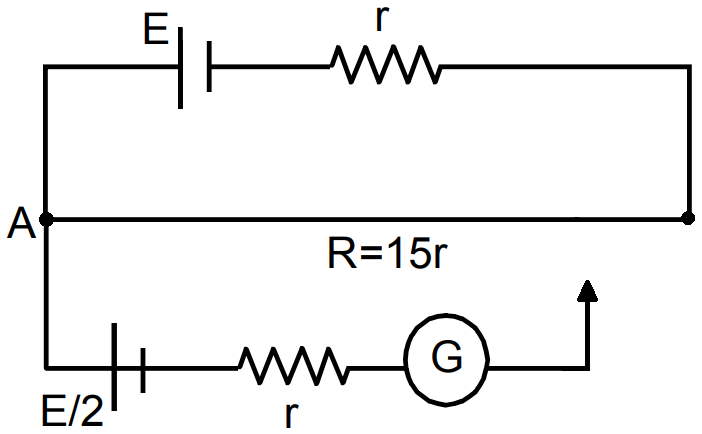
Consider the potentiometer circuit as arranged in the figure. The potentiometer wire is 600cm long. (a) At what distance from the point A should the jockey touch the wire to get zero deflection in the galvanometer? (b) If the jockey touches the wire at a distance of 560cm from A, what will be the current in the galvanometer?