Question
State Soddy-Fajan’s displacement laws for radioactive transformations.

Answer

The atoms of radioactive element are unstable. When an atom of a radioactive element disintegrates, an entirely new element is formed. This new element possesses entirely new chemical and radioactive properties. The disintegrating element is called the parent element and the resulting product after disintegration is called the daughter element. Soddy and Fajan studied the successive product elements of disintegration of radioactive elements and gave the following conclusions:
  1. Alpha-Emission: a-particle is nucleus of a helium atom having atomic number 2 and atomic weight 4. It is denoted by $_2He^4.$ Therefore when an $\alpha-$particle is emitted from a radioactive parent atom (X), its atomic number is reduced by 2 and atomic weight is reduced by 4. Thus the daughter element has its place two groups lower in the periodic table. Thus the process of a-emission may be expressed as:
$_\text{Z}\text{X}^\text{A}\ \rightarrow \ _{\text{z}-2}\text{Y}^{\text{A}-4}\ +\ _2\text{He}^4\\\ \ \ \ \ \ \ \ \ \ \ \ \ \ \ \ \ \ \ \ \ \ \ \ \ \ \ \ \ \ \ \ \ \ \ \ \ (\alpha-\text{particle})$
Examples:
92U238 90Th234 $+ _2He^4$
80Ra226 86Rn222 $+ _2He^4​​​​​​​$​​​​​​​
  1. Beta-Emission: $\beta-$particle is an electron (e) and is denoted by $_{-1}\beta^0.$ When a $\beta-$particle is emitted from a parent atom (X), it atomic number increases by 1. while atomic weight remains unchanged. As a result the doughter element (Y) has a place one group higher in the periodic table. Thus the process of $\beta-$emission may be expressed as:
$_\text{Z}\text{X}^\text{A}\rightarrow_{\text{Z}+1}\text{Y}^\text{A}+_{-1}\beta^0+\bar{\text{v}}$
where $\bar{\text{v}}$ is a fundamental particle called antineutrino which is massless and chargeless.
Example: $_{90}\text{Th}^{228}\rightarrow_{89}\text{Ac}^{228}+_{-1}\text{b}^0+\bar{\text{v}}$
  1. Gamma-Emission: The emission of $\lambda-$ray from a radioactive atom neither chages its atomic number nor its atomic weight. Therefore its place in periodic table remains undisplaced. In natural radioactivity $\lambda-$radiation is accompanied with either $\alpha$ or $\beta-$emission.

Need a full question paper?

Generate a complete, print-ready paper with questions like this in minutes — across 16+ boards, with answer keys.
Start Generating Free

Similar questions

State ampere's law. Obtain expression for magnetic field at a point located (i) externally (ii) internally due to a long cylindrical solid current carrying conductor.###Calculate the value of magnetic field at points $(r>a)$ and $(r
A source contains two phosphorous radio nuclides $^{32}_{15}\text{P }(\text{T}_{1/2}=14.3\text{d})$ and $^{33}_{15}\text{P }(\text{T}_{1/2}=25.3\text{d})$ Initially, 10% of the decays come from $^{33}_{15}\text{P}.$ How long one must wait until 90% do so?
When a light ray passes from the atmosphere (a) through the combination of two mediums water (b) and glass (c), then find the relationship between the refractive indices of the three mediums.
An electron makes $3 \times 10^5$ revolutions per second in a circle of radius 0.5 angstrom. Find the magnetic field B at the centre of the circle.
Explain ac voltage applied on a capacitor.Explain charging and discharging of a capacitor.
Compare and contrast the nature of $\alpha-, \beta-$ and $\gamma-$radiations.
A block of mass m is kept on a horizontal ruler. The friction coefficient between the ruler and the block is g. The ruler is fixed at one end and the block is at a distance L from the fixed end. The ruler is rotated about the fixed end in the horizontal plane through the fixed end.
  1. What can the maximum angular speed be for which the block does not slip?
  2. If the angular speed of the ruler is uniformly increased from zero at an angular acceleration $\alpha,$ at what angular speed will the block slip?
Two wires carrying equal currents i each, are placed perpendicular to each other, just avoiding a contact. If one wire is held fixed and the other is free to move under magnetic forces, what kind of motion will result?
Sea water at frequency $ν = 4 \times 10^8$Hz has permittivity $\in\approx80\in_0$, permeability $\mu \approx\mu_0$ and resistivity $\rho=0.25\Omega-\text{m}$. Imagine a parallel plate capacitor immersed in sea water and driven by an alternating voltage source $\text{V(t)}=\text{V}_0\sin(2\pi\text{vt})$. What fraction of the conduction current density is the displacement current density?
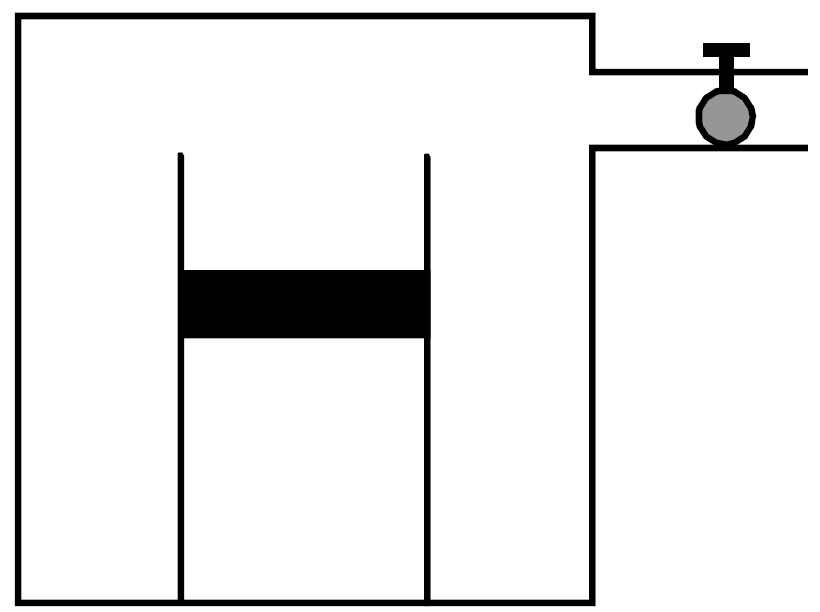
An ideal gas is kept in a long cylindrical vessel fitted with a frictionless piston of cross-sectional area $10cm^2$ and weight 1kg (figure.) The vessel itself is kept in a big chamber containing air at atmospheric pressure 100kPa. The length of the gas column is 20cm. If the chamber is now completely evacuated by an exhaust pump, what will be the length of the gas column? Assume the temperature to remain constant throughout the process.