Question
Consider the following equilibrium at 2773K
$\text{H}_2(\text{g})+\text{Cl}_2(\text{g})\rightleftharpoons2\text{HCl}(\text{g})$
Initially $0.25M H_2$ and $0.25MCl_2$ are introduced into a reaction vessel and the system in allowed to attain equilibrium. At equilibrium the concentrations of $H_2(g)$ and $Cl_2(g)$ became $0.0314M$. Calculate $K_c$ and $K_p$.
Answer

  1. $\begin{matrix}&\text{H}_2(\text{g})&+&\text{Cl}_2(\text{g})\rightleftharpoons&\text{2Hcl}(\text{g})\\\text{Initial Conc. }&0.25&&0.25\text{M}&0\\\text{Final Conc.at equilibrium}&0.0314\text{M}&&0.0314\text{M}&0\end{matrix}$
$2(0.25-0.0314)=0.2186\text{M}\times2$

$=0.219\text{M}\times2=0.438$

$\text{K}_{\text{c}}=\frac{[\text{HCl}]^2}{[\text{H}_2][\text{Cl}_2]}$

$=\frac{(0.438)^2}{0.0314\times0.314}=195$
  1. $\text{K}_{\text{p}}=\text{K}_{\text{c}}(\text{RT})^{\Delta\text{n}}$
$\Delta\text{n}=0$

$\text{K}_{\text{p}}=\text{K}_{\text{c}}=195$

Need a full question paper?

Generate a complete, print-ready paper with questions like this in minutes — across 16+ boards, with answer keys.

Start Generating Free

Similar questions

Which out of $\mathrm{NH}_3$ and $\mathrm{NF}_3$ has higher dipole moment and why?
At $450K, K_p= 2.0 \times 10^{10}/bar$ for the given reaction at equilibrium.
$2\text{SO}_2\text{(g) + O}_2\text{(g)}\rightleftharpoons\text{2SO}_3\text{(g)}$
What is $K_c$ at this temperature?
What is hyperconjugation? Explain with example and with help of this explain the stability of carbocations and alkenes.
  1. Consider the following endothermic reaction:
$\text{CH}_4(\text{g})+\text{H}_2\text{O}(\text{g})\rightleftharpoons\text{CO(g)}+3\text{H}_2(\text{g})$
  1. Write expression for $K_p$ for the above reaction.
  2. How will the values of $K_p$ and composition of equilibrium mixture be affected by.
  1. increasing the pressure.
  2. increasing the temperature.
  3. using a catalyst?
  1. Calculate the pH of the resultant mixture of $10$ml of $0.1$M $H_2SO_4 + 10$ ml of $0.1$M KOH.
You have a mixture of three liquids A, B and C. There is a large difference in the boiling points of A and rest of the two liquids i.e., B and C. Boiling point of liquids B and C are quite close. Liquid A boils at a higher temperature than B and C and boiling point of B is lower than C. How will you separate the components of the mixture. Draw a diagram showing set up of the apparatus for the process.
How do you account for the strong reducing power of lithium in aqueous solution?
Derive the equation required to determine pH of acidic buffer.
Explain with the help of suitable example polar covalent bond.
Attempt any five of the following:
1. What is electrophile in sulphonation?
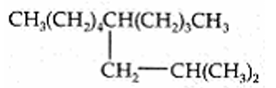
2. Write IUPAC name of following:
Image
3. Write IUPAC name: $CH _3 CH - C \left( CH _3\right)_2$
4. Methane does not react with chlorine in dark. Why?
5. How would you convert ethene to ethane molecule?
6. What is Huckel rule?
7. What is decarboxylation? Give an example.
Which important property did Mendeleev use to classify the elements in his periodictable and did he stick to that?