MCQ
Consider the following statements

Assertion $(A)$ : $A$ cyclist always bends inwards while negotiating a curve

Reason $(R)$ : By bending he lowers his centre of gravity Of these statements,

  • A
    both $A$ and $R$ are true and $R$ is the correct explanation of $A$
  • both $A$ and $R$ are true but $R$ is not the correct explanation of $A$
  • C
    $A$ is true but $R$ is false
  • D
    $A$ is false but $R$ is true

Answer

Correct option: B.
both $A$ and $R$ are true but $R$ is not the correct explanation of $A$
b

Need a full question paper?

Generate a complete, print-ready paper with questions like this in minutes — across 16+ boards, with answer keys.

Start Generating Free

Similar questions

The speed of light depends:
  1. On elasticity of the medium only.
  2. On inertia of the medium only.
  3. On elasticity as well as inertia.
  4. Neither on elasticity nor on inertia.
A person can throw a ball upto a maximum range of $100 \,m$. How high above the ground he can throw the same ball?
Moment of inertia of a dise of mass $M$ and radius ' $R$ ' about any of its diameter is $\frac{ MR ^2}{4}$. The moment of inertia of this disc about an axis normal to the disc and passing through a point on its edge will be, $\frac{ x }{2} MR ^2$. The value of $x$ is $..........$.
A spherical uniform planet is rotating about its axis. The velocity of a point on its equator is $V.$ Due to the rotation of planet about its axis the acceleration due to gravity $g$ at equator is $1/2$ of $g$ at poles. The escape velocity of a particle on the planet in terms of $V.$
The length of a son meter wire $AB$ is $110\; cm$. Where should the two bridges be placed from $A$ to divide the wire in $3$ segments whose fundamental frequencies are in the ratio of $1:2:3$?
Absolute scale of temperature is reproduced in the laboratory by making use of a
Two masses $m_1$ and $m_2$ connected by a spring of spring constant $k$ rest on a frictionless surface. If the masses are pulled apart and let go, the time period of oscillation is
On a linear temperature scale $Y$, water freezes at $- 160^o\, Y$ and boils at $- 50^o\, Y$. On this $Y$ scale , a temperature of $340\, K$ would be read as........ $^oY$  ( water freezes at $273\, K$ and boils at $373\, K$)
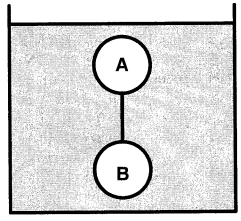
Two solid spheres $A$ and $B$ of equal volumes but of different densities $d_A$ and $d_B$ are connected by a string. They are fully immersed in a fluid of density $d_F$. They get arranged into an equilibrium state as shown in the figure with a tension in the string. The arrangement is possible only if

$(A)$ $d_Ad_F$  $(B)$ $d_B > d_F$ $(C)$ $d_A>d_F$ $(D)$ $d_A+d_B=2 d_F$

Equivalent resistance of two resistors $\text{R}_1=100\pm312$ and $\text{R}_2=200\pm4\Omega$ in series is: