Question
Consider the objective function Z = 40x + 50y The minimum number of constraints that are required to maximize Z are:
  1. 4
  2. 2
  3. 3
  4. 1

Answer

  1. 3
Solution:
Since in the given function Z = 40x + 50y, two variables are used.
So, the two constraints will be $\text{x}\geq0,\text{y}\geq0$ and the third one will be of the type
$\text{ax}+\text{by}\geq\text{c}.$
Hence, at least 3 constraints are required.

Need a full question paper?

Generate a complete, print-ready paper with questions like this in minutes — across 16+ boards, with answer keys.
Start Generating Free

Similar questions

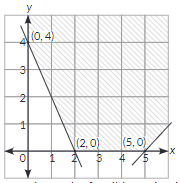
A linear programming problem (LPP) along with the graph of its constraints is shown below. The corresponding objective function is
Minimize: $Z=3 x+2 y$. The minimum value of the objective function is obtained at the corner point ( 2 , 0).
The optimal solution of the above linear programming problem $\qquad$
Image
$\int\limits^\infty_0\frac{1}{1+\text{e}^\text{x}}\text{dx}$ equals:
  1. $\log2-1$
  2. $\log2$
  3. $\log4-1$
  4. $-\log2$
If $A=\left[\begin{array}{ccc}2 & \lambda & -3 \\ 0 & 2 & 5 \\ 1 & 1 & 3\end{array}\right]$, then $A^{-1}$ exists only if
Find the cofactor of each element of the first column of matrix $A=\left[\begin{array}{ccc}2 & 5 & -1 \\ -3 & 0 & 1 \\ 1 & 1 & -1\end{array}\right].$
The direction cosines of any normal to the xy plane are:
  1. 1, 0 ,0
  2. 0, 1, 0
  3. 1, 1, 0
  4. 1, 1, 0
The number of real solution of the equation
$\sqrt{1+\cos2\text{x}}=\sqrt2\sin^{-1}(\sin\text{x}),-\pi\leq\text{x}\leq\pi$ is:
  1. 0
  2. 1
  3. 2
  4. infinite
$2\tan^{-1}(\cos\text{x})=\tan^{-1}(2\text{cosec x})$
  1. $0$
  2. $\frac{\pi}{3}$
  3. $\frac{\pi}{4}$
  4. $\frac{\pi}{2}$
If A and B are non-singular matrices of same order with det(A) = 5, then $\operatorname{det}\left(B^{-1} A B\right)^2$ is is equal to.
Area bounded by the ellipse $\frac{\text{x}^2}{4}+\frac{\text{y}^2}{9}=1$
  1. $6\pi\text{ sq}.\text{units}$
  2. $3\pi\text{ sq}.\text{units}$
  3. $12\pi\text{ sq}.\text{units}$
  4. $\text{None of these}$
ABCD is a parallelogram with AC and BD as diagonals. Then, $\overrightarrow{\text{AC}}-\overrightarrow{\text{BD}}=$
  1. $4\overrightarrow{\text{AB}}$
  2. $3\overrightarrow{\text{AB}}$
  3. $2\overrightarrow{\text{AB}}$
  4. $\overrightarrow{\text{AB}}$