Question
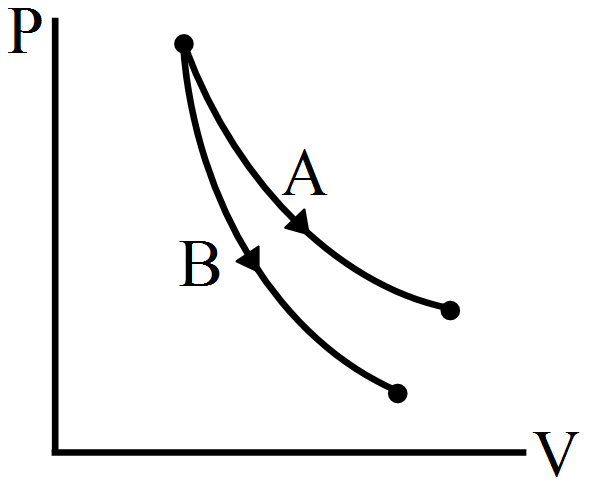
Consider the processes A and B shown in the figure. It is possible that:
  1. Both the processes are isothermal.
  2. Both the processes are adiabatic.
  3. A is isothermal and B is adiabatic.
  4. A is adiabatic and B is isothermal.

Answer

  1. A is isothermal and B is adiabatic.

Explanation:

The slope of an adiabatic process is greater than that of an isothermal process. Since A and B are initiated from the same initial state, both cannot be isothermal or adiabatic, as they would be overlapping. But the curve of process B is steeper than the curve of process A. Hence, A is isothermal and B is adiabatic.

Need a full question paper?

Generate a complete, print-ready paper with questions like this in minutes — across 16+ boards, with answer keys.

Start Generating Free

Similar questions

What determines the nature of the path followed by the particle
In a p-n junction with open ends:
  1. There is no systematic motion of charge carriers.
  2. Holes and conduction electrons systematically go from the p-side to the n-side and from the n side to the p-side respectively.
  3. There is no net charge transfer between the two sides.
  4. There is a constant electric field near the junction.
The number of significant figures in 61,00,000 is:
If a vector $\vec A$ is parallel to another vector $\vec B$ then the resultant of the vector $\vec A \times \vec B$ will be equal to
A car is moving on a horizontal circular track of radius $0.2 \,km$ with a constant speed. If coefficient of friction between tyres of car and road is $0.45$, then speed of car may be ........ $m / s$ [Take $g=10 \,m / s ^2$ ]
If time $(t)$, velocity $(u)$, and angular momentum $(I)$ are taken as the fundamental units. Then the dimension of mass $({m})$ in terms of ${t}, {u}$ and ${I}$ is
A body dropped from the top of a tower covers a distance $7 x$ in the last second of its journey, where $x$ is the distance covered in first second.$.........\,s$ time does it take to reach the ground.
A vessel of volume $0.02 \,\,m^3$ contains a mixture of hydrogen and helium at $20\,^oC$ and $2$ atmospheric pressure. The mass of mixture is $5\,\, gms$. Find the ratio of mass of hydrogen to that of helium in the mixture.
A closed pipe and an open pipe have their first overtones identical in frequency. Their lengths are in the ratio
The unit of permittivity of free space ${\varepsilon _0}$ is