Question
Consider the situation of the previous problem. Take "the table plus the ball" as the system. Friction between the table and the ball is then an internal force. As the ball slows down, the momentum of the system decreases. Which external force is responsible for this change in the momentum?
Answer

In this case as friction is internal force, The force applied by table offered to the ball is reason of decrease in momentum of the ball. (As Newton's third law as ball moves forward the table exerts some force on the ball that is in opposite direction)

Need a full question paper?

Generate a complete, print-ready paper with questions like this in minutes — across 16+ boards, with answer keys.

Start Generating Free

Similar questions

The coil of a moving-coil galvanometer keeps on oscillating for a long time if it is deflected and released. If the ends of the coil are connected together, the oscillation stops at once. Explain
Give an example for which $\overrightarrow{\text{A}}.\overrightarrow{\text{B}}=\overrightarrow{\text{C}}.\overrightarrow{\text{B}}$ but $\overrightarrow{\text{A}}\neq\overrightarrow{\text{C}}.$
Define the distance of closest approach. An α-particle of kinetic energy 'K' is bombarded on a thin gold foil. The distance of the closest approach is 'r'. What will be the distance of closest approach for an α-particle of double the kinetic energy?
A parallel beam of light of wavelength 560nm falls on a thin film of oil (refractive index = 1.4). What should be the minimum thickness of the film so that it strongly reflects the light?
A bullet travelling with a velocity of 16m/s penetrates a tree trunk and comes to rest in 0.4m. Find the time taken during the retardation.
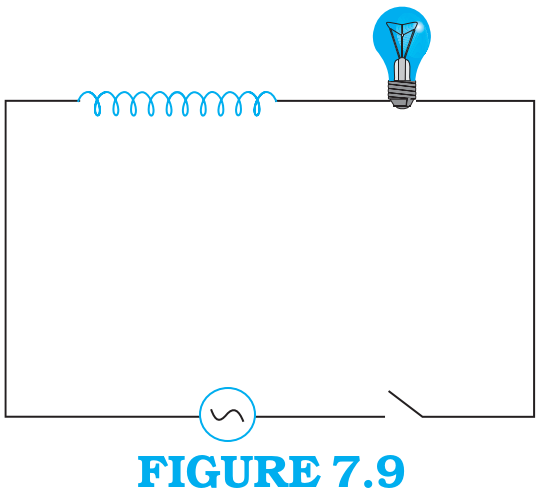
A light bulb and an open coil inductor are connected to an ac source through a key as shown in Fig. 7.9.
Image
The switch is closed and after sometime, an iron rod is inserted into the interior of the inductor. The glow of the light bulb (a) increases; (b) decreases; (c) is unchanged, as the iron rod is inserted. Give your answer with reasons.
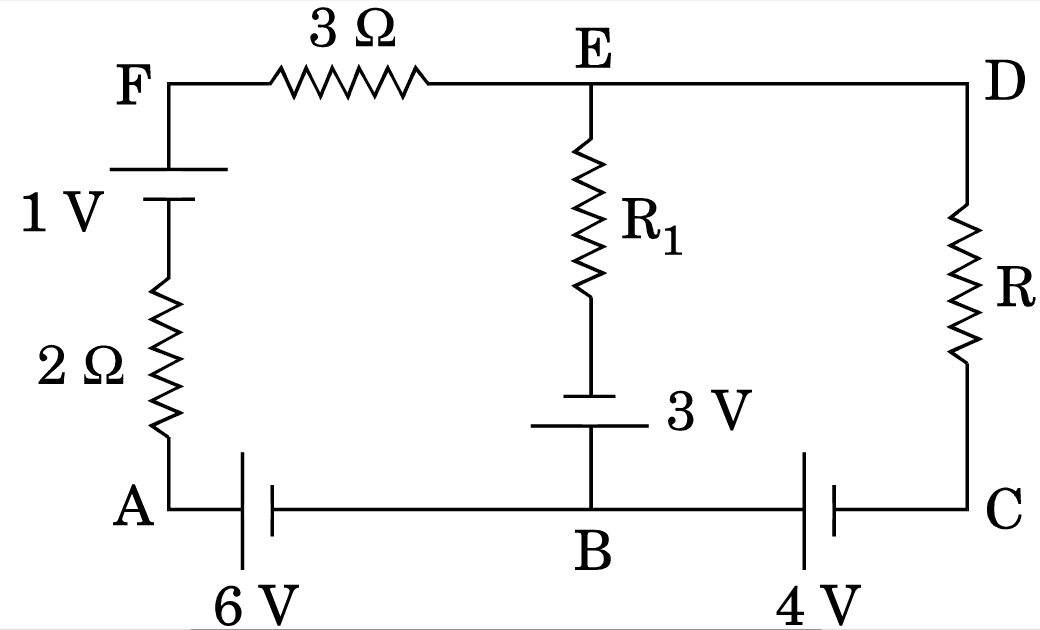
Use Kirchhoff ’s rules to determine the potential difference between the points A and D when no current flows in the arm BE of the electric network shown in the figure.

How much positive and negative charge is there in a cup of water?
Arrange the following electromagnetic radiations in ascending order of their frequencies:
  1. Microwave.
  2. Radio wave.
  3. X-rays.
  4. Gamma rays.
Write two uses of any one of these.
Use the formula $\lambda_{ m } T =0.29 cm K$ to obtain the characteristic temperature ranges for different parts of the electromagnetic spectrum. What do the numbers that you obtain tell you?