Question types

Centre of Mass, Linear Momentum, Collision question types

118 questions across 6 question groups — pick any mix to generate a Physics paper with step-by-step answer keys.

118
Questions
6
Question groups
5
Question types
Sample Questions

Centre of Mass, Linear Momentum, Collision questions

One sample from each question group in this chapter. Select any group above to see the full set with answer keys.

Q 1M.C.Q [1M]1 Mark
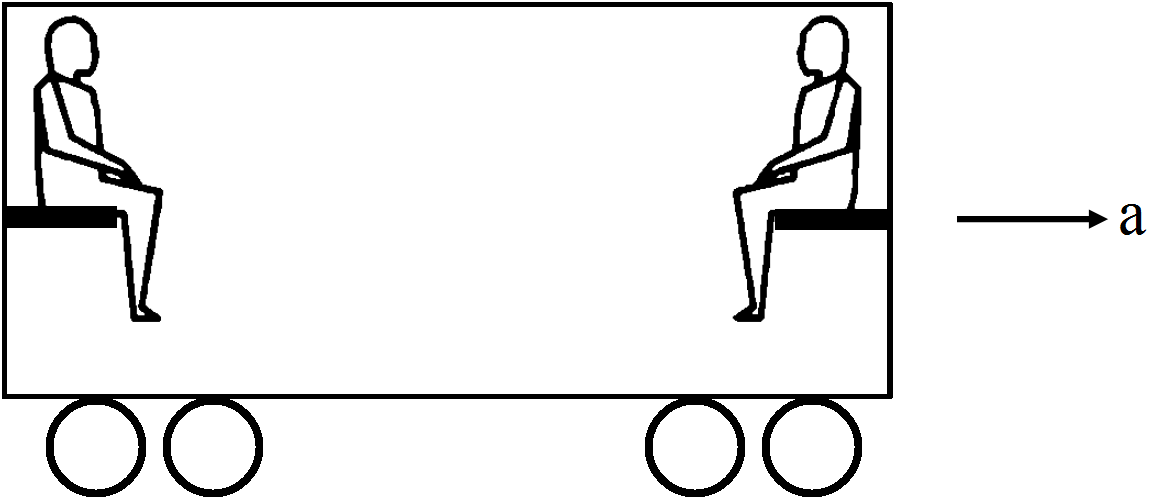
Internal forces can change:
  1. The linear momentum but not the kinetic energy.
  2. The kinetic energy but not the linear momentum.
  3. Linear momentum as well as kinetic energy.
  4. Neither the linear momentum nor the kinetic energy.
View full solution
Q 2M.C.Q [1M]1 Mark
Consider a system of two identical particles. One of the particles is at rest and the other has an acceleration $\overrightarrow{\text{a}}.$ The centre of mass has an acceleration:

  1. Zero

  2. $\frac{1}{2}\overrightarrow{\text{a}}$

  3. $\overrightarrow{\text{a}}$

  4. $2\overrightarrow{\text{a}}$

View full solution
Q 3M.C.Q [1M]1 Mark
In an inelastic collision:
  1. The initial kinetic energy is equal to the final kinetic energy.
  2. The final kinetic energy is less than the initial kinetic energy.
  3. The kinetic energy remains constant.
  4. The kinetic energy first increases then decreases.
View full solution
Q 4M.C.Q [1M]1 Mark
The quantities remaining constant in a collisions are
  1. Momentum, kinetic energy and temperature.
  2. Momentum and kinetic energy but not temperature.
  3. Momentum and temperature but not kinetic energy.
  4. Momentum, but neither kinetic energy nor temperature.
View full solution
Q 5M.C.Q [1M]1 Mark
If the external force acting on a system have zero resultant, the centre of mass:
  1. Must not move.
  2. Must not accelerate.
  3. May move.
  4. May accelerate.
View full solution
A ball is moved on a horizontal table with some velocity. The ball stops after moving some distance. Which external force is responsible for the change in the momentum of the ball?
View full solution
Suppose we define a quantity 'Linear Pomentum' as linear pomentum = mass × speed. The linear pomentum of a system of particles is the sum of linear pomenta of the individual particles. Can we state a principle of conservation of linear pomentum as ''linear pomentum of a system remains constant if no external force acts on it?''
View full solution
Use the definition of linear pomentum from the previous question. Can we state the principle of conservation of linear pomentum for a single particle?
View full solution
To accelerate a car we ignite petrol in the engine of the car. Since only an external force can accelerate the centre of mass, is it proper to say that ''the force generated by the engine accelerates the car?''
View full solution
A railroad car of mass M is at rest on frictionless rails when a man of mass m starts moving on the car towards the engine. If the car recoils with a speed v backward on the rails, with what velocity is the man approaching the engine?
View full solution
Q 163 Marks Question3 Marks
A 60kg man skating with a speed of 10m/s collides with a 40kg skater at rest and they cling to each other. Find the loss of kinetic energy during the collision.
View full solution
Q 173 Marks Question3 Marks
Consider a head-on collision between two particles of masses m1 and m2. The initial speeds of the particles are u1 and u2 in the same direction. The collision starts 2 at t = 0 and the particles interact for a time interval $\triangle\text{t}.$ During the collision, the speed of the first particle varies as.

$\text{v}(\text{t})=\text{u}_1+\frac{\text{t}}{\triangle\text{t}}(\text{v}_1-\text{u}_1).$

Find the speed of the second particle as a function of time during the collision.

View full solution
Q 193 Marks Question3 Marks
Two blocks of mares 10kg and 20kg are placed on the X-axis. The first mass is moved on the axis by a distance of 2cm. By what distance should the second mass be moved to keep the position of the centre of mass unchanged?
View full solution
Q 203 Marks Question3 Marks
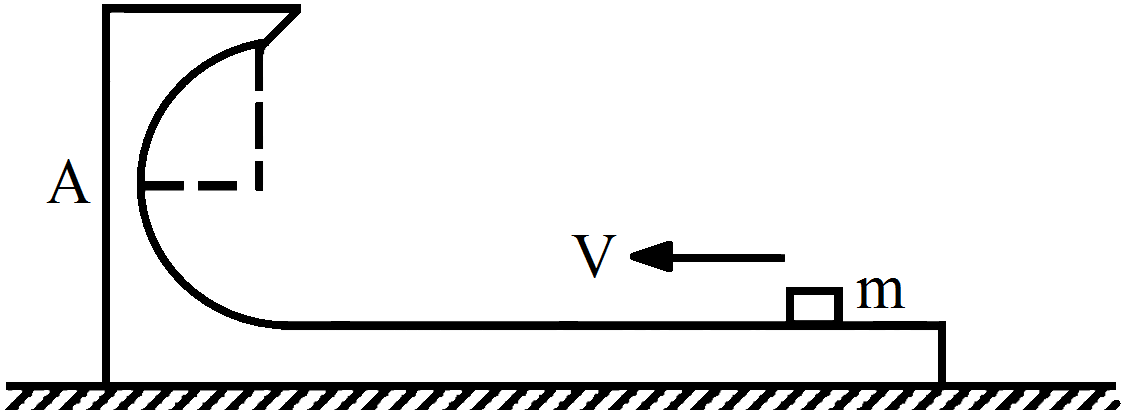
Figure shows a small block of mass m which is started with a speed v on the horizontal part of the bigger block of mass M placed on a horizontal floor. The curved part of the surface shown is semicircular. All the surfaces are frictionless. Find the speed of the bigger block when the smaller block reaches the point A of the surface.

View full solution
The weight Mg of an extended body is generally shown in a diagram to act through the centre of mass. Does it mean that the earth does not attract other particles?
View full solution
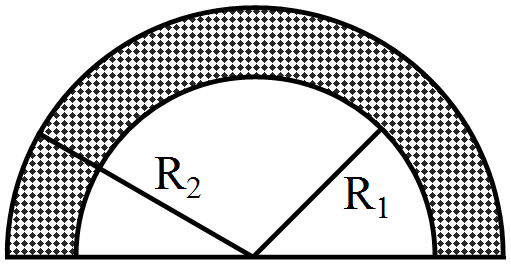
What can be said about the centre of mass of a uniform hemisphere without making any calculation? Will its distance from the centre be more than $\frac{\text{r}}{2}$ or less than $\frac{\text{r}}{2}?$
View full solution
Consider a gravity-free hall in which an experimenter of mass 50kg is resting on a 5kg pillow, 8ft above the floor of the hall. He pushes the pillow down so that it starts falling at a speed of 8ft/s. The pillow makes a perfectly elastic collision with the floor, rebounds and reaches the experimenter's head. Find the time elapsed in the process.
View full solution
A fat person is standing on a light plank floating on a calm lake. The person walks from one end to the other on the plank. His friend sitting on the shore watches him and finds that the person hardly moves any distance because the plank moves backward about the same distance as the person moves on the plank. Explain.
View full solution
A collision experiment is done on a horizontal table kept in an elevator. Do you expect a change in the results if the elevator is accelerated up or down because of the noninertial character of the frame?
View full solution
Two friends A and B (each weighing 40kg) are sitting on a frictionless platform some distance d apart. A rolls a ball of mass 4kg on the platform towards B which B catches. Then B rolls the ball towards A and A catches it. The ball keeps on moving back and forth between A and B. The ball has a fixed speed of 5m/s on the platform.
  1. Find the speed of A after he rolls the ball for the first time.
  2. Find the speed of A after he catches the ball for the first time.
  3. Find the speeds of A and B after the ball has made 5 round trips and is held by A.
  4. How many times can A roll the ball?
  5. Where is the centre of mass of the system ''A + B + ball'' at the end of the nth trip?
View full solution
Two masses m1 and m2 are connected by a spring of spring constant k and are placed on a frictionless horizontal surface. Initially the spring is stretched through a distance x0 when the system is released from rest. Find the distance moved by the two masses before they again come to rest.
View full solution
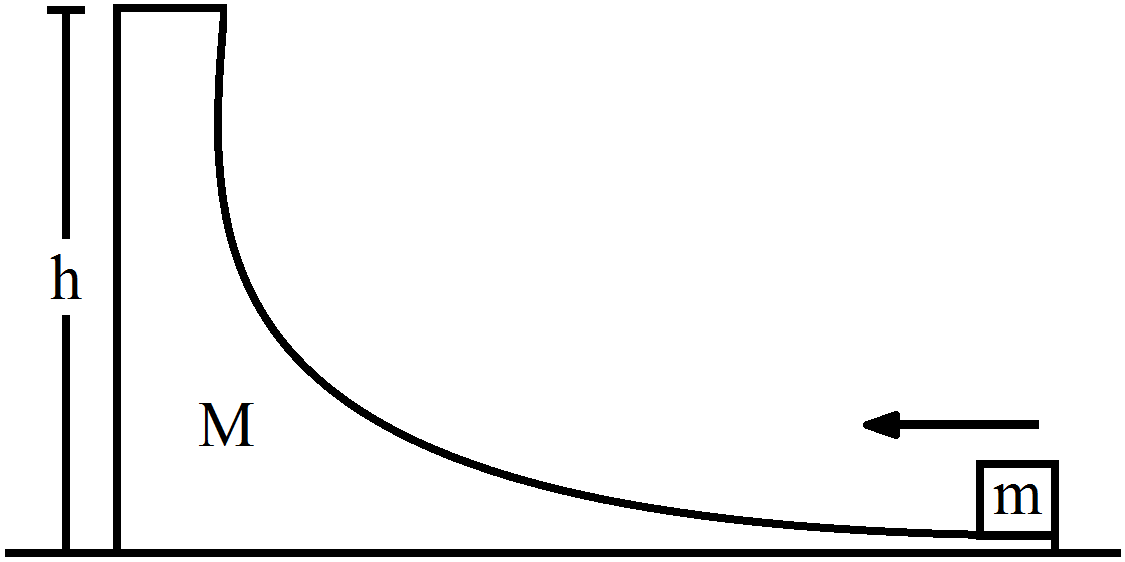
Figure shows a small body of mass m placed over a larger mass M whose surface is horizontal near the smaller mass and gradually curves to become vertical. The smaller mass is pushed on the longer one at a speed v and the system is left to itself. Assume that all the surfaces are frictionless.
  1. Find the speed of the larger block when the smaller block is sliding on the vertical part.
  2. Find the speed of the smaller mass when it breaks off the larger mass at height h.
  3. Find the maximum height (from the ground) that the smaller mass ascends.
  4. Show that the smaller mass will again land on the bigger one. Find the distance traversed by the bigger block during the time when the smaller block was in its flight under gravity.
​​​​​​​
View full solution
A block of mass 200g is suspended through a vertical spring. The spring is stretched by 1.0cm when the block is in equilibrium. A particle of mass 120g is dropped on the block from a height of 45cm. The particle sticks to the block after the impact. Find the maximum extension of the spring. Take g = 10m/s2.

View full solution

Generate a Centre of Mass, Linear Momentum, Collision paper free

Pick question groups from the list above, set marks and difficulty, and export a branded PDF with step-by-step answer keys. First 3 chapters free — no signup.

Download App