MCQ
Consider the situation shown in figure. The straight wire is fixed but the loop can move under magnetic force. The loop will:
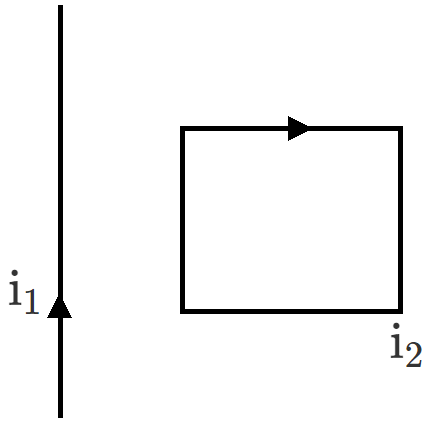
- ARemain stationary.
- BMove towards the wire.
- CMove away from the wire.
- DRotate about the wire.
Explanation:
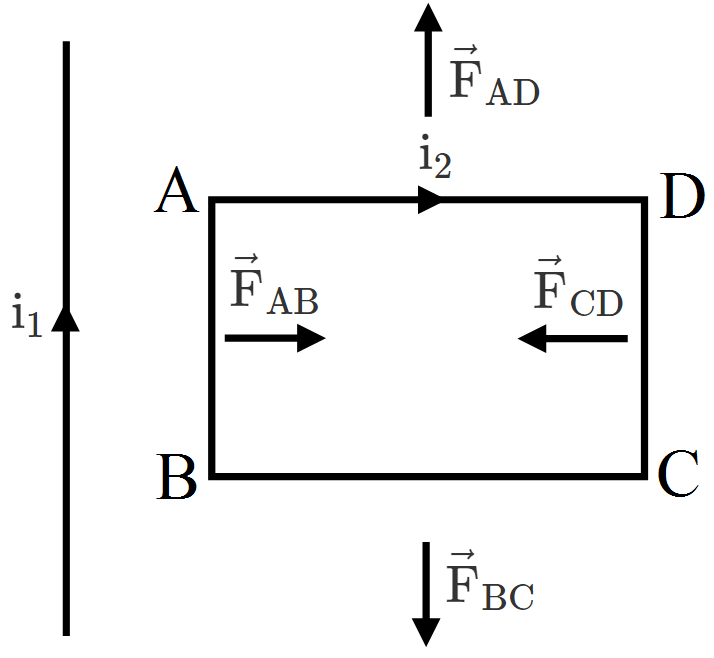
$\overrightarrow{\text{F}}_\text{AD}+\overrightarrow{\text{F}}_\text{BC}=0$
$\overrightarrow{\text{F}}_\text{AB}>\overrightarrow{\text{F}}_\text{CD}$
Force acting on the wire per unit length carrying current i2 due to the wire carrying current i1 placed at a distance d is given by,
$\text{F}=\frac{\mu_0\text{i}_1\text{i}_2}{2\pi\text{d}}$
So, forces per unit length acting on sides AB and CD are as follows:
$\text{F}_\text{AB}=\frac{\mu_0\text{i}_1\text{i}_2}{2\pi\text{d}}$ (Towards the wire)
$\text{F}_\text{CD}=\frac{\mu_0\text{i}_1\text{i}_2}{2\pi(\text{d}+\text{a})}$ (Away from the wire)
Here, FAB > FCD because force is inversly proportional to the distance from the wire and wire AB is closer to the wire carrying current i1.
The forces per unit length acting on sides BC and DA will be equal and opposite, as they are equally away from the wire carrying current i1, with current i2 flowing in the opposite direction.
$\therefore\text{F}_\text{BC}=-\text{F}_\text{DA}$
Now,
Net force:
$\text{F} = \text{F}_\text{AB}+\text{F}_\text{BC}+\text{F}_\text{CD}+\text{F}_\text{DA}$
$\Rightarrow\text{F}=\frac{\mu_0\text{i}_1\text{i}_2}{2\pi\text{d}}+\text{F}_\text{BC}-\frac{\mu_0\text{i}_1\text{i}_2}{2\pi(\text{d+a})}-\text{F}_\text{BC}$
$\Rightarrow\text{F}=\frac{\mu_0\text{i}_1\text{i}_2}{2\pi}\Big(\frac{1}{\text{d}}-\frac{1}{\text{d+a}}\Big)$
$\Rightarrow\text{F}=\frac{\mu_0\text{i}_1\text{i}_2\text{a}}{2\pi\text{d}(\text{d+a})}$
(Towards the wire)
Therefore, the loop will move towards the wire.
Generate a complete, print-ready paper with questions like this in minutes — across 16+ boards, with answer keys.
An inductor of 2 henry and a resistance of 10 ohms are connected in series with a battery of 5 volts. The initial rate of change of current is
|
(a) 0.5 amp/sec |
(b) 2.0 amp/sec |
(c) 2.5 amp/sec |
(d) 0.25 amp/sec |
Work function of a metal is 2.1 eV. Which of the waves of the following wavelengths will be able to emit photoelectrons from its surface
|
(a) 4000 Å, 7500 Å |
(b) 5500 Å, 6000 Å |
(c) 4000 Å, 6000 Å |
(d) None of these |
In a dc motor, induced e.m.f. will be maximum
|
(a) When motor takes maximum speed |
(b) When motor starts rotating |
|
(c) When speed of motor increases |
(d) When motor is switched off |
The refractive indices of violet and red light are 1.54 and 1.52 respectively. If the angle of prism is 10°, then the angular dispersion is
|
(a) 0.02 |
(b) 0.2 |
(c) 3.06 |
(d) 30.6 |
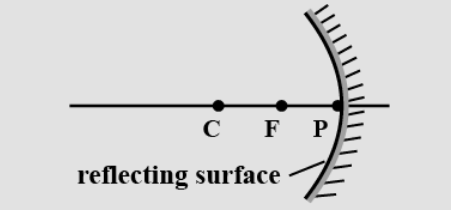
The distance CP is the:
Assertion : The film which appears bright in reflected system will appear dark in the transmitted light and vice-versa.
Reason : The conditions for film to appear bright or dark in reflected light are just reverse to those in the transmitted light.
|
(a) If both assertion and reason are true and the reason is the correct explanation of the assertion. |
|
(b) If both assertion and reason are true but reason is not the correct explanation of the assertion. |
|
(c) If assertion is true but reason is false. |
|
(d) If the assertion and reason both are false. |