MCQ
Consider the two idealized systems: (i) a parallel plate capacitor with large plates and small separation and (ii) a long solenoid of length L > > R, radius of cross-section. In (i) E is ideally treated as a constant between plates and zero outside. In (ii) magnetic field is constant inside the solenoid and zero outside. These idealised assumptions, however, contradict fundamental laws as below:
  • A
    Case (i) contradicts Gauss’s law for electrostatic fields.
  • B
    Case (ii) contradicts Gauss’s law for magnetic fields.
  • C
    Case (i) agrees with $\oint\text{E.dl=0.}$
  • D
    Case (ii) contradict $\oint\text{H.dl}=\text{I}_\text{en}$.
Answer

  1. Case (ii) contradicts Gauss’s law for magnetic fields.

Solution:

Key concept: The electrostatic field lines, do not form a continuous closed path (this follows from the conservative nature of electric field) while the magnetic field lines form the closed paths.

According to the Gauss' law, $\oint\text{E.ds}=\frac{\text{q}}{\in_0}$ for electronstatic field. It does not contradict foe eletrostatic fields as the elecric field lines do not form a continuous closed path.

According to Gauss' law in magnetism.

$\oint\text{B.ds}=0$

Which implies that number of magnetic field lines entering the Gaussian surface is equal to the number of magnetic field lines leaving it. Therefore case (ii) is not possible.

Need a full question paper?

Generate a complete, print-ready paper with questions like this in minutes — across 16+ boards, with answer keys.

Start Generating Free

Similar questions

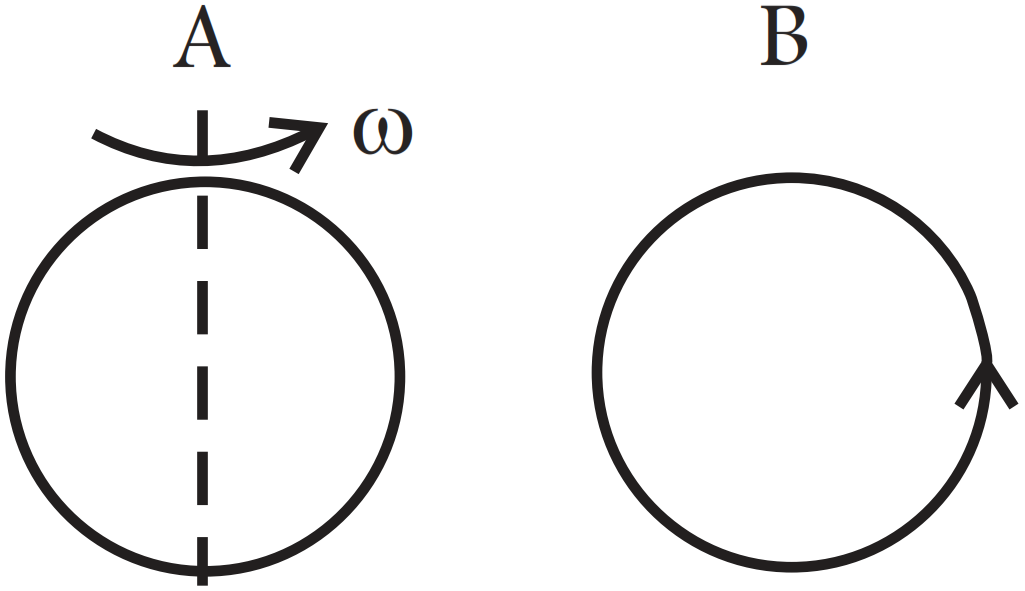
Same as problem 4 except the coil A is made to rotate about a vertical axis (Fig). No current flows in B if A is at rest. The current in coil A, when the current in B (at t = 0) is counterclockwise and the coil A is as shown at this instant, t = 0, is:

Assertion  :   The possibility of an electric bulb fusing is higher at the time of switching ON and OFF

Reason     : Inductive effects produce a surge at the time of switch ON and OFF

(a) If both assertion and reason are true and the reason is the correct explanation of the assertion.

(b) If both assertion and reason are true but reason is not the correct explanation of the assertion.

(c) If assertion is true but reason is false.

(d) If the assertion and reason both are false.

The time period of a freely suspended magnet is 4 seconds. If it is broken in length into two equal parts and one part is suspended in the same way, then its time period will be

(a) 4 sec 

(b) 2 sec

(c) 0.5 sec

(d) 0.25 sec

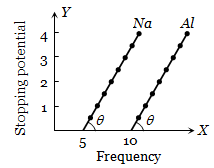
From the figure describing photoelectric effect we may infer correctly that         

(a) Na and Al both have the same threshold frequency

(b) Maximum kinetic energy for both the metals depend linearly on the frequency

(c) The stopping potentials are different for Na and Al for the same change in frequency

(d) Al is a better photo sensitive material than Na

Identify the definition of sensitivity of a galvanometer from the following.

A fuse wire with radius 1 mm blows at 1.5 amp. The radius of the fuse wire of the same material to blow at 3A will be

(a)  

(b)  

(c)  

(d)  

The electrical conductivity of pure germanium can be increased by:

A rod of length 20 cm is rotating with angular speed of 100 rps in a magnetic field of strength 0.5 T about it’s one end. What is the potential difference between two ends of the rod

(a) 2.28 V

(b) 4.28 V

(c) 6.28 V  

(d) 2.5 V

Given a point source of light, which of the following can produce a parallel beam of light

(a) Convex mirror

(b) Concave mirror

(c) Concave lens

(d) Two plane mirrors inclined at an angle of 90°

When light travels from glass to air, the incident angle is  and the refracted angle is . The true relation is

(a)  

(b)  

(c)  

(d) Not predictable