- ACase (i) contradicts Gauss’s law for electrostatic fields.
- BCase (ii) contradicts Gauss’s law for magnetic fields.
- CCase (i) agrees with $\oint\text{E.dl=0.}$
- DCase (ii) contradict $\oint\text{H.dl}=\text{I}_\text{en}$.
Solution:
Key concept: The electrostatic field lines, do not form a continuous closed path (this follows from the conservative nature of electric field) while the magnetic field lines form the closed paths.
According to the Gauss' law, $\oint\text{E.ds}=\frac{\text{q}}{\in_0}$ for electronstatic field. It does not contradict foe eletrostatic fields as the elecric field lines do not form a continuous closed path.
According to Gauss' law in magnetism.
$\oint\text{B.ds}=0$
Which implies that number of magnetic field lines entering the Gaussian surface is equal to the number of magnetic field lines leaving it. Therefore case (ii) is not possible.
Generate a complete, print-ready paper with questions like this in minutes — across 16+ boards, with answer keys.
Two infinite plane parallel sheets separated by a distance d have equal and opposite uniform charge densities σ. Electric field at a point between the sheets is
|
(a) Zero |
(b) |
|
(c) |
(d) Depends upon the location of the point |
A bar magnet of magnetic moment
is placed in a magnetic field of induction
. The torque exerted on it is
|
(a) |
(b) - |
(c) |
(d) |
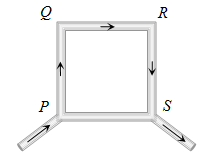
PQRS is a square loop made of uniform conducting wire the current enters the loop at P and leaves at S. Then the magnetic field will be

|
(a) Maximum at the centre of the loop |
(b) Zero at the centre of loop |
|
(c) Zero at all points inside the loop |
(d) Zero at all points outside of the loop |
Magnetic flux in a circuit containing a coil of resistance 2Ω changes from 2.0 Wb to 10 Wb in 0.2 sec. The charge passed through the coil in this time is
|
(a) 0.8 C |
(b) 1.0 C |
(c) 5.0 C |
(d) 4.0 C |
A concave lens of focal length 20 cm placed in contact with a plane mirror acts as a
|
(a) Convex mirror of focal length 10 cm |
|
(b) Concave mirror of focal length 40 cm |
|
(c) Concave mirror of focal length 60 cm |
|
(d) Concave mirror of focal length 10 cm |
The mass of a neutron is the same as that of
|
(a) A proton |
(b) A meson |
(c) An epsilon |
(d) An electron |