The total mechanical energy of a particle in $SHM$ is
Easy


Download our appand get started for free
Experience the future of education. Simply download our apps or reach out to us for more information. Let's shape the future of learning together!No signup needed.*
Similar Questions
- 1A $S.H.M.$ is represented by $x = 5\sqrt 2 (\sin 2\pi t + \cos 2\pi t).$ The amplitude of the $S.H.M.$ is .... $cm$View Solution
- 2The graphs in figure show that a quantity $y$ varies with displacement $d$ in a system undergoing simple harmonic motion. Which graphs best represents the relationship obtained when $y$ is The total energy of the systemView Solution

- 3A particle executes harmonic motion with an angular velocity and maximum acceleration of $3.5\, rad/sec$ and $ 7.5\, m/s^2$ respectively. The amplitude of oscillation is .... $m$View Solution
- 4A damped harmonic oscillator has a frequency of $5$ oscillations per second. The amplitude drops to half its value for every $10$ oscillations. The time it will take to drop to $\frac{1}{1000}$ of the original amplitude is close to .... $s$View Solution
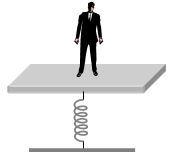
- 5A man weighing $60\, kg$ stands on the horizontal platform of a spring balance. The platform starts executing simple harmonic motion of amplitude $0.1\, m$ and frequency $\frac{2}{\pi }Hz$. Which of the following statement is correctView Solution
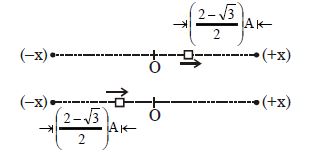
- 6Two bodies performing $SHM$ have same amplitude and frequency. Their phases at a certain instant are as shown in the figure. The phase difference between them isView Solution
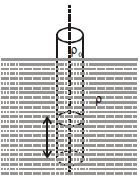
- 7A solid cylinder of density $\rho_0$, cross-section area $A$ and length $l$ floats in a liquid $\rho(> \rho_0)$ with its axis vertical, as shown. If it is slightly displaced downward and released, the time period will beView Solution
- 8Two masses $m_1$ and $m_2$ connected by a spring of spring constant $k$ rest on a frictionless surface. If the masses are pulled apart and let go, the time period of oscillation isView Solution
- 9When a particle executes $SHM$ the nature of graphical representation of velocity as a function of displacement is :View Solution
- 10If a spring of stiffness $k$ is cut into two parts $A$ and $B$ of length $l_{A}: l_{B}=2: 3$, then the stiffness of spring $A$ is given byView Solution