Question
Consider two particles A and B having equal charges and placed at some distance. The particle A is slightly displaced towards B. Does the force on B increase as soon as the particle A is displaced? Does the force on the particle A increase as soon as it is displaced?
Answer

Electrostatic force follows the inverse square law, $\text{F}=\frac{\text{k}}{\text{r}^2}.$ This means the the force on two particles carrying charges increases on decreasing the distance between them. Therefore, as particle A is slightly displaced towards B, the force on B as well as a A will increase.

Need a full question paper?

Generate a complete, print-ready paper with questions like this in minutes — across 16+ boards, with answer keys.

Start Generating Free

Similar questions

Discuss the similarities and differences of BiotSavart law with the Coulomb's law.
State the concept of mobile telephony and explain its working.
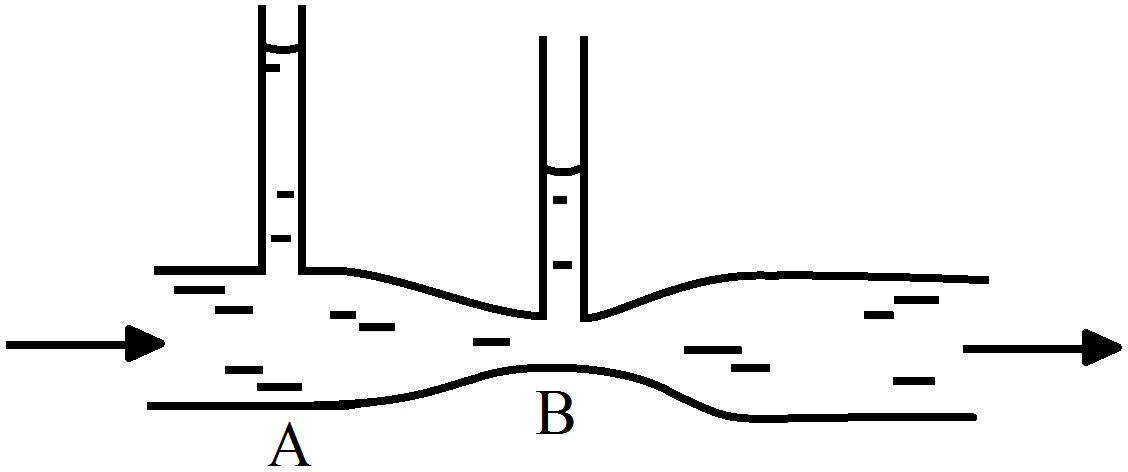
Water flows through a horizontal tube as shown in  If the difference of heights of water column in the vertical tubes is 2cm, and the areas of cross-section at A and B are 4cm2 and 2cm2 respectively, find the rate of flow of water across any section.

Using the curve for the binding energy per nucleon as a function of mass number A, state clearly how the release in energy in the processes of nuclear fission and nuclea fusion can be explained.
A particle moves on a given straight line with a constant speed v. At a certain time it is at a point P on its straight line path. O is a fixed point. Show that $\overrightarrow{\text{OP}}\times\overrightarrow{\text{v}}$ is independent of the position P.
(a) The peak voltage of an ac supply is 300 V. What is its rms voltage?
(b) The rms value of current in an ac circuit is 10 A. What is the peak current?
What is the Brewster angle for air to glass transition? (Refractive index of glass = 1.5.)
Write the definition of wave front.
Write down the expression (equation) to find the distance of $n^{\text {th }}$ bright fringe and $n^{\text {th }}$ dark fringe from the central maximum.
The electric current in a discharging R-C circuit is given by $\text{i}=\text{i}_0\text{e}^{-\frac{\text{t}}{\text{RC}}}$ where i0, R and C are constant parameters and t is time. Let $\text{i}_0=2.00\text{A},\text{R}=600\times10^5\Omega$ and $\text{C}=0.500\mu\text{F}.$
  1. Find the current at t = 0.3s.
  2. Find the rate of change of current at t = 0.3s.
  3. Find approximately the current at t = 0.31s.