Question types

Electric Field and Potential question types

107 questions across 5 question groups — pick any mix to generate a Physics paper with step-by-step answer keys.

107
Questions
5
Question groups
5
Question types
Sample Questions

Electric Field and Potential questions

One sample from each question group in this chapter. Select any group above to see the full set with answer keys.
Q 1M.C.Q [1M]1 Mark
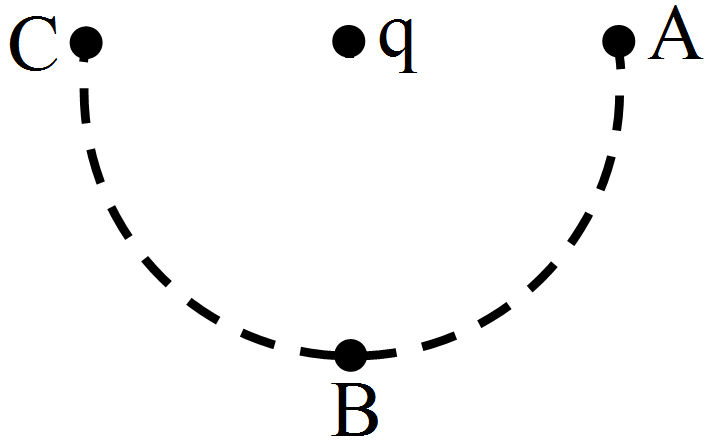
Consider the situation of figure. The work done in taking a point charge from P to A is WA, from P to B is WB and from P to C is WC.

  1. WA < WB < WC
  2. WA > WB > WC
  3. WA = WB = WC
  4. None of these.

View full solution
Q 2M.C.Q [1M]1 Mark
If a body is charged by rubbing it, its weight
  1. Remains precisely constant.
  2. Increases slightly.
  3. Decreases slightly.
  4. May increase slightly or may decrease slightly.
View full solution
Q 3M.C.Q [1M]1 Mark
The electric potential decreases uniformly from 120V to 80V as one moves on the x-axis from x = -1cm to x = + 1cm. The electric field at the origin.
  1. Must be equal to 20Vcm-1
  2. May be equal to 20Vcm-1
  3. May be greater than 20Vcm-1
  4. May be lees than 20Vcm-1
View full solution
Q 4M.C.Q [1M]1 Mark
The electric field and the electric potential at a point are E and V respectively.
  1. If E = 0, V must be zero.
  2. If V = 0, E must be zero.
  3. If $\text{E}\neq0,$ V cannot be zero.
  4. If $\text{V}\neq0,$ E cannot be zero.
View full solution
Q 5M.C.Q [1M]1 Mark
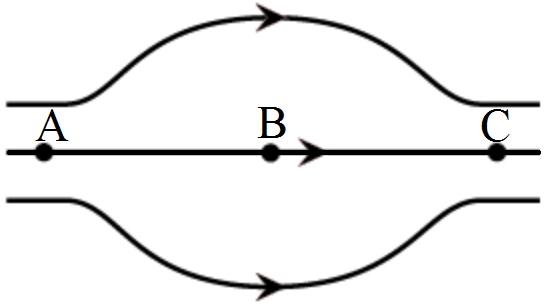
Figure, shows some of the electric field lines corresponding to an electric field. The figure suggests that,

  1. EA > E8 > Ee
  2. EA = EB = Ee
  3. EA = Ec > EB
  4. EA = Ec < EB.
View full solution
Two charged particles having charge 2.0 × 10-8C each are joined by an insulating string of length 1m and the system is kept on a smooth horizontal table. Find the tension in the string.
View full solution
NaCl molecule is bound due to the electric force between the sodium and the chlorine ions when one electron. of sodium is transferred to chlorine. Taking the separation between the ions to be 2.75 × 10cm, find the force of attraction between them· State the assumptions (if any) that you have made.
View full solution
A sample of HCI gas is placed in an electric field of 2.5 × 104NC-1. The dipole moment of each HCI molecule is 3.4 × 10-30Cm. Find the maximum torque that can act on a molecule.
View full solution
Two charged particles are placed at a distance 1.0cm apart. What is the minimum possible magnitude of the electric force acting on each charge?
View full solution
Consider a gold nucleus to be a sphere of radius 6.9 fermi in which protons and neutrons are distributed. Find the force of repulsion between two protons situated at largest separation. Why do these protons not fly apart under this repulsion?
View full solution
Q 173 Marks Question3 Marks
When a charged comb is brought near a small piece of paper, it attracts the piece. Does the paper become charged when the comb is brought near it?
View full solution
Q 183 Marks Question3 Marks
A 10cm long rod carries a charge of $+50\mu\text{C}$ distributed uniformly along its length. Find the magnitude of the electric field at a point 10cm from both the ends of the rod.
View full solution
Q 193 Marks Question3 Marks
The number of electrons in an insulator is of the same order as the number of electrons in a conductor. What is then the basic difference between a conductor and an insulator?
View full solution
Q 203 Marks Question3 Marks
A particle having a charge of 2.0 × 10-4C is placed directly below and at a separation of 10cm from the bob of a simple pendulum at rest. The mass of the bob is 100g. What charge should the bob be given so that the string becomes loose?
View full solution
Two identical pith balls, each carrying a charge q, are suspended from a common point by two strings of equal length l. Find the mass of each ball if the angle between the strings is $2\theta$ in equilibrium.
View full solution
Two identical pith balls are charged by rubbing against each other. They are suspended from a horizontal rod through two strings of length 20cm each, the separation between the suspension points being 5cm. In equilibrium, the separation between the balls is 3cm. Find the mass of each ball and the tension in the strings. The charge on each ball has a magnitude 2.0 × 10-8C.
View full solution
A particle A having a charge of 2.0 × 10-6C and a mass of 100g is placed at the bottom of a smooth inclined plane of inclination 30°. Where should another particle B, having same charge and mass, be placed on the incline so that it may remain in equilibrium?
View full solution

Generate a Electric Field and Potential paper free

Pick question groups from the list above, set marks and difficulty, and export a branded PDF with step-by-step answer keys. First 3 chapters free — no signup.

Download App