Question
Consists of two statements, namely, Assertion (A) and Reason (R). For selecting the correct answer, use the following code:
  1. Both Assertion (A) and Reason (R) are true and Reason (R) is a correct explanation of Assertion (A).
  2. Both Assertion (A) and Reason (R) are true but Reason is not a correct explanation of Assertion (A).
  3. Assertion (A) is true and Reason (R) is false.
  4. Assertion (A) is false and Reason (R) is true.
Assertion (A)Reason (R)
$\sqrt{3}$ is an irrational number.Square root a positive integer which is not a perfect square is an irrational number.
The correct answer is: (a), (b), (c), (d).

Answer

  1. Both Assertion (A) and Reason (R) are true and Reason (R) is a correct explanation of Assertion (A).
    Solution:
    We know that if $\sqrt{\text{x}}$ is an irratinal number, it means x is not a perfect square.
    Thus, Assertion (A) is true
    Since Reason (R) gives Assertion (A), so (a) holds.

Need a full question paper?

Generate a complete, print-ready paper with questions like this in minutes — across 16+ boards, with answer keys.

Start Generating Free

Similar questions

Statement-1 (A): If $a+b+c=6, a b+b c+c a=11$, then $a^2+b^2+c^2=14$
Statement-2 (R): $(a+b+c)^2=a^2+b^2+c^2+2(a b+b c+c a)$
Statement-1 (A): The sum of any two sides of a triangle is greater than the third side.
Statement-2 (R): It is possible to construct a triangle with lengths of its sides as 4 cm, 3 cm and 7 cm.
Statement-1 (A): It is not possible to construct a triangle with lengths of its sides as 9 cm , 7 cm and 17 cm .
Statement-2 (R): The difference of any two sides of a triangles is less than the third side.
Directions: In the following questions, the Assertions (A) and Reason(s) (R) have been put forward. Read both the statements carefully and choose the correct alternative from the following:
Assertion: If  $\sqrt2=1.414.,$ $\sqrt3=1.732,$ then $\sqrt5=\sqrt2+\sqrt3.$
Reason: Square root of a positive real number always exists.
  1. Assertion and Reason both are correct statements and Reason is the correct explanation of Assertion.
  2. Assertion and Reason both are correct statements but Reason is not the correct explanation of Assertion.
  3. Assertion is correct statement but Reason is wrong statement.
  4. Assertion is wrong statement but Reason is correct statement.
Statement-1 (A): The product of any two irrational numbers is an irrational number.
Statement-2 (R): There are two irrational numbers whose product is not an irrational number.
Statement-1 (A): $(a-b)^3+(b-c)^3+(c-a)^3=3(a-b)(b-c)(c-a)$
Statement-2 (R): If $a+b+c=0$, then $a^3+b^3+c^3=3 a b c$
Statement-1 $(A)$ : The product of $\left(x^2+4 y^2+z^2+2 x y+x z-2 y z\right)$ and $(-z+x-2 y)$ is $x^3-8 y^3-z^3-6 x y z$
Statement-2 $(R): \quad a^3+b^3+c^3-3 a b c=(a+b+c)\left(a^2+b^2+c^2-a b-b c-c a\right)$
Statement-1 (A): $\left[\left\{\left(\frac{1}{7^2}\right)^{-2}\right\}^{-1 / 3}\right]^{1 / 4}=7^{-1 / 3}$
Statement-2 (R): $\left(\left(a^m\right)^n\right)^s=a^{m n s}, a>0$
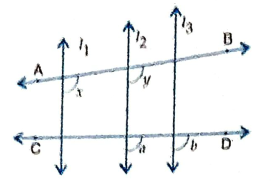
Statement-1 (A): In fig., if $x=y$ and $a=b$, then line $I_1$ is parallel to linte $I_3$
Statement-2 (R): If a transvereral intersects two lines in such an way that a pair of corresponding angles are equal, then the two lines are parallel.
Image
Directions: In the following questions, the Assertions (A) and Reason(s) (R) have been put forward. Read both the statements carefully and choose the correct alternative from the following:
Assertion: A rational number between $\frac{1}{3}$ and $\frac{1}{2}$ is $\frac{5}{12}.$
Reason: Rational number between two numbers a and b is $\sqrt{\text{ab}}.$
  1. Assertion and Reason both are correct statements and Reason is the correct explanation of Assertion.
  2. Assertion and Reason both are correct statements but Reason is not the correct explanation of Assertion.
  3. Assertion is correct statement but Reason is wrong statement.
  4. Assertion is wrong statement but Reason is correct statement.