MCQ
Constantan wire is used for making standard resistance, because it has:
- AHigh melting point.
- BLow specific resistance.
- CHigh specific resistance.
- DNegligible temperature coefficient of resistance.
Explanation:
Constantan is a copper-nickel alloy. Its main feature is its resistivity, which is constant over a wide range of temperatures. Thus it has low temperature coefficient of resistance.that's why it is used for making of standard resistances.
Generate a complete, print-ready paper with questions like this in minutes — across 16+ boards, with answer keys.
In the following circuit, 5W resistor develops 45 J/s due to current flowing through it. The power developed per second across 12 W resistor is

|
(a) 16 W |
(b) 192 W |
(c) 36 W |
(d) 64 W |
An electron is travelling along the x-direction. It encounters a magnetic field in the y-direction. Its subsequent motion will be
|
(a) Straight line along the x-direction |
(b) A circle in the xz-plane |
|
(c) A circle in the yz-plane |
(d) A circle in the xy-plane |
By properly combining two prisms made of different materials, it is possible to:
Which of the following phenomena can explain quantum nature of light
|
(a) Photoelectric effect |
(b) Interference |
(c) Diffraction |
(d) Polarisation |
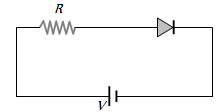
For the given circuit of PN-junction diode, which of the following statement is correct
|
(a) In forward biasing the voltage across R is V |
|
(b) In forward biasing the voltage across R is 2V |
|
(c) In reverse biasing the voltage across R is V |
|
(d) In reverse biasing the voltage across R is 2V |
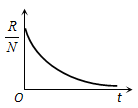
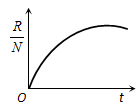
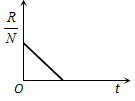
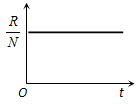
A radioactive sample has  active atoms at t = 0. If the rate of disintegration at any time is R and the number of atoms is N, then the ratio R/N varies with time as
|
(a)
|
(b)
|
(c)
|
(d)
|
The current in a simple series circuit is 5.0 amp. When an additional resistance of 2.0 ohms is inserted, the current drops to 4.0 amp. The original resistance of the circuit in ohms was
|
(a) 1.25 |
(b) 8 |
(c) 10 |
(d) 20 |
Assertion : A compass needle when placed on the magnetic north pole of the earth rotates in vertical direction.
Reason : The earth has only horizontal component of its magnetic field at the north poles.
|
(a) If both assertion and reason are true and the reason is the correct explanation of the assertion. |
|
(b) If both assertion and reason are true but reason is not the correct explanation of the assertion. |
|
(c) If assertion is true but reason is false. |
|
(d) If the assertion and reason both are false. |