Question
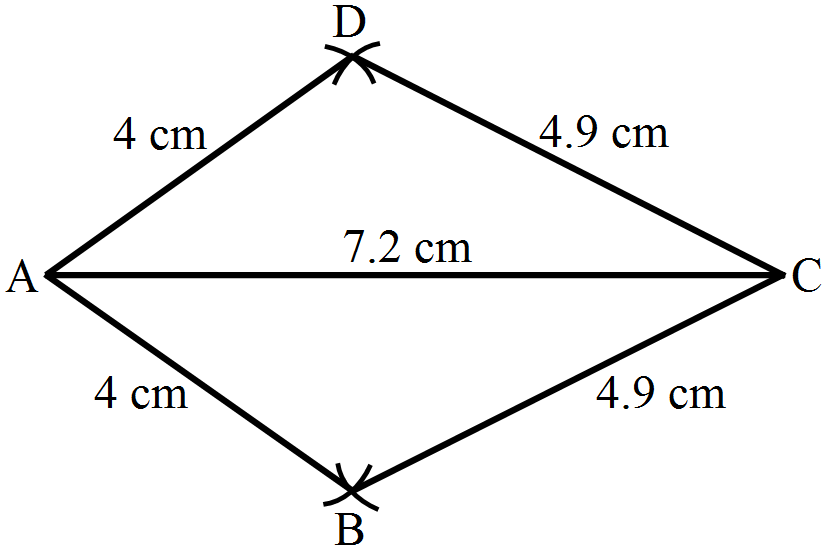
Construct a kite ABCD in which AB = 4cm, BC = 4.9cm and AC = 7.2cm.

Answer


Steps of construction:
Step I: Draw AC = 7.2cm.
Step II: With A as the centre and radius 4cm, draw arcs on both sides of the line segment AC.
Step III: With C as the centre and radius 4.9cm, draw arcs on both sides of AC intersecting the previous arcs of step II at B and D.
Step IV: Join BA, DA, BC and CD. Thus, the quadrilateral ABCD so obtained is the required kite.

Need a full question paper?

Generate a complete, print-ready paper with questions like this in minutes — across 16+ boards, with answer keys.

Start Generating Free

Similar questions

Romesh borrowed a sum of Rs. 245760 at 12.5% per annum, compounded annually. On the same day, he lent out his money to Ramu at the same rate of interest, but compounded semi-annually. Find his gain after 2 years.
Solve the following equation and verify your answer:
$\frac{3\text{x}+5}{4\text{x}+2}=\frac{3\text{x}+4}{4\text{x}+7}$
The sum of the age of Anup and his father is 100. When Anup is as his father now, he will be five times as old as his son Anuj is now. will be years older then Anup is now, when Anup is as old as his father. what are their ages now?
Construct a quadrilateral ABCD in which AB = 7.7cm, BC = 6.8cm, CD = 5.1cm, AD = 3.6cm and $\angle\text{C}=120^\circ.$
Solve the following equation and also check your result in case:
$\frac{7\text{x}-1}{4}-\frac{1}{3}\Big(2\text{x}-\frac{1-\text{x}}{2}\Big)=\frac{10}{3}$
There is a pentagonal shaped park as shown in Fig. Jyoti and Kavita divided it in two different ways.


A tradesman marks his goods at such a price that after allowing a discount of 15%, he makes a profit of 20%. What is the marked price of an article whose cost price is Rs. 170?
Find the area of pentagon ABCDE in which $\text{BL}\perp\text{AC},\text{DM}\perp\text{AC}$ and $\text{EN}\perp\text{AC}$ such that AC = 18cm, AM = 14cm, AN = 6cm, BL = 4cm, DM = 12cm and EN = 9cm.
Construct a rectangle PQRS by taking two convenient adjacent sides. Name the point of intersection of diagonals as T. Using divider and ruler, measure the following lengths.
i. lengths of opposite sides, seg QR and seg PS.
ii. lengths of seg PQ and seg SR.
iii. lengths of diagonals PR and QS.
iv. lengths of seg PT and seg TR, which are parts of the diagonal PR.
v. lengths of seg QT and seg TS, which are parts of the diagonal QS.
Observe the measures. Discuss about the measures obtained by your classmates.
A car with speed $60 \mathrm{~km} / \mathrm{hr}$ takes 8 hours to travel some distance. What should be the increase in the speed if the same distance is to be covered in $7 \frac{1}{2}$ hours?