Question
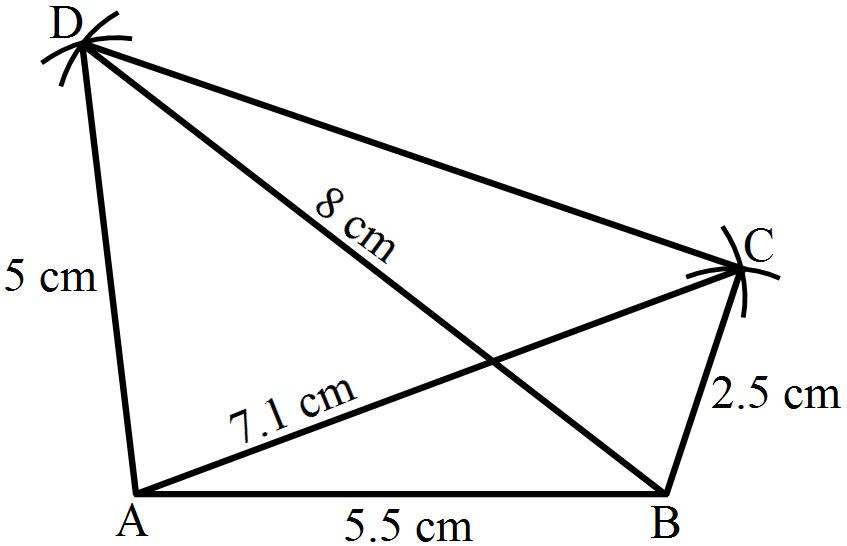
Construct a quadrilateral ABCD given AD = 5cm, AB = 5.5cm, BC = 2.5cm, AC = 7.1cm and BD = 8cm.
Answer


Steps of construction:
Step I: Draw AB = 5.5cm.
Step II: With A as the centre and radius 7.1cm, draw an arc.
Step III: With B as the centre and radius 2.5cm, draw an arc to intersect the arc drawn in Step II at C.
Step IV: With B as the centre and radius 8cm, draw an arc.
Step V: With A as the centre and radius 5cm, draw an arc to intersect the arc drawn in Step IV at D.
Step VI: Join DA, DB, BC, AC and CD to obtain the required quadrilateral.

Need a full question paper?

Generate a complete, print-ready paper with questions like this in minutes — across 16+ boards, with answer keys.
Start Generating Free

Similar questions

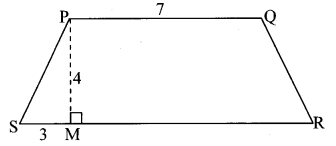
☐PQRS is an isosceles trapezium. l(PQ) = 7 cm, seg PM ⊥ seg SR, l(SM) = 3 cm. Distance between two parallel sides is 4 cm, find the area of ☐PQRS.
Image
In the following table, data of the transport means used by students in 8th standard for commutation between home and school is given. Draw a subdivided bar diagram to show the data.
(Scale: On Y axis: 1 cm = 500 students)
Means of commutation\TownPaithanYeolaShahapur
Cycle325015001250
Bus and auto750500500
On foot10001000500
In a parallelogram ABCD, AB = 10cm, AD = 6cm. The bisector of $\angle\text{A}$ meets DC in E. AE and BC produced meet at F. Find the length of CF.
It is known that for a given mass of gas, the volume v varies inversely as the pressure p.
Fill in the missing entries in the following table:
$v\left(\right.$ in $\left.cm ^3\right)$
...
48
60
...
100
...
200
p (in atmospheres)
2
...
$\frac{3}{2}$
1
...
$\frac{1}{2}$
...
Construct a trapezium ABCD in which AB = 6cm, BC = 4cm, CD = 3.2cm, $\angle\text{B}=75^\circ$ and DC || AB.
Find the area of a rhombus, side of which measures 20cm and one of whose diagonals is 24cm.
Construct a quadrilateral ABCD given BC = 6.6cm, CD = 4.4cm, AD = 5.6cm and $\angle\text{C}=100^\circ$ and $\angle\text{C}=95^\circ.$
The volume of a cubical box is 474.552 cubic metres. Find the length of each side of the box.
In ∆MORE, l(MO) = 5.8 cm, l(OR) = 4.4 cm, m∠M = 58°, m∠O = 105°, m∠R = 90°.
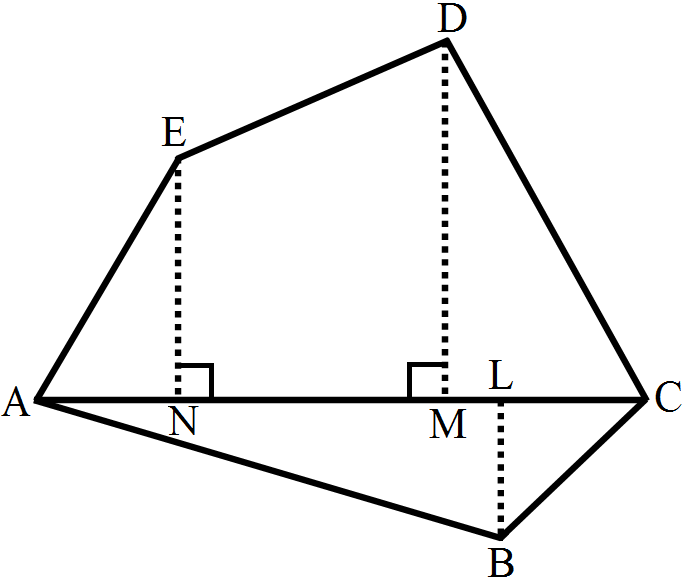
Find the area of pentagon ABCDE in which $\text{BL}\perp\text{AC},\text{DM}\perp\text{AC}$ and $\text{EN}\perp\text{AC}$ such that AC = 18cm, AM = 14cm, AN = 6cm, BL = 4cm, DM = 12cm and EN = 9cm.