Question
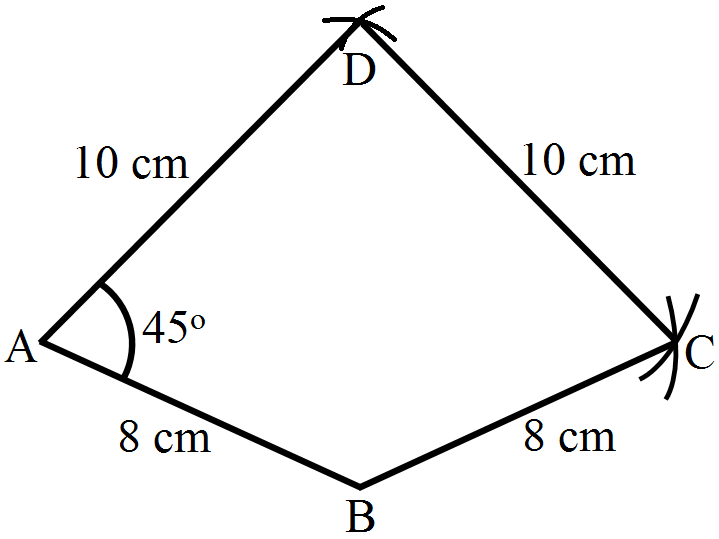
Construct a quadrilateral ABCD, given that AB = 8cm, BC = 8cm, CD = 10cm, AD = 10cm and $\angle\text{A}=45^\circ.$
Answer


Steps of Construction:
Step I: Draw AB = 8cm.
Step II: Construct $\angle\text{BAD}=45^\circ.$
Step III: With A as the centre and radius 10cm, cut off AD = 10cm.
Step IV: With D as the centre and radius 10cm, draw an arc.
Step V: With B as the centre and radius 8cm, draw an arc to intersect the arc drawn in Step IV at C.
Step VI: Join BC and CD to obtained the required quadrilateral.

Need a full question paper?

Generate a complete, print-ready paper with questions like this in minutes — across 16+ boards, with answer keys.

Start Generating Free

Similar questions

Resolve of the folloeing quadratic equation trinomials into factor: $(x-2 y)^2-5(x-2 y)+6$
Construct a square, each of whose diagonals measures 5.8cm.
Find the cube root of the following rational numbers:
$\frac{-19683}{24689}$

S.No.

Number

Power of the root

Root of the power

1.

(225)^((3)/(2))

" Cube of square root of 225

" Square root of cube of 225"

2.

(45)^((4)/(5))

3.

(81)^((6)/(7))

4.

(100)^((4)/(10))

5.

(21)^((3)/(7))

Draw a square WXYZ with side 5.2 cm.
Construct a histogram for the following data:
Monthly school fee (in Rs.)
30-60
60-90
90-120
120-150
150-180
180-210
210-240
Number of schools
5
12
14
18
10
9
4
Observe the following pattern,
$1^2=\frac{1}{6}\big[1\times(1+1)\times(2\times1+1)\big]$
$1^2+2^2=\frac{1}{6}\big[2\times(2+1)\times(2\times2+1)\big]$
$1^2+2^2+3^2=\frac{1}{6}\big[3\times(3+1)\times(2\times3+1)\big]$
$1^2+2^2+3^2+4^2=\frac{1}{6}\big[4\times(4+1)\times(2\times4+1)\big]$
and find the values of each of the following:
  1. $1^2+2^2+3^2+4^2+\ .....\ +10^2$
  2. $5^2+6^2+7^2+8^2+9^2+10^2+11^2+12^2$
A tradesman marks his goods at such a price that after allowing a discount of 15%, he makes a profit of 20%. What is the marked price of an article whose cost price is Rs. 170?
Ramesh bought two boxes for Rs. 1300. He sold one box at a profit of 20% and the other box at a loss of 12%. If the selling price of both boxes is the same, find the cost price of each box.
A car with speed $60 \mathrm{~km} / \mathrm{hr}$ takes 8 hours to travel some distance. What should be the increase in the speed if the same distance is to be covered in $7 \frac{1}{2}$ hours?