Question
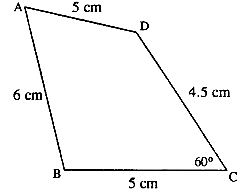
Construct a quadrilateral $\text{ABCD}\ ;$ if : $AB = 6 \ cm, CD = 4.5 \ cm, BC = AD = 5 \ cm$ and $\angle BCD = 60^\circ$ .
Answer

The rough figure is as follow :


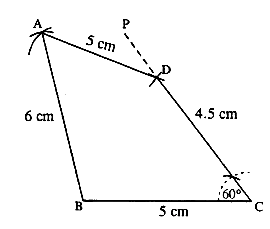
The Actual figure is constructed as follows.


Steps :
  1. Draw $BC = 5 \ cm$.
  2. Draw $\angle PCB = 60^\circ$ and cut $CD = 4.5 \ cm$.
  3. From $B$ and $D$, draw arcs of radii $6 \ cm$ and $5 \ cm$ respectively which intersect at $A$.
  4. Join $AB$ and $AD$.
    Thus $\text{ABCD}$ is the required quadrilateral.

Need a full question paper?

Generate a complete, print-ready paper with questions like this in minutes — across 16+ boards, with answer keys.

Start Generating Free

Similar questions

Construct a rectangle $\text{ABCD}\ ;$ if : $AB = 5.0 \ cm$ and diagonal $AC = 6.7 \ cm.$
Find the length of each edge of a cube, if its volume is : $(i)\  216\  cm^3\ (ii)\  1.728\  m^3$
Draw a straight line $AB = 6.5 \ cm$. Draw another line which is parallel to $AB$ at a distance of $2.8 \ cm$ from it.
What sum of money borrowed on $24\ th$ May will amount to $Rs.10210.20$ on $17\ th$ October of the same year at $5$ percent per annum simple interest.
$AB, BC$ and $CD$ are three consecutive sides of a regular polygon. If angle $BAC = 20^\circ$ ; find : $(i)$ its each interior angle, $(ii)$ its each exterior angle $(iii)$ the number of sides in the polygon.
Which of the following are cubes of an odd number $.216, 729, 3375, 8000, 125, 343, 4096$ and $9261.$
Construct a frequency table for the following data : $3, 2, 1, 5, 4, 3, 2, 5, 5, 4, 2, 2, 2, 1, 4, 1, 5, 4.$
Consider the following sets :
$\begin{array}{l}
A=\{x: x \in N, x \text { is a factor of } 3\} \\
B=\{x: x \in N, x \text { is a factor of } 5\} \\
C=\{x: x \in N, x \text { is a factor of } 9\}
\end{array}$

1. $A \cap B=$ ?
(a) $\{x: x \in N, x$ is a factor of 3 or 5$\}$ $\quad$ (b) $\{x: x \in N, x$ is a factor of both 3 and 5\}
(c) $\{x: x \in N, x$ is a factor of 15$\}$ $\quad$ (d) Both (b) and (c)

2. $A \cup B=$ ?
(a) $\{x: x \in N, x$ is a factor of either 3 or 5$\}$ $\quad$ (b) $\{x: x \in N, x$ is a factor of 3 or 5 or both $\}$
(c) $\{x: x \in N, x$ is a factor of 15$\}$ $\quad$ (d) $\{x: x \in N, x$ is a factor of both 3 and 5$\}$

3. $A \cup C=$ ?
(a) $\{x: x \in N, x$ is a factor of 3$\}$ $\quad$ (b) $\{x: x \in N, x$ is a factor of 9$\}$
(c) $\{x: x \in N, x$ is a factor of 27$\}$ $\quad$ (d) None of these

4. $A \cap C=$ ?
(a) $\{x: x \in N, x$ is a factor of 3$\}$ $\quad$ (b) $\{x: x \in N, x$ is a factor of 9$\}$
(c) $\{x: x \in N, x$ is a factor of 27\} $\quad$ (d) None of these

5. How many of the following statements are true:
I. $A \subset B$ II. $A \subseteq C$ III. $B \subseteq A$ IV. $C \subseteq A$
(a) Nil $\quad$ (b) One
(c) Two $\quad$ (d) All
Divide the sum of $\frac{5}{8}$ and $\frac{-11}{12}$ by the difference of $\frac{3}{7}$ and $\frac{5}{14}$.