Question 15 Marks
Draw a parallelogram $\text{ABCD}$, with $AB = 6 \ cm, AD = 4.8 \ cm$ and $\angle DAB = 45^\circ$ . Draw the perpendicular bisector of side $AD$ and let it meet $AD$ at point $P$. Also, draw the diagonals $AC$ and $BD\ ;$ and let them intersect at point $O$. Join $O$ and $P$. Measure $OP$.
Answer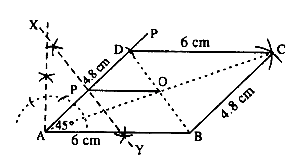
Steps :
- Draw $AB = 6 \ cm.$
- Draw $\angle PAB = 45^\circ .$
- Cut $AD = 4.8 \ cm.$
- From $D$, draw an arc of radius $6 \ cm$.
- From $B$, draw an arc of radius $4.8 \ cm$ which meets the first arc at $C.$
- Join $BC, CD, AD.$
Thus $\text{ABCD}$ is the required $||\ gm.$
- Draw perpendicular bisector $XY$ of $AD$ which cuts $AD$ at $P$.
- Join $AC$ and $BD$ which intersect at $O$.
- Join $OP$ and measure it.$OP = 3 \ cm.$
View full question & answer→Question 25 Marks
Using ruler and compasses only, construct a parallelogram $\text{ABCD}$, in which : $AB = 6 \ cm, AD = 3 \ cm$ and $\angle DAB = 60^\circ$ . In the same figure draw the bisector of angle $DAB$ and let it meet $DC$ at point $P$. Measure angle $APB.$
Answer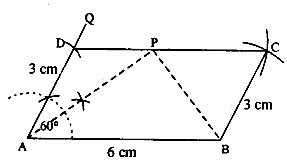
Steps :
- Draw $AB = 6 \ cm.$
- At $A$ draw $\angle QAB = 60^\circ .$
- From $AQ$ cut $AD = 3 \ cm.$
- From $D$, draw an arc of radius $6 \ cm.$
- From $B$, draw an arc of radius $3 \ cm$ which meets the first arc at $C.$
- Join $CD$ and $BC$.
Thus $\text{ABCD}$ is the required ||gm.
- Bisect $\angle DAB$, so that bisector meets $CD$ at $P$.
- Join $PB$ and measure $ZAPB.\ \therefore \angle APB = 90^\circ .$
View full question & answer→Question 35 Marks
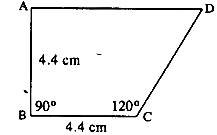
Construct a quadrilateral $\text{ABCD}$, such that $AB = BC = CD = 4.4 \ cm, \angle B = 90^\circ$ and $\angle C = 120^\circ$ .
AnswerThe rough figure is as follow
The Actual figure is constructed as follow:
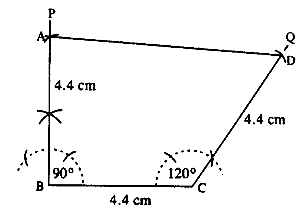
Steps :
- Draw $BC = 4.4 \ cm.$
- At $B$, draw $\angle PBC = 90^\circ .$
- Cut $BA = 4.4 \ cm.$
- At $C$, draw $\angle QCB = 120^\circ$ .
- Cut $CD = 4.4 \ cm.$
- Join $AD.$
Thus $\text{ABCD}$ is the required quadrilateral.
View full question & answer→Question 45 Marks
Construct a quadrilateral $\text{ABCD}$ in which ; $\angle A = 120^\circ , \angle B = 60^\circ , AB = 4 \ cm, BC = 4.5 \ cm$ and $CD = 5 \ cm.$
AnswerThe rough figure is as follow :
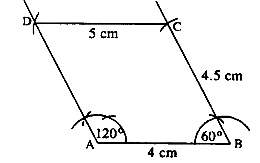
The Actual figure is constructed as follow
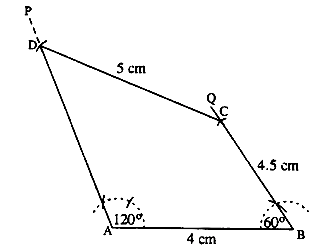
Steps :
- Draw $AB = 4 \ cm$.
- At $A$, draw $\angle PAB = 120^\circ$ .
- At $B$, draw $\angle QBA = 60^\circ$ .
- From $BQ$, cut $BC = 4.5 \ cm$.
- From $C$, draw an arc of radius $5 \ cm$ which meets $AP$ at $D$.
- Join $CD$.
Thus $\text{ABCD}$ is the required quadrilateral.
View full question & answer→Question 55 Marks
Construct a square, if : its each side is $4.3 \ cm.$
Answer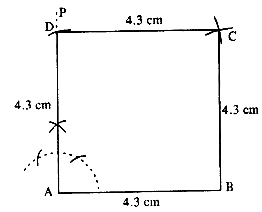
Steps :
- Draw $AB = 4.3 \ cm.$
- Draw $\angle PAB = 90^\circ$ at $A$.
- Cut $AD = 4.3 \ cm.$
- From $B$ and $D$, draw arcs of radii $4.3 \ cm$ each which intersect at $C$.
- Join $AD, BC$, and $CD$.
Hence $\text{ABCD}$ is the required square.
View full question & answer→Question 65 Marks
Construct a rhombus $\text{ABCD}$, if ; $BC = 4.7 \ cm$ and $\angle B = 75^\circ .$
Answer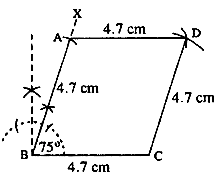
Steps :
- Draw $BC = 4.7 \ cm.$
- At $B$, draw $\angle XBC = 75^\circ$
- Cut $BA = 4.7 \ cm.$
- From $A$ and $C$, draw arcs of radii $4.7 \ cm$ each which intersect at $D$.
- Join $AD$ and $CD$.
Thus $\text{ABCD}$ is the rhombus.
View full question & answer→Question 75 Marks
Construct a rhombus $\text{ABCD}$, if ; $AB = 4 \ cm$ and $\angle B = 120^\circ .$
Answer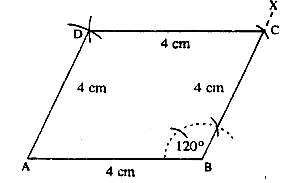
Steps :
- Draw $AB = 4 \ cm.$
- At $B$, draw $\angle XBA = 120^\circ$
- Cut $BC = 4 \ cm.$
- Draw arcs of radii $4 \ cm$ each from $A$ and $C$ which intersect at $D$.
- Join $CD$ and $AD$.
Thus $\text{ABCD}$ is the required rhombus.
View full question & answer→Question 85 Marks
Construct a rectangle $\text{ABCD}\ ;$ if : each diagonal is $5.5 \ cm$ and the angle between them is $60^\circ .$
Answer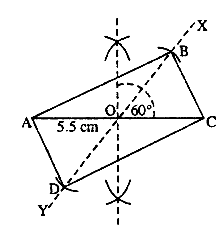
Steps :
- Draw $AC = 5.5 \ cm.$
- Bisect $AC$ at $O.$
- At $O$, draw $ \angle XOC = 60^\circ$ and produce $XO$ to $Y$.
- Cut $OB = OA$ and $OD = OA ($half the diagonal $AC).$
- Join $AB, BC, AD$, and $CD.$
Thus $\text{ABCD}$ is the required rectangle.
View full question & answer→Question 95 Marks
Construct a rectangle $\text{ABCD}\ ;$ if : each diagonal is $6 \ cm$ and the angle between them is $45^\circ .$
Answer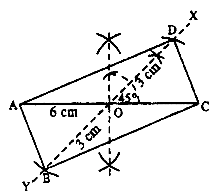
Steps :
- Draw $AC = 6 \ cm$.
- Bisect $AC$ at $O$.
- At $O$, draw $\angle XOC = 45^\circ$ and produce $XO$ to $Y$.
- Cut $OB = OD = 3 \ cm ($half the diagonal $6 \ cm)$
- Join $AB, CB, AD$, and $CD$.
Thus $\text{ABCD}$ is the required rectangle.
View full question & answer→Question 105 Marks
Construct a rectangle $\text{ABCD}$ ; if : $AD = 4.8 \ cm$ and diagonal $AC = 6.4 \ cm.$
Answer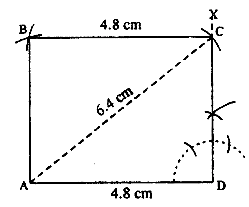
Steps :
- Draw $AD = 4.8 \ cm.$
- At $D$, draw $\angle XDA = 90^\circ $.
- From $A$, draw an arc of radius $6-4 \ cm$ which meets $DX$ at $C$.
- From $A$, draw an arc of radius equal to $DC$.
- From $C$, draw an arc of radius $4.8 \ cm$ which meets the first arc at $B$.
- Join $AB$ and $CB$. Thus $\text{ABCD}$ is the required rectangle.
View full question & answer→Question 115 Marks
Construct a rectangle $\text{ABCD}\ ;$ if : $AB = 5.0 \ cm$ and diagonal $AC = 6.7 \ cm.$
Answer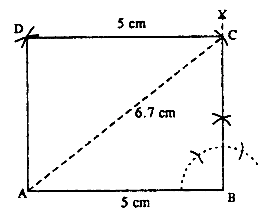
Steps :
- Draw $AB = 5 \ cm$.
- At $B$, draw $\angle XBA = 90^\circ $.
- From $A$, draw an arc of radius $6.7 \ cm$ which meets $XB$ at $C$.
- From $C$, draw an arc of a radius of $5 \ cm$.
- From $A$, draw an arc of radius equal to $BC$ which meets the first arc at $D$.
- Join $AD$ and $CD$. Thus $\text{ABCD}$ is the required rectangle.
View full question & answer→Question 125 Marks
Construct a rectangle $\text{ABCD}\ ;$ if : $ BC = 6.1 \ cm$ and $CD = 6.8 \ cm$.
Answer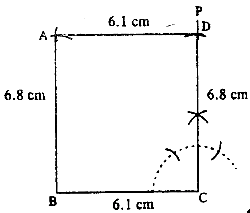
Steps:
- Draw $BC = 6.1 \ cm$.
- At $C,$ draw $\angle PCB = 90^\circ $.
- Cut $CD = 6.8 \ cm.$
- Draw an arc of radius $6.8 \ cm$ from $B$.
- From $D$, draw an arc of radius $6.1 \ cm$ which meets the first arc at $A$.
- Join $AB$ and $AD$.
Thus $\text{ABCD}$ is the required rectangle.
View full question & answer→Question 135 Marks
Construct a rectangle $ABCD$ ; if : $AB = 4.5 \ cm$ and $BC = 5.5 \ cm.$
Answer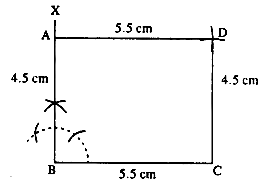
Steps :
- Draw $BC = 5.5 \ cm.$
- At $B$, draw $\angle XBC = 90^\circ$
- Cut $BA = 4.5 \ cm.$
- From $A$, draw an arc of radius $5.5 \ cm.$
- From $C$, draw an arc of radius $4 5 \ cm$ which meets the first arc at $D$.
- Join $AD$ and $CD$.
Thus $\text{ABCD}$ is the required rectangle.
View full question & answer→Question 145 Marks
Construct a parallelogram $\text{ABCD}$ , if : lengths of diagonals $AC$ and $BD$ are $5.4 \ cm$ and $6.7 \ cm$ respectively and the angle between them is $60^\circ$ .
Answer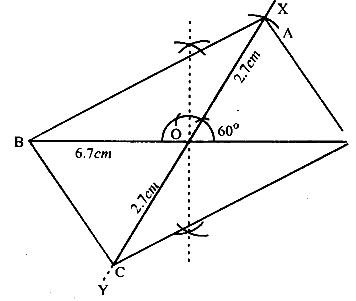
Steps :
- Draw $BD\ 6.7 \ cm$.
- Bisect $BD$ at $O$.
- At $O$, draw $\angle XOD = 60^\circ$ and produce $XO$ to $Y$.
- Cut $OA = OC = 2.7 \ cm ($half the diagonals $5.4 \ cm)$
- Join $AB, AD, BC$, and $CD$.
Thus $ABCD$ is the required $||\ gm$.
View full question & answer→Question 155 Marks
Construct a parallelogram $\text{ABCD}$, if : lengths of diagonals $AC$ and $BD$ are $6.3 \ cm$ and $7.0 \ cm$ respectively, and the angle between them is $45^\circ$ .
Answer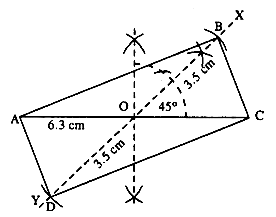
Steps :
- Draw $AC = 6.3 \ cm.$
- Bisect $AC$ at $O$.
- At $O$, draw $\angle XOC = 45^\circ$ and produce $XO$ to $Y$.
- Cut $OB = OD = 3.5 \ cm\ ($half the diagonal $7 \ cm)$
- Join $AB, CB, AD$, and $CD.$ Thus $\text{ABCD}$ is the required $|| gm$.
View full question & answer→Question 165 Marks
Construct a parallelogram $\text{ABCD},$ if : diagonal $AC = 6.4 \ cm$, diagonal $BD = 5.6 \ cm$ and angle between the diagonals is $75^\circ$ .
AnswerThe rough figure is as follows.
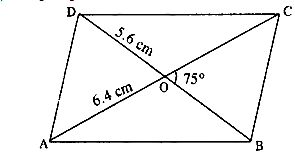
Diagonals of $|| gm$ bisect each other.
$\therefore OB = OD = `1/2`BD = 2.8 \ cm.$
The actual figure is constructed with the help of the above figure as follows
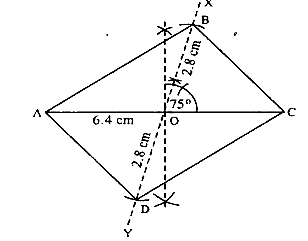
Steps :
- Draw $AC = 6.4 \ cm$.
- Bisect $AC$ at $O$.
- Draw $\angle XOC = 75^\circ$ and produce $XO$ to $Y$.
- Cut $OB = OD = 2 8 \ cm$.
- Join $AB, BC, AD$, and $CD$.
Thus $\text{ABCD}$ is the required $||\ gm.$
View full question & answer→Question 175 Marks
Construct a parallelogram $\text{ABCD}$, if : $AB = 5.8 \ cm, AD = 4.6 \ cm$ and diagonal $AC = 7.5 \ cm.$
AnswerThe rough figure is as follow :
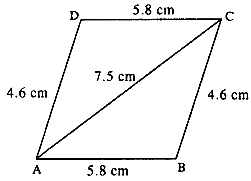
opposite sides of $||\ gm$ are equal
$BC = AD = 4.6 \ cm.$
The actual figure is constructed as follow :
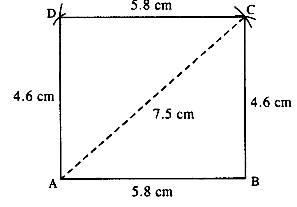
Steps:
- Draw $AB = 5.8 \ cm$.
- Draw an arc of radius $4.6 \ cm$ with centre $B$.
- Draw an arc of radius $7.5 \ cm$ from $A$ which intersects the first arc at $C$.
- From $A,$ draw an arc of radius $4.6 \ cm.$
- From $C$, draw an arc of radius $5.8 \ cm$ which intersects the first arc at $D$.
- Join $AD, CD, BC$, and $AC$.
Thus $\text{ABCD}$ is the required $||\ gm.$
View full question & answer→Question 185 Marks
Construct a parallelogram $\text{ABCD}$, if : $AD = 4 \ cm, DC = 5 \ cm$ and diagonal $BD = 7 \ cm$.
AnswerThe rough figure is as follow :
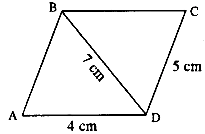
$\because$ opposite sides of $||\ gm$ are equal
$\therefore AB = DC = 5 \ cm$
Actual $||\ gm$ is constructed as follow
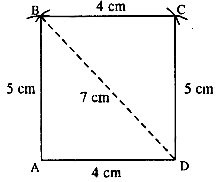
Steps :
- Draw $AD = 4 \ cm$.
- From $A$, draw an arc of radius $5 \ cm.$
- From $B$, draw an arc of radius $4 \ cm.$
- From $D$, draw an arc of radius $5 \ cm$ which intersects the first arc at $C.$
- Join $AB, BD, BC$, and $CD$.
Thus $\text{ABCD}$ is the required $||\ gm$.
View full question & answer→Question 195 Marks
Construct a parallelogram $\text{ABCD}$, if : $BC = 4.5 \ cm, CD = 5.2 \ cm$ and $\angle ADC = 75^\circ$ .
AnswerThe rough figure is as follow :
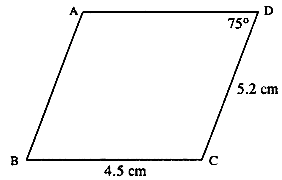
$\because$ opposite sides of $||gm$ are equal
$\therefore AD = BC = 4.5 \ cm.$
$\therefore$ Actual construction is as follow:
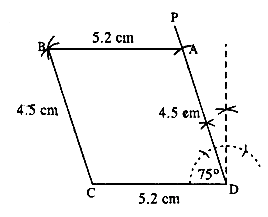
Steps :
- Draw $CD = 5.2 \ cm$.
- Draw $\text{ZCDP} = 75^\circ$
- Cut $DA = 4.5 \ cm$.
- A drawn arc of radius $5.2 \ cm.$
- From $C$, draw an arc of radius $4.5 \ cm$ which meets the first arc at $B$.
- Join $AB$ and $CB$.
Thus $\text{ABCD}$ is the required $||\ gm$.
View full question & answer→Question 205 Marks
Construct a parallelogram $\text{ABCD}$, if : $AB = 3.6 \ cm, BC = 4.5 \ cm$ and $\angle ABC = 120^\circ $.
AnswerThe rough figure is as follow :
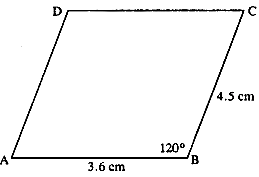
The above rough figure is used to construct the actual $||\ gm$ as follow :
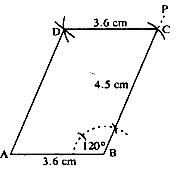
Steps :
- Draw $AB = 3.6 \ cm$.
- Draw $BP$ such that $\angle B = 120^\circ$ .
- Cut $BC = 4.5 \ cm$.
- From $A$, draw an arc of radius $4.5 \ cm$.
- From $C$, draw an arc of radius $3.6 \ cm$. Which intersects the first arc at $D$.
- Join $AD$ and $CD$.
Hence $\text{ABCD}$ is the required $||\ gm.$
View full question & answer→Question 215 Marks
Construct a quadrilateral $\text{ABCD}\ ;$ if : $AB = AD = 5\ cm, BD = 7 \ cm$ and $BC = DC = 5.5 \ cm$
AnswerThe rough figure is as follow :
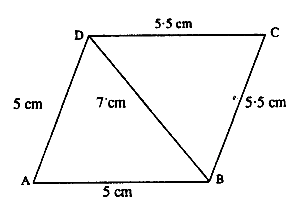
Actual construction is as follows $($using the above rough fig.$)$
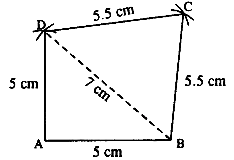
Steps :
- Draw $AB = 5 \ cm$.
- From $A B$ draw arcs of radii $5 \ cm$ and $7\ cm$ which intersect at $D$.
- From $B D$ draw arcs of radii $5.5 \ cm$ each which intersect at $C$.
- Join $AD, BD, DC$, and $BC$.
Thus $\text{ABCD}$ is the required quadrilateral.
View full question & answer→Question 225 Marks
Construct a quadrilateral $ABCD\ ;$ if : $AB = 6 \ cm = AC, BC = 4 \ cm, CD = 5 \ cm$ and $AD = 4.5 \ cm.$
AnswerThe rough figure is as shown below.
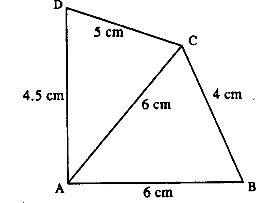
The actual quadrilateral is constructed as follows with the help of the above rough figure.
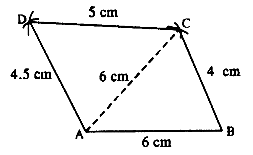
Steps :
- Draw $AB = 6 \ cm$.
- From $A$ and $B$, draw arcs of radii $6 \ cm$ and $4 \ cm$ which cut at $C$.
- From $A$ and $C$, draw arcs of radii $4.5 \ cm$ and $5 \ cm$ respectively which intersect at $D$.
- Join $BC, CD$, and $DA$. Thus $\text{ABCD}$ is the required quadrilateral.
View full question & answer→Question 235 Marks
Construct a quadrilateral $\text{ABCD}\ ;$ if : $AB = 5 \ cm, BC = 6.5 \ cm, CD =4.8 \ cm, \angle B = 75^\circ$ and $\angle C = 120^\circ .$
AnswerThe rough figure is as shown below.
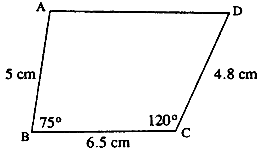
Actual construction is as follows $($using rough fig.$)$
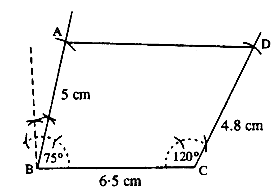
Steps :
- Draw $BC = 6-5 \ cm.$
- Draw $\angle B = 75^\circ$ and cut $BA = 5 \ cm.$
- Draw $\angle C = 120^\circ$ and cut $CD = 4.8 \ cm.$
- Join $AD$.
Thus $\text{ABCD}$ is the required quadrilateral.
View full question & answer→Question 245 Marks
Construct a quadrilateral $\text{ABCD}\ ;$ if : $AB = 8 \ cm, BC = 5.4 \ cm, AD = 6 \ cm, \angle A = 60^\circ$ and $\angle B = 75^\circ$ .
AnswerThe rough figure is as follow :
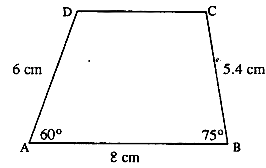
The actual quadrilateral is constructed with the help of the above rough figure.
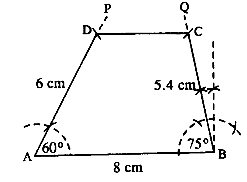
Steps :
- Draw $AB = 8 \ cm.$
- At $A$, draw $\angle PAB = 60^\circ$ and cut $DA = 6 \ cm$.
- At $B$, draw $\angle QBA = 75^\circ$ and cut $BC = 5.4 \ cm$.
- Join $DC$.
Thus $\text{ABCD}$ is the required quadrilateral.
View full question & answer→Question 255 Marks
Construct a quadrilateral $\text{ABCD}\ ;$ if : $AB = 6 \ cm, CD = 4.5 \ cm, BC = AD = 5 \ cm$ and $\angle BCD = 60^\circ$ .
AnswerThe rough figure is as follow :
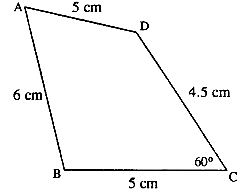
The Actual figure is constructed as follows.
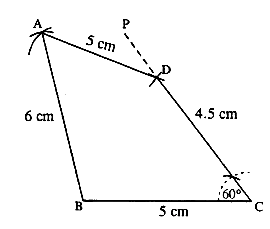
Steps :
- Draw $BC = 5 \ cm$.
- Draw $\angle PCB = 60^\circ$ and cut $CD = 4.5 \ cm$.
- From $B$ and $D$, draw arcs of radii $6 \ cm$ and $5 \ cm$ respectively which intersect at $A$.
- Join $AB$ and $AD$.
Thus $\text{ABCD}$ is the required quadrilateral.
View full question & answer→Question 265 Marks
Construct a quadrilateral $\text{ABCD}\ ;$ if : $AB = 4.3 \ cm, BC = 5.4, CD = 5 \ cm, DA = 4.8 \ cm$ and angle $ABC = 75^\circ .$
AnswerThe rough figure is as follow :
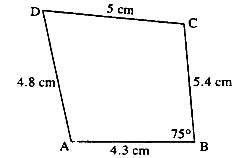
The actual figure is as follow:
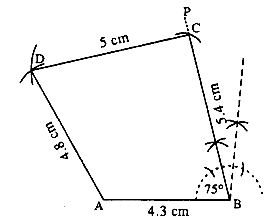
Steps :
- Draw $AB = 4.3 \ cm.$
- At $B$, draw $\angle PBA = 75^\circ$
- Cut $BC = 5.4 \ cm$.
- From $C A,$ draw arcs of radii $5 \ cm$ and $4.8 \ cm$ respectively which intersect at $D$.
- Join $AD$ and $DC$.
$\text{ABCD}$ is the required quadrilateral.
View full question & answer→Question 275 Marks
Using a ruler and compasses only, construct a rhombus whose diagonals are $8 \ cm$ and $6 \ cm$. Measure the length of its one side.
Answer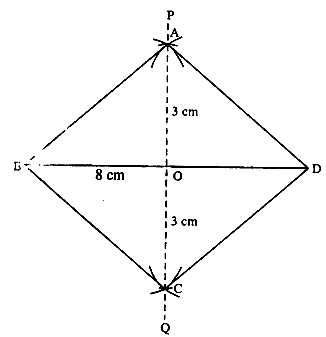
Steps :
- Draw $BD = 8 \ cm$.
- Draw perpendicular bisector $PQ$ of $BD$.
- Cut $OA = OC = 3 \ cm [$half the diagonal $6 \ cm]$
- Join $AB, AD, BC$, and $CD$.
- Measure side $AB$ which is $5 \ cm$.
Thus $\text{ABCD}$ is the required rhombus.
View full question & answer→Question 285 Marks
Construct an angle $ABC = 90^\circ$ . Locate a point $P$ which is $2.5 \ cm$ from $AB$ and $3.2 \ cm$ from $BC$.
AnswerSteps of construction :
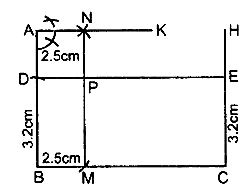
- Draw $\angle ABC = 90^\circ$
- From $AB$, cut $BD = 3.2 \ cm.$
- Through point $C,$ draw $CH\perp BC$. From $CH$, cut $CE = 3.2$. Join $DE$. Now $DE$ is a line parallel to $BC$ and at a distance of $3.2 \ cm$ from $BC.$
- From $BC$ cut $BM = 2.5 \ cm.$
- Through point $A$, draw $AK \perp AB$. From $AK$ cut $AN = 2.5 \ cm$. Join $NM$. Therefore $NM$ is parallel to $AB$ and at a distance of $2.5 \ cm$ from $AB$.
- $DE$ and $MN$ intersect each other at $P$. Thus $P$ is the required point which is $2.5 \ cm$ from $AB$ and $3.2 \ cm$ from $BC$.
View full question & answer→Question 295 Marks
Draw an angle $ABC = 60^\circ$ . Draw the bisector of it. Also, draw a line parallel to $BC$ a distance of $2.5 \ cm$ from it.Let this parallel line meet $AB$ at point $P$ and angle bisector at point $Q$. Measure the length of $BP$ and $PQ$. Is $BP = PQ$?
AnswerSteps of construction :
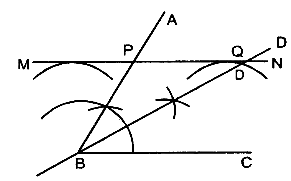
- Draw, $\angle ABC = 60^\circ$
- Draw $BD$, the bisector of $\angle ABC$.
- Taking $B$ as centre, draw an arc of radius $2.5 \ cm$.
- Taking $C$ as a centre, draw another arc of radius $2.5 \ cm$.
- Draw a line $MN$ that touches these two arcs drawn. Then $MN$ is the required line parallel to $BC$.
- Let this line $MN$ meets $AB$ at $P$ and bisector $BD$ at $Q$.
- Measure $BP$ and $PQ$.
By measurement, we see $BP = PQ.$
View full question & answer→Question 305 Marks
Construct an angle $PQR = 80^\circ$ . Draw a line parallel to $PQ$ at a distance of $3 \ cm$ from it and another line parallel to $QR$ at a distance of $3.5 \ cm$ from it. Mark the point of intersection of these parallel lines as $A$.
AnswerSteps of construction :
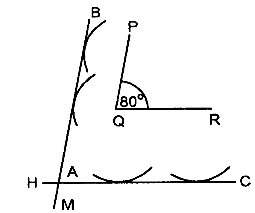
- Draw $\angle PQR = 80^\circ$
- With $P$ as centre draw an arc of radius $2 \ cm$.
- Again with $Q$ as a centre, draw another arc of radius $2 \ cm$. Then $BM$ is a line which touches the two arcs. Then $BM$ is a line parallel to $PQ$.
- With $Q$ as a centre, draw an arc of radius $3.5 \ cm$. With $R$ as centre draw another arc of radius $3.5 \ cm$. Draw a line $HC$ which touches these two arcs. Let these two parallel lines intersect at $A$.
View full question & answer→Question 315 Marks
Draw a straight line $AB = 6.5 \ cm$. Draw another line which is parallel to $AB$ at a distance of $2.8 \ cm$ from it.
AnswerSteps of construction :
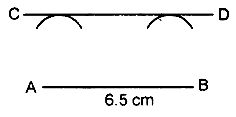
- Draw a straight line $AB = 6.5 \ cm$
- Taking point $A$ as a centre, draw an arc of radius $2.8 \ cm$.
- Taking $B$ as centre, drawn another arc of radius $2.8 \ cm$.
- Draw a line $CD$ that touches the two arcs drawn.
Thus $CD$ is the required parallel line.
View full question & answer→Question 325 Marks
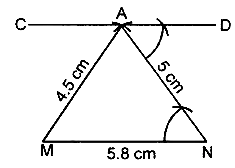
Draw a line $MN = 5.8 \ cm$. Locate a point $A$ which is $4.5 \ cm$ from $M$ and $5 \ cm$ from $N$. Through $A $ draw a line parallel to line $MN$.
AnswerSteps of construction :
- Draw a line $MN = 5.8 \ cm$
- With $M$ as centre and radius $= 4.5 \ cm$, draw an arc.
- With $N$ as centre draw another arc of radius $5 \ cm$. These arcs intersect each other at $A$.
- Join $AM$ and $AN$.
- At point $A$, draw $\angle DAN = \angle ANM$
- Produce $DA$ to any point $C.$
Thus $CAD$ is the required parallel line.
View full question & answer→Question 335 Marks
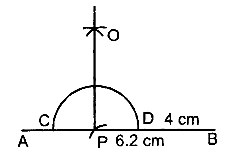
Draw a line segment $AB = 6.2 \ cm$. Mark a point $P$ in $AB$ such that $BP = 4 \ cm$. Through point $P$ draw perpendicular to $AB.$
AnswerSteps of Construction :
- Draw a line segment $AB = 6.2 \ cm$
- Cut off $BP = 4 \ cm$
- With $P$ as the centre and some radius draw arc meeting $AB$ at the points $C, D.$
- With $C, D$ as centres and equal radii $[$each is more than half of $CD]$ draw two arcs, meeting each other at the point $O.$
- Join $OP$. Then $OP$ is perpendicular for $AB.$
View full question & answer→Question 345 Marks
Draw a line segment $AB = 5.5 \ cm$. Mark a point $P$, such that $PA = 6 \ cm$ and $PB = 4.8 \ cm$. From point $P$, draw a perpendicular to $AB.$
AnswerStep of Construction :
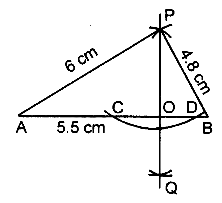
- Draw a line segment $AB = 5.5 \ cm$
- With $A$ as centre and radius $= 6 \ cm$, draw an arc.
- With $B$ as centre and radius $= 4.8 \ cm$ draw another arc.
- Let these arcs meet each other at point $P. PA = 6 \ cm, PB = 4.8$
- With $P$ as a centre and some suitable radius draw an arc meeting $AB$ at points $C$ and $D$.
- With $C$ as centre and radius more than half of $CD$, draw an arc.
- With $D$ as a centre and same radius as in step $6$, draw an arc.
- Let these arcs meet each other at point $Q$.
- Join $PQ$.
- The $PQ$ meet $AB$ at point $O$.
Then $PO \perp AB$ i.e; $\angle AOP = 90^\circ = \angle POB.$
View full question & answer→Question 355 Marks
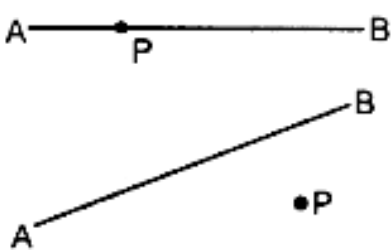
In each of the following, draw perpendicular through point $P$ to the line segment $AB$ :
$(i)$

$(ii)$

$(iii)$
Answer(i) Steps of Construction :
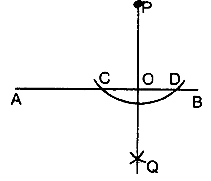
- With $P$ as a centre, draw an arc of a suitable radius which cuts $AB $at points $C$ and $D$.
- With $C$ and $D$ as centres, draw arcs of equal radii and let these arcs intersect each other at point $Q$.
$[$The radius of these arcs must be more than half of $CD$ and both the arcs must be drawn on the other side$]$
- Join $P$ and $Q$
- Let $PQ$ cut $AB$ at the point $O.$
Thus, $OP$ is the required perpendicular clearly, $\angle AOP = \angle BOP = 90^\circ$
(ii) Steps of Construction :
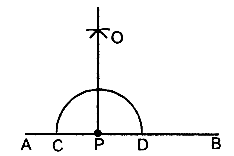
- With $P$ as a centre, draw an arc of any suitable radius which cuts $AB$ at points $C$ and $D.$
- With $C$ and $D$ as centres, draw arcs of equal radii. Which intersect each other at point $A$.
$[$This radius must be more than half of $CD$ and let these arc intersect each other at the point $0]$
- Join $P$ and $O$. Then $OP$ is the required perpendicular.
$\angle OPA = \angle OPB = 90^\circ$
(iii) Steps of Construction :
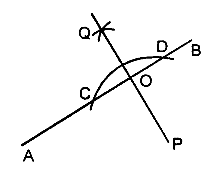
- With $P$ as a centre, draw an arc of any suitable radius which cuts $AB$ at points $C$ and $D$.
- With $C$ and $D$ as a centre, draw arcs of equal radii
$[$The radius of these arcs must be more than half of $CD$ and both the arcs must be drawn on the other side.$]$
and let these arcs intersect each other at the point $Q$.
- Join $Q$ and $P$. Let Q$P$ cut $AB$ at the point $O$. Then O$P$ is the required perpendicular.
Clearly, $\angle AOP = \angle BOP = 90^\circ$
View full question & answer→Question 365 Marks
Draw a line segment $PQ = 4.8 \ cm$. Construct the perpendicular bisector of $PQ$.
AnswerSteps of Construction :
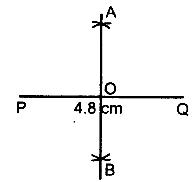
- Draw a line segment $PQ = 4.8 \ cm.$
- With $P$ as centre and radius equal than half of $PQ$, draw an arc on both the $PQ$.
- With $Q$ as the centre and the same radius as taken in step $2$, draw arcs on both sides of $PQ.$
- Let the arcs intersect each other at point $A$ and $B$
- Join $A$ and $B$.
- The line $AB$ cuts the line segment $PQ$ at the point $O$. Here $OP = OQ$ and $\angle AOQ = 90^\circ .$ Then the line $AB$ is a perpendicular bisector of $PQ$.
View full question & answer→Question 375 Marks
Draw a line segment $AB$ of length $5.3 \ cm$. Using two different methods bisect $AB.$
AnswerSteps of Construction :
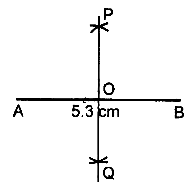
- Draw a line segment $AB = 5.3 \ cm$
- With $A$ as centre and radius equal to more than half of $AB$, draw arcs on both sides of $AB.$
- With $B$ as the centre and with the same radius as taken in step $2$, draw arcs on both sides of $AB.$
- Let the arcs intersect each other at points $P$ and $Q$.
- Join $P $ and $Q$.
- The line $PQ$ cuts the given line segment $AB$ at point $O$.
Thus, $PQ$ is a bisector of $AB$ such that
$\mathrm{OA}=\mathrm{OB}=\frac{1}{2} \mathrm{AB}$
Second Method
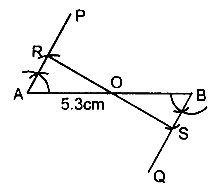
Steps of Construction :
- Draw the given line segment $AB = 5.3 \ cm.$
- At $A$, construct $\angle PAB$ of any suitable measure. Then $\angle PAB = 60^\circ$ construct $\angle QBA = 60^\circ$
- From $AP$, cut $AR$ of any suitable length and from $BQ\ ;$ cut $BS = AR.$
- Join $R$ and $S$
- Let $RS$ cut the given line segment $AB$ at the point $O$.
Thus $RS$ is a bisector of $AB$ such that $O A=O B=\frac{1}{2} A B$
View full question & answer→Question 385 Marks
Draw angle $ABC$ of any suitable measure.$(i)$ Draw $BP$, the bisector of angle $ABC.(ii)$ Draw $BR$, the bisector of angle $PBC$ and draw $BQ$, the bisector of angle $ABP.(iii)$ Are the angles $ABQ, QBP, PBR$ and $RBC$ equal ? $(iv)$ Are the angles $ABR$ and $QBC$ equal?
AnswerSteps of Construction :
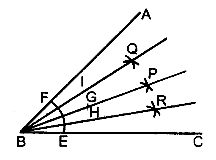
Construct any angle $ABC$
With $B$ as a centre, draw an arc $EF$ meeting $BC$ at $E$ and $AB$ at $F$.
With $E, F$ as centres draws two arcs of equal radii meeting each other at the point $P$.
Join $BP$. Then $BP$ is the bisector of $\angle ABC$
$\angle ABP = \angle PBC =\frac{1}{2} \angle ABC$
Similarly draw $BR$, the bisector of $\angle PBC$ and draw $BQ$ as the bisector of $\angle ABP [$With the same method as in steps $2, 3]$
Then $\angle ABQ = \angle QBP = \angle PBR = \angle RBC$
$\angle ABR =\frac{3}{4} \angle ABC$ and $\angle QBC =\frac{3}{4} \angle ABC$
$\angle ABR = \angle QBC.$ View full question & answer→Question 395 Marks
Construct angle $ABC = 45^\circ$ in which $BC = 5 \ cm$ and $AB = 4.6 \ cm.$
AnswerSteps of Construction :
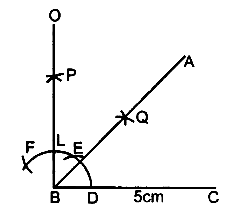
- Draw a line segment $BC = 5 \ cm$
- Taking $B$ as centre, draw an arc of any suitable radius, which cuts $BC$ at the point $D$.
- With $D$ as the centre and the same radius, as taken in step $2$, draw an arc which cuts the previous arc at point $E.$
- With $E$ as the centre and the same radius, draw one more arc which cuts the first arc at point $F$.
- With $E$ and $F$ as centres and radii equal to more than half the distance between $E$ at $F,$ draw an arc which cut each other at point $P$.
- Join $BP$ to meet $EF$ at $L$ and produce to point $O$. Then $\angle OBC = 90^\circ$
- Draw $BA$, the bisector of angle $OBC. [$With $D, L$ as centres and suitable radius draw two arc meeting each other at $Q$ produced it to $R]$
$=> \angle ABC = 45^\circ [\therefore BA$ is bisector of $\angle OBC \therefore \angle ABC = 45^\circ ]$
- From $BR$ cut arc $AB = 4.6 \ cm$
View full question & answer→Question 405 Marks
Given below are the angles $x, y,$ and $z.$
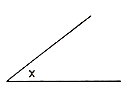
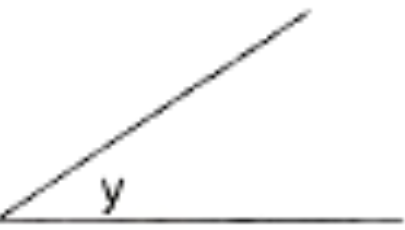
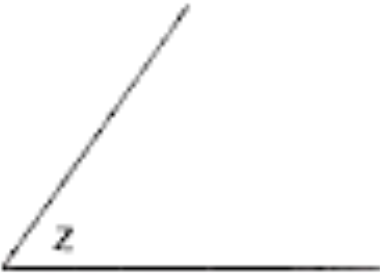
Without measuring these angles construct :
$(i)\ (ii)\ (iii)$ Answer(i) Steps of Construction :
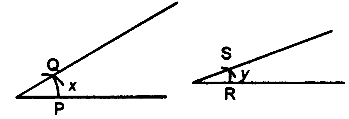
Draw line segment $BC$ of any suitable length.
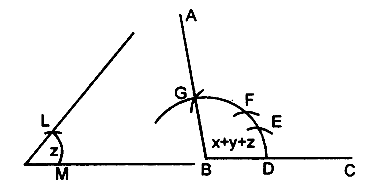
- With $B$ as a centre, draw an arc of any suitable radius. With the same radius, draw arcs with the vertices of given angles as centres. Let these arcs cut arms of the angle $x$ at the points $P$ and $Q$ and arms of the angle $y$ at points $R$ and $S$ and arms of the angle $z$ at the points $L$ and $M$.
- From the arc, with centre $B$, cut
$DE = PQ =$ arc of $x, EF = RS =$ arc of $y$ and $FG = LM =$ arc of $z.$
- Join $BG$ and produce it up to $A$.
Then $\angle ABC = x + y + z$
$(ii)$ Proceed as in part $(i)$ up to step $2$.
3. From the arc, with centre $B$, cut
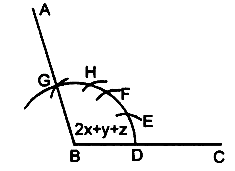
$DE = 2PQ = 2$ arc of $x$
$EF = RS =$ arc of $y$
$FG = LM =$ arc of $z$
4. Join $BG$ and produce it up to point $A$
Then $\angle ABC = 2x + y + z$
$(iii)$ proceed as in $(i)$ up to step $2$
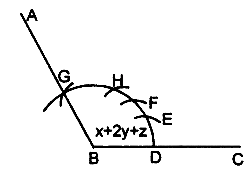
3. Here cut arc $DE =$ arc $PQ =$ arc of $x$ arc $EF = 2$ arc $RS = 2$ arc of $y$ arc $FG =$ arc $LM =$ arc of $z$.
4. Join $BG$ and produce it up to $A$
5. Then $\angle ABC = x + 2y + z$ View full question & answer→Question 415 Marks
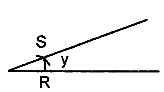
Given below are the angles $x$ and $y.$
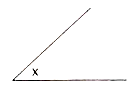
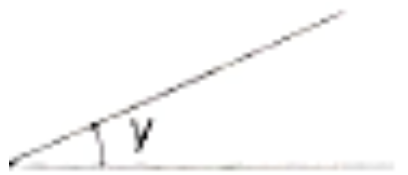
Without measuring these angles, construct :
$(i)\ (ii)\ (iii)$ Answer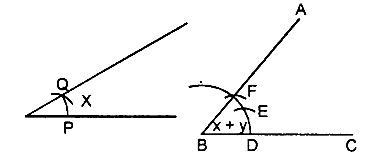
(i) Steps of Construction :
Draw a line segment $BC$ of any suitable length.
With $B$ as the centre, draw an arc of any suitable radius. With the same radius, draw arcs with the vertices of given angles as centres. Let these arcs cut arms of the arc $x$ at points $P$ and $Q$ and arms of angle $y$ at points $R$ and $S.$
From the arc, with centre $B$, cut $DE = PQ$ arc of $x$ and $EF = RS$ arc of $y$
Join $BF$ and produce up to point $A$.
Thus $\angle ABC = x + y$
(ii) Steps of Construction :
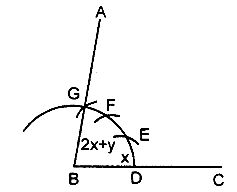
Proceed in exactly the same way as in part$(i)$
takes $DE = PQ =$ arc of $x$.
$EF = PQ =$ arc of $x$ and $FG = RS =$ arc of $y$.
Join $BG$ and produce it up to $A$.
Thus $\angle ABC = x + x+ y = 2x + y$
(iii) Steps of Construction :
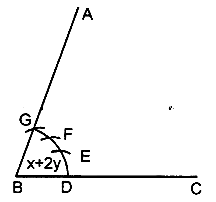
Proceed in exactly the same way as in $(ii)$
taking $DE = PQ =$ arc of $x$. and $EF = RS =$ arc of $y$ and $FG = RS =$ arc of $y.$
4. Join $BF$ and produce up to point $A$.
Thus $\angle ABC = x + y + y = x + 2y$ View full question & answer→