Question
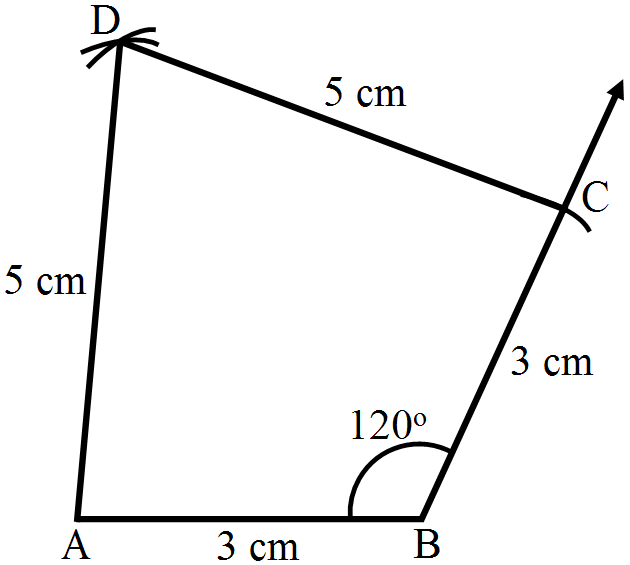
Construct a quadrilateral ABCD in which AB = BC = 3cm, AD = CD = 5cm, and $\angle\text{B}=120^\circ.$
Answer


Steps of construction:
Step I: Draw AB = 3cm.
Step II: Construct $\angle\text{ABC}=120^\circ.$
Step III: With B as the centre and radius 3cm, cut off BC = 3cm.
Step IV: With C as the centre and radius 5cm, draw an arc.
Step V: With A as the centre and radius 5cm, draw an arc to intersect the arc drawn in Step IV at D.
Step VI: Join AD and CD to obtain the required quadrilateral.

Need a full question paper?

Generate a complete, print-ready paper with questions like this in minutes — across 16+ boards, with answer keys.
Start Generating Free

Similar questions

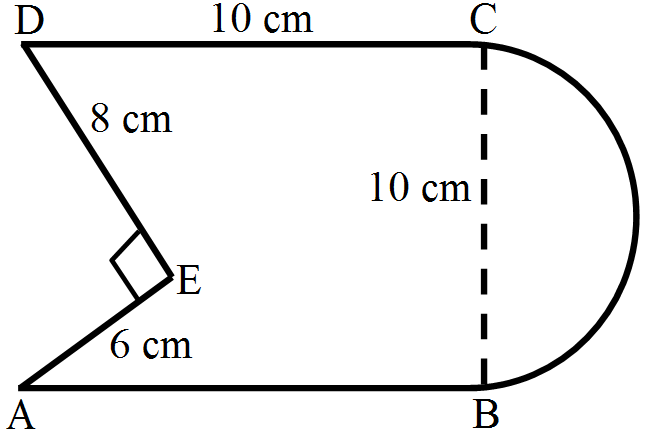
Find the area of Fig. in square cm, correct to one place of decimal. $\Big(\text {Take }\pi=\frac{22}{7}\Big)$

The number of boys and girls, in std 5 to std 8 in a Z.P. School is given in the table. Draw a subdivided bar graph to show the data. (Scale : On Y axis, 1cm = 10 students)
Standard5th6th7th8th
Boys34262125
Girls17141420
Represent the following data by a pie-diagram:
Items of expenditure
Expenditure
Family A
Family B
Food
4000
6400
Clothing
2500
480
Rent
1500
3200
Education
400
1000
Miscellaneous
1600
600
Total
10000
16000
Draw five circles of different radii on a paper. Draw a chord in each circle. Find the midpoint of each chord. Join the centre of the circle and midpoint of the chord as shown in the figure. Name the chord as AB and midpoint of the chord as P. Check with set-square or protractor that ∠APO or ∠BPO are right angles.
Check whether the same result is observed for the chord of each circle.
Observe the following pattern,
$2^2-1^2=2+1$
$3^2-2^2=3+2$
$4^2-3^2=4+3$
$5^2-4^2=5+4$
and find the value of,
i. $100^2-99^2$
ii. $111^2-109^2$
iii. $99^2-96^2$
The following table shows the amount of rice grown by a farmer in different years:
Years: 2000 2001 2002 2003 2004 2005 2006
Rice grown (in quintals): 200 180 240 260 250 200 270
Construct ₹LMNO such that
l(LM) = l(LO) = 6 cm,
l(ON) = l(NM) = 4.5 cm, l(OM) = 7.5 cm.
Diagonals of a parallelogram ABCD intersect at O. AL and CM are drawn perpendiculars to BD such that L and M lie on BD. Is AL = CM? Why or why not?
Find the area of the field shown in Fig. by dividing it into a square, a rectangle and a trapezium.

The parallel sides of a trapezium are 25cm and 11cm, while its nonparallel sides are 15cm and 13cm. Find the area of the trapezium.