Question
Construct a quadrilateral BDEF, where DE = 4.5cm, EF = 3.5cm, FB = 6.5cm, $\angle\text{F}=50^\circ$ and $\angle\text{E}=100^\circ.$
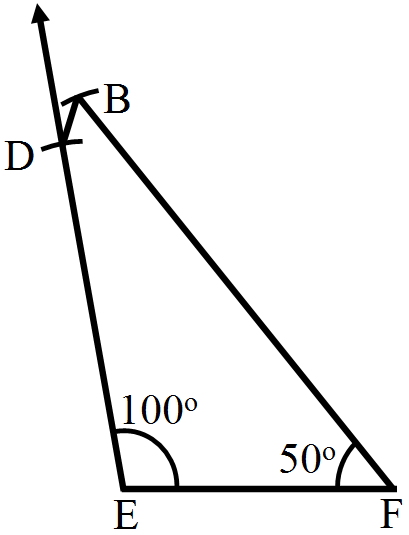
Answer


Steps of construction:
Step I: Draw EF = 3.5cm.
Step II: Construct $\angle\text{DEF}=100^\circ$ at E.
Step III: With E as the centre and radius 4.5cm, cut off DE = 4.5cm.
Step IV: Construct $\angle\text{EFB}=50^\circ$ at F.
Step V: With F as the centre and radius 6.5cm, cut off FB = 6.5cm.
Step VI: Join BD.
The quadrilateral so obtained is the required quadrilateral.

Need a full question paper?

Generate a complete, print-ready paper with questions like this in minutes — across 16+ boards, with answer keys.

Start Generating Free

Similar questions

Write the cubes of all natural numbers between 1 and 10 and verify the following statements:
  1. Cubes of all odd natural numbers are odd.
  2. Cubes of all even natural numbers are even.
Construct a quadrilateral ABCD in which BC = 7.5cm, AC = AD = 6cm, CD = 5cm and BD = 10cm.
In the following table number of trees planted in the year 2016 and 2017 in four towns is given. Show the data with the help of subdivided bar graph.
Year\TownkarjatWadgaonShivapurKhandala
2016150250200100
2017200300250150
Number of workshops organized by a school in different areas during the last five years are as follows:
Year No. of workshops
1995-1996 25
1996-1997 30
1997-1998 42
1998-1999 50
1999-2000 65
Draw a histogram representing the above data.
The table given below depicts the annual gross profit of a company for a period of 5 years. Study the table and draw a line graph for the same.
Year
2013
2014
2015 2016
2017
Gross profit (in lakhs of Rs.)
17
15.5
11.4
12.1
14.9
Construct a trapezium ABCD in which AB = 6cm, BC = 4cm, CD = 3.2cm, $\angle\text{B}=75^\circ$ and DC || AB.
Find three consecutive whole numbers whose sum is more than 45 but less than 54.
The perimeter of a rhombus is 180cm and one of its diagonals is 72cm. Find the length of the other diagonal and the area of the rhombus.
The following table shows the percentage of students who dropped out of school after completing high school.
Age (in Year)
8
9
10
11
12
13
14
15
16
17
18
Boys
72%
75%
78%
81%
84%
88%
92%
95%
98%
99%
100%
Girls
77%
81%
84%
88%
91%
95%
98%
99%
99.5%
100%
100%
Now, use the graph to answer the following question:
  1. In which year both boys and the girls achieve their maximum height?
  2. Who grows faster at puberty (14 years to 16 years of age).
Simplify:
$\left(x^3-2 x^2+3 x-4\right)(x-1)-(2 x-3)\left(x^2-x+1\right)$