Question
Construct a regular hexagon of side $3.2 \ cm$
Answer

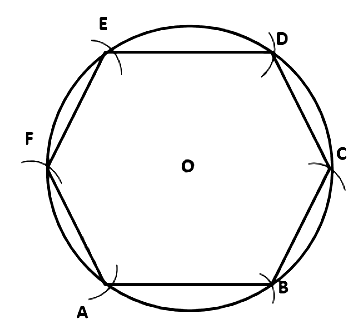
The length of the side of a regular hexagon is equal to the radius of its circumcircle.
Steps of construction:
$1.$ Draw a circle of radius $3.2 \ cm$
$2.$ Taking any point $A$ on the circumference of the circle as a centre, draw arcs of same radii $($i.e. $3.2 \ cm)$ which cut the circumference at $B$ and $F$.
$3$. With $B$ and $F$ as centres, again draw two arcs of same radii which cut the circumference at $C$ and $E$ respectively.
$4$. With $C$ or $E$ as a centre, draw one more arc of the same radius which cuts the circumference at point $D.$
In this way, the circumference of the circle is divided into six equal parts.
$5$. Join $A B, B C, C D, D E, E F$ and $F A$.


$\text{A B C D E F}$ is the required regular hexagon.

Need a full question paper?

Generate a complete, print-ready paper with questions like this in minutes — across 16+ boards, with answer keys.
Start Generating Free

Similar questions

A certain sum of money amounts to $Rs. 23,400$ in $3$ years at $10\%$ per annum simple interest. Find the amount of the same sum in $2$ years and at $10\% p.a$. compound interest.
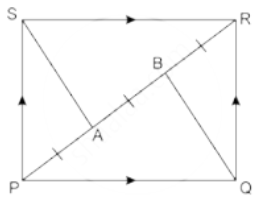
In the given figure,$\text{PQRS}$ is a parallelogram in which $PA = AB$ Prove that: $\text{SAQB}$ is a parallelogram.
Image
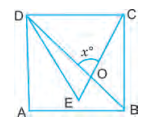
DEC is an equilateral triangle in a square ABCD . If BD and CE intersect at O and $\angle COD =x$, find the value of $x$.
Image
Construct a quadrilateral ABCD in which AB = 3.2 cm, BC = 2.8 cm CD = 4 cm, DA = 4.5 cm and BD = 5.3 cm. Also construct a triangle equal in area to this quadrilateral.
If $m \neq n$ and $(m + n)^{-1}(m^{-1}+ n^{-1}) =m^xn^y$, show that : $x + y + 2 = 0$
Draw a histogram for the following frequency distribution:
Train fare $0 - 50$ $50 - 100$ $100 - 150$ $150 - 200$ $200 - 250$ $250 - 300$
No. of travellers $25$ $40$ $36$ $20$ $17$ $12$
A wire in the form of a circle of radius $42\ cm$. It is bent into a square. Determine the side of the square and compare the area of the regions enclosed in the two cases.
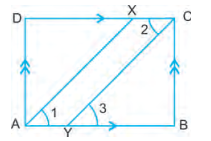
In the adjoining figure, ABCD is a parallelogram. Line segments $A X$ and $C Y$ bisect $\angle A$ and $\angle C$ respectively.
Prove that:
(i) $\triangle ADX \cong \triangle CBY$
(ii) $AX = CY$
(iii) $A X \| C Y$
(iv) AYCX is a parallelogram.
Image
Draw a graph of each of the following equations: $2(x-5)=\frac{3}{4}(y-1)$
If $\triangle ABC, D$ and $E$ are points on $AB$ and $AC.$ Show that $DE \| BC$ for each of the following case or not:$AD = 5.7\ cm, BD = 9.5\ cm, AE = 3.3\ cm,$ and $EC = 5.5\ cm$