Question
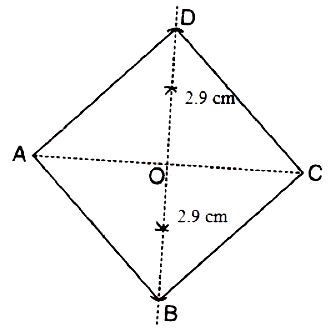
Construct a rhombus $\text{ABCD},$ when:Diagonal $AC = 6.3 \ cm$ and diagonal $BD = 5.8 \ cm.$

Answer


Steps:
$1.$ Draw $AC =6.3 \ cm$.
$2.$ Draw perpendicular bisector to $AC$ which cuts $AC$ at $O$.
$3.$ From this perpendicular cut $OD$ and $O$B such that,
$OD = OB =\frac{1}{2} BD =\frac{1}{2} \times 5.8=2.9 \ cm$.
$4.$ Join $AB , BC , CD$, and $DA$.
$\text{ABCD}$ is the required rhombus.

Need a full question paper?

Generate a complete, print-ready paper with questions like this in minutes — across 16+ boards, with answer keys.
Start Generating Free

Similar questions

Evaluate :[$\left.(18.6)^2-(1.4)^2\right]$
In $\triangle ABC$, point $D$ divides $AB$ in the ratio $5: 7$, Find: $\frac{ AE }{ EC }$
Solve the equations:
$\frac{3}{x+y}+\frac{2}{x-y}=3, \frac{2}{x+y}+\frac{3}{x-y}=\frac{11}{3} \quad\left[\right.$ Hint. Put $\frac{1}{x+y}=u$ and $\left.\frac{1}{x-y}=v\right]$
Solve for $\mathbf{x}$, if $: \log _x 49-\log _x 7+\log _x \frac{1}{343}+2=0$
If $a \neq 0$ and $a-\frac{1}{a}=4 ;$ find $:\left(a^4+\frac{1}{a^4}\right)$
Image
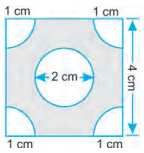
Find the perimeter and area of the shaded region shown in the figure. The four corners are circle quadrants and at the centre, there is a circle. (Take $\pi$ = 3.14)
$\begin{aligned} {[\text { Hint. Perimeter }} & =4 \times\left\{\left(\frac{1}{4} \times 2 \pi \times 1\right)\right\}+\{4-(1+1)\} \times 4+(2 \pi \times 1) \\ & =(4 \pi+8) cm =(4 \times 3.14+8) cm =20.56 cm \\ \text { Area } & =\left[(4 \times 4)-\left(\pi \times 1^2\right)-\left(\pi \times 1^2\right)\right] cm ^2=(16-2 \pi) cm ^2 \\ & \left.=(16-2 \times 3.14) cm ^2=9.72 cm^2 .\right]\end{aligned}$
Evaluate$:\frac{2^n \times 6^{m+1} \times 10^{m-n} \times 15^{m+n-2}}{4^m \times 3^{2 m+n} \times 25^{m-1}}$
In $\triangle A B C$, $A D$ is perpendicular to $B C$. Prove that: $A B^2+C D^2=A C^2+B D^2$
When a two-digit number is divided by the sum of its digits, the quotient is 8. On diminishing the ten's digit by three times the unit's digit, the remainder obtained is 1. Find the number.
[Hint. Let the ten's digit be $x$ and unit's digit be $y$. Then, $\frac{10 x+y}{x+y}=8$ and $x-3 y=1$ ]
Simplify : $\frac{\sqrt{5}+\sqrt{3}}{\sqrt{5}-\sqrt{3}}+\frac{\sqrt{5}-\sqrt{3}}{\sqrt{5}+\sqrt{3}}$