Question
Construct a rhombus ABCD whose diagonals AC and BD are 8 cm and 6 cm respectively. Find by construction a point P equidistant from AB and AD and also from C and D.
Answer


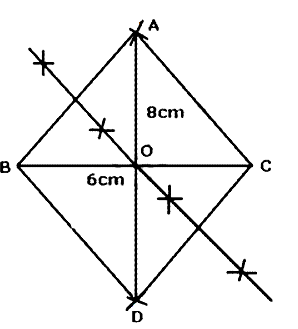
Steps of Construction:
(i) Draw BC = 6 cm.
(ii) Draw AD = 8 on perpendicular to BC.
(iii) With B as centre draw arcs on AD.
(iv) With C as centre draw arcs on AD. ABCD is the required rhombus.
(v) Draw perpendicular bisectors of AB, and CD, which meet at 0.
(vi) Since AD and BC are diagonals of rhombus and meet at 0.
AO = OD
O is the point equidistant from AB, AD and C, D.

Need a full question paper?

Generate a complete, print-ready paper with questions like this in minutes — across 16+ boards, with answer keys.

Start Generating Free

Similar questions

Solve the following equation by factorisation :
$
\sqrt{3 x^2-2 x-1}=2 x-2
$
The compound interest, calculated yearly, on a certain sum of money for the second year is Rs. 1320 and for the third year is Rs. 1452. Calculate the rate of interest and the original sum of money.
A man invests a certain sum of money in 6% hundred-rupee shares at Rs.12 premium. When the shares fell to Rs.96, he sold out all the shares bought and invested the proceed in 10%, ten-rupee shares at Rs.8. If the change in his income is Rs.540, Find the sum invested originally
In ∆ABC, ∠B = 90° and BD ⊥ AC.
(i) If CD = 10 cm and BD = 8 cm; find AD.
(ii) IF AC = 18 cm and AD = 6cm; find BD.
(iii) If AC = 9 cm and AB = 7cm; find AD.
Find the mean of the following frequency distribution by the step deviation method : 
$\text{Class}$ $100-110 $ $110-120 $ $120-130 $ $130-140 $ $140-150 $
$\text{Frequency}$ $15$ $18$ $32$ $25$ $10$
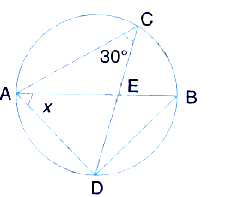
In the given circle with diameter AB, find the value of x.
Prove that the perimeter of a right triangle is equal to the sum of the diameter of its incircle and twice the diameter of its circumcircle.
In Δ PQR, s is a point on PR such that ∠ PQS = ∠ RQS . Prove thats is equidistant from PQ and QR.
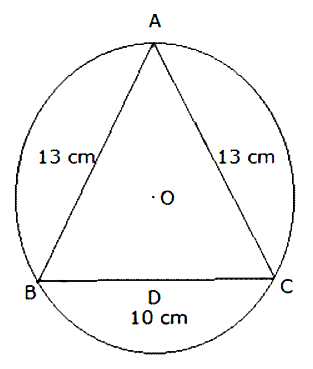
In figure, $A B C$ is an isosceles triangle inscribed in a circle with centre $O$ such that $A B=A C=13 cm$ and $B C=10 cm$. Find the radius of the circle.
Draw a straight line AB of 9 cm. Draw the locus of all points which are equidistant from A and B. Prove your statement.