Question
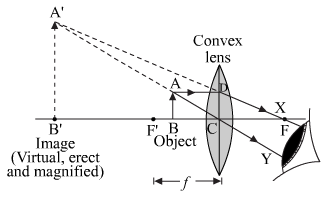
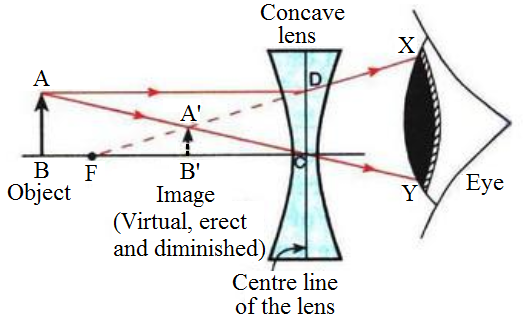
Construct ray diagrams to illustrate the formation of a virtual image using:
  1. A converging lens, and.
  2. A diverging lens.

Answer

  1.  


  1.  

Need a full question paper?

Generate a complete, print-ready paper with questions like this in minutes — across 16+ boards, with answer keys.

Start Generating Free

Similar questions

A student is unable to see clearly the words written on the blackboard placed at a distance of approximately 4 m from him. Name the defect of vision the boy is suffering from. Explain the method of correcting this defect. Draw ray diagram for the:
  1. Defect of vision and also.
  2. For its correction.
One-half of a convex lens is covered with a black paper. Will this lens produce a complete image of the object? Verify your answer experimentally. Explain your observations.
  1. What is a magnetic field? How can the direction of magnetic field lines at a place be determined?
  2. State the rule for the direction of the magnetic field produced around a current carrying conductor. Draw a sketch of the pattern of field lines due to a current flowing through a straight conductor.
What is long-sightedness? State the two causes of long-sightedness (or hypermetropia). With the help of ray diagrams, show:
  1. The eye-defect long-sightedness.
  2. Correction of long-sightedness by using a lens.
i. A person suffering from myopia (near-sightedness) was advised to wear the corrective lens of power -2.5 D . A spherical lens of the same focal length was taken in the laboratory. At what distance should a student place an object from this lens so that it forms an image at a distance of 10 cm from the lens?
ii. Draw a ray diagram to show the position and nature of the image formed in the above case.
  1. What is meant by saying that the potential difference between two points is 1 volt? Name a device that helps to measure the potential difference across a conductor.
  2. Why does the connecting cord of an electric heater not glow hot while the heating element does?
  3. Electrical resistivities of some substances at $20^{0}\text{C}$ are given below:
Silver $1.60\times10^{-8} \Omega \text{ m}$
Copper $1.62\times10^{-8} \Omega \text{ m}$
Tungsten $5.20\times10^{-8} \Omega \text{ m}$
Iron $10.0\times10^{-8} \Omega \text{ m}$
Mercury $94.0\times10^{-8} \Omega \text{ m}$
Nichrome $100\times10^{-6} \Omega \text{ m}$

Answer the following questions in relation to them:
  1. Among silver and copper, which one is a better conductor? Why?
  2. Which material would you advise to be used in electrical heating devices? Why?
You are given three resistances of 1,2 and 3 ohms. Show by diagrams, how with the help of these resistances you can get:
  1. $6\Omega$
  2. $\frac{6}{11}\Omega$
  3. $1.5\Omega$
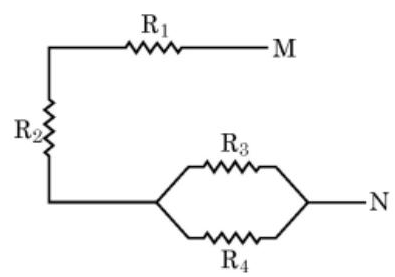
i. For the combination of resistors shown in the following figure, find the equivalent resistance between M & N.
Image
ii. State Joule’s law of heating.
iii. Why we need a 5 A fuse for an electric iron which consumes 1 kW power at 220 V?
iv. Why is it impracticable to connect an electric bulb and an electric heater in series?
What is meant by power of a lens? Name and define its S.I. unit. One student uses a lens of focal length +50cm and another of -50cm. State the nature and find the power of each lens. Which of the two lenses will always give a virtual, erect and diminished image irrespective of the position of the object?
Write the main difference between an acid and a base. With the help of suitable examples the term  neutralization and the formation of:
  1. Acidic
  2. Basic
  3. Neutral salts.