Question
Write the main difference between an acid and a base. With the help of suitable examples the term  neutralization and the formation of:
  1. Acidic
  2. Basic
  3. Neutral salts.

Answer

Acid
Base
1
An acid produces H+ ions in aqueous solution.
A base produces OH-ions in aqueous solution.
2
Acids are sour in taste.
Bases are bitter in taste.
3
Acids change the colour of blue litmus to red.
Bases change the colour of red litmus to blue.
Neutralization - A reaction of an acid with a base to produce salt and water.
  1. $\text{Acidic}-\text{NH}_4\text{OH}\ +\ \text{HCl}\xrightarrow{ \ \ \ \ \ \ \ }\text{NH}_4\text{Cl}+\text{H}_2\text{O}$
  2. $\text{Basic}-\text{NaOH}\ +\ \text{H}_2\text{CO}_3\xrightarrow{ \ \ \ \ \ \ \ }\text{Na}_2\text{CO}_3+\text{H}_2\text{O}$
  3. $\text{Neutral}-\text{KOH}\ +\ \text{HNO}_3\xrightarrow{ \ \ \ \ \ \ \ }\text{KNO}_3+\text{H}_2\text{O}$

Need a full question paper?

Generate a complete, print-ready paper with questions like this in minutes — across 16+ boards, with answer keys.
Start Generating Free

Similar questions

How can three resistors of resistances 2 Ω, 3 Ω, and 6 Ω be connected to give a total resistance of (a) 4 Ω, (b) 1 Ω?
State Ohm's law. Write the necessary conditions for its validity. How is this law verified experimentally? What will be the nature of graph between potential difference and current for a
conductor? Name the physical quantity that can be obtained from this graph.
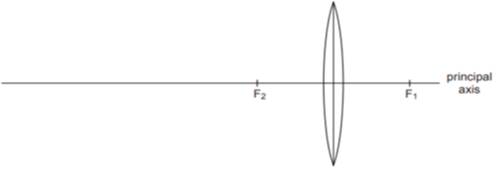
Image
The above image shows a thin lens of focal length $5 m$.
(i) What is the kind of lens shown in the above figure?
(ii) If a real inverted image is to be formed by this lens at a distance of $7 m$ from the pole, then show with calculation where should the object be placed?
(iii) Draw a neatly labelled diagram of the image formation mentioned in (ii)
  1. One-half of a convex lens is covered with a black paper. Will such a lens produce an image of the complete object? Support your answer with a ray diagram.
  2. An object 5 cm high is held 25 cm away from a converging lens of focal length 10 cm.
  1. Draw the ray diagram.
  2. Calculate the position and size of the image formed.
  3. What is the nature of the image?
Construct ray diagrams to illustrate the formation of a virtual image using:
  1. A converging lens, and.
  2. A diverging lens.
What is meant by ‘reflection of light’? Define the following terms used in the study of reflection of light by drawing a labelled ray-diagram :
  1. Incident ray.
  2. Point of incidence.
  3. Normal.
  4. Reflected ray.
  5. Angle of incidence.
  6. Angle of reflection.
  1. Define the following terms in the context of spherical mirrors:
  1. Pole.
  2. Centre of curvature.
  3. Principal axis.
  4. Principal focus.
  1. Draw ray diagrams to show the principal focus of a:
  1. Concave mirror.
  2. Convex mirror.
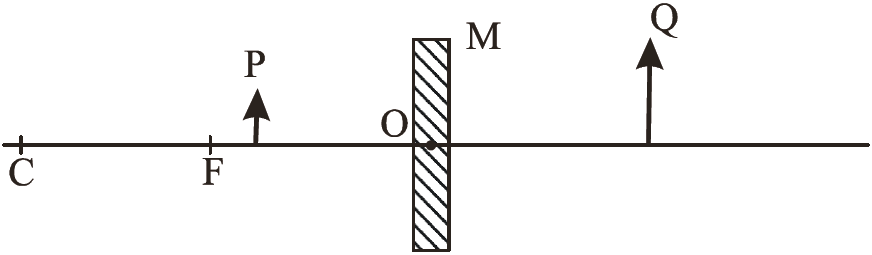
  1. Consider the following diagram in which M is a mirror and P is an object and Q is its magnified image formed by the mirror.


State the type of the mirror M and one characteristic property of the image Q.
With the help of a labelled ray-diagram, describe how a plane mirror forms an image of a point source of light placed in front of it. State the characteristics of the image formed in a plane mirror.
i. Draw a ray diagram to show the path of the reflected ray in each of the following cases:
A ray of light incident on a convex mirror
1. parallel to its principal axis, and
2. is directed towards its principal focus
ii. A 1.5 cm tall candle flame is placed perpendicular to the principal axis of a concave mirror of focal length 12 cm . If the distance of the flame from the pole of the mirror is 18 cm , use mirror formula to determine the position and size of the image formed.
Why does a magnetic compass needle pointing North and South in the absence of a nearby magnet get deflected when a bar magnet or a current carrying loop is brought near it. Describe some salient features of magnetic lines of field concept.