Question
Constructive and destructive interference occur in:

Answer

  1. All of these
Explanation:
Interference (constructive and destructive) is one of the basic properties of a wave, therefore it will occur in all the given waves, no matter they are electromagnetic or mechanical, transverse or longitudinal.

Need a full question paper?

Generate a complete, print-ready paper with questions like this in minutes — across 16+ boards, with answer keys.
Start Generating Free

Similar questions

Potential difference in ac circuit is $V =20 \sin \omega t$ and current flowing is $I =5 \cos \omega t$, then power dissipated in watts is :
The plates of parallel plate capacitor are charged upto 100 V. A 2mm  thick plate is inserted between the plates. Then to maintain the same potential difference, the distance between the plates is increased by 1.6 mm. The dielectric constant of the plate is(a) 5 (b) 1.25(c) 4  (d) 2.5
       
In a concave mirror experiment, an object is placed at a distance $x_1$ from the focus and the image is formed at a distance $x_2$ from the focus. The focal length of the mirror would be
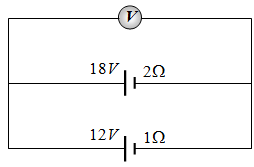
Two batteries, one of emf $18$ volts and internal resistance $2\Omega$ and the other of emf $12$ volt and internal resistance $1 \Omega,$ are connected as shown. The voltmeter $V$ will record a reading of
Boolean expression for NAND gate is :
An $\alpha -$particle travels in a circular path of radius $0.45 m$ in a magnetic field $B=1.2\ Wb/m^2$ with a speed of $2.6 \times 10^7 m / \sec$ The period of revolution of the $\alpha -$particle is
The magnetic induction in air at a distance $d$ from an isolated point pole of strength $m$ unit will be
 
A radioactive element emits 200 particles per second. After three hours 25 particles per second are emitted. The half life period of element will be(a) 50 minutes(b) 60 minutes(c) 70 minutes(d) 80 minutes
       
Self induction of a solenoid is(a) Directly proportional to current flowing through the coil(b) Directly proportional to its length(c) Directly proportional to area of cross-section(d) Inversely proportional to area of cross-section


The apparent wavelength of the light from a star moving away from the earth is 0.01% more than its real wavelength. Then the velocity of star is(a) 60 km/sec(b) 15 km/sec(c) 150 km/sec(d) 30 km/sec