Question
Copy Figure on your notebook and draw a perpendicular to $l$ through $P,$ using $(i)$ set squares $(ii)$ Protractor $(iii)$ ruler and compasses. How many such perpendiculars are you able to draw?

Answer


We draw perpendicular to $l$ through $P$ using.
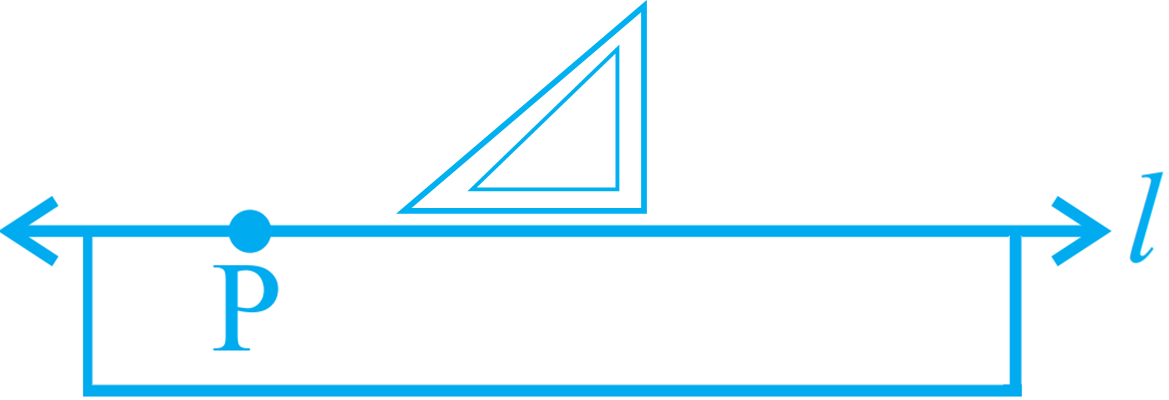
$I.\ $Set square:
Steps of construction are as follows:
Step $I:$ A line $l$ and a point $P$ are given. Note that $P$ is on the line $l.$

Step $II:$ Place a ruler with one of its edges along $l.$ Hold it firmly.

Step $III:$ Place a set square with one of its edges along the already aligned edge of the ruler, such that the right angled comer is in contact with the ruler.

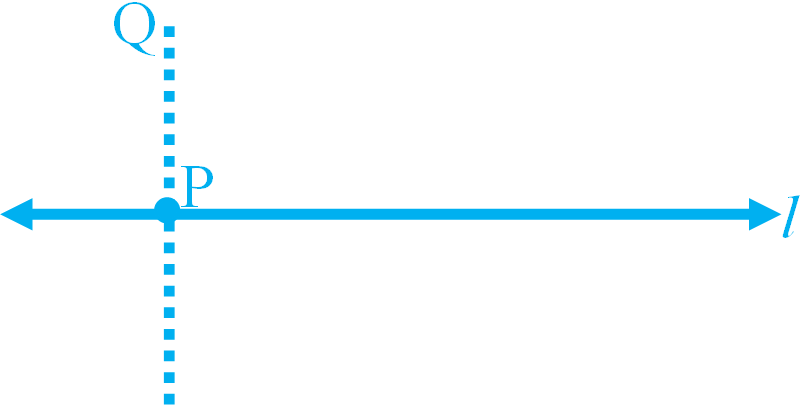
Step $IV:$ Hold the set square firmly in this position. Draw $\overline{\text{PQ}}$ along the edge of the set square.

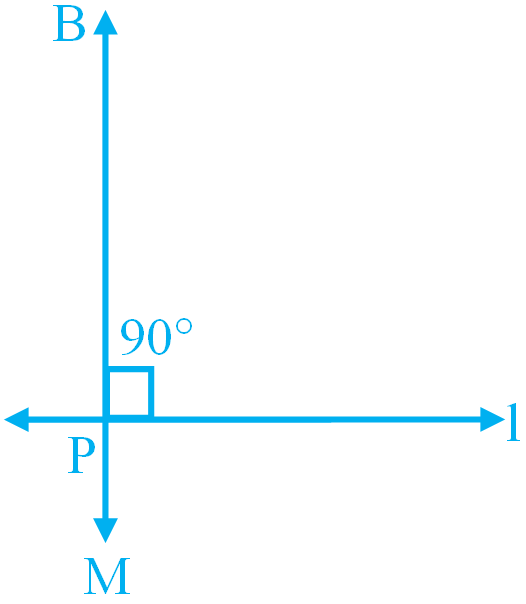
$II.\ $Protractor:
Step $I:$ A line $l$ and a point $P$ are given. Note that $P$ is on the line $l.$

Step $II:$ Place the protractor on the line, such that its base line coincides with l and its centre falls on $P.$
Step $III:$ Mark a point $B$ against the $90^\circ$ mark on the protractor.
Step $IV:$ Remove the protractor and draw a line m passing through $P$ and $B.$
Then, $\text{PB}\bot\text{l}$

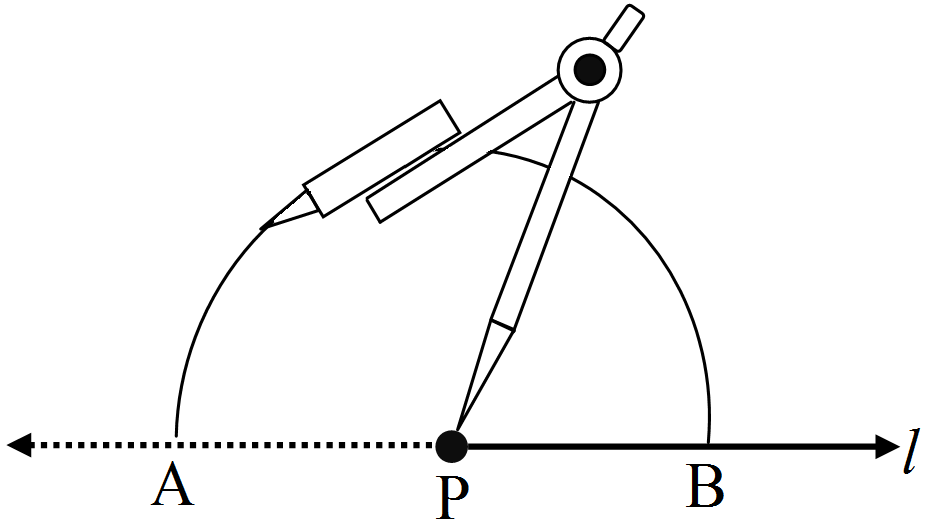
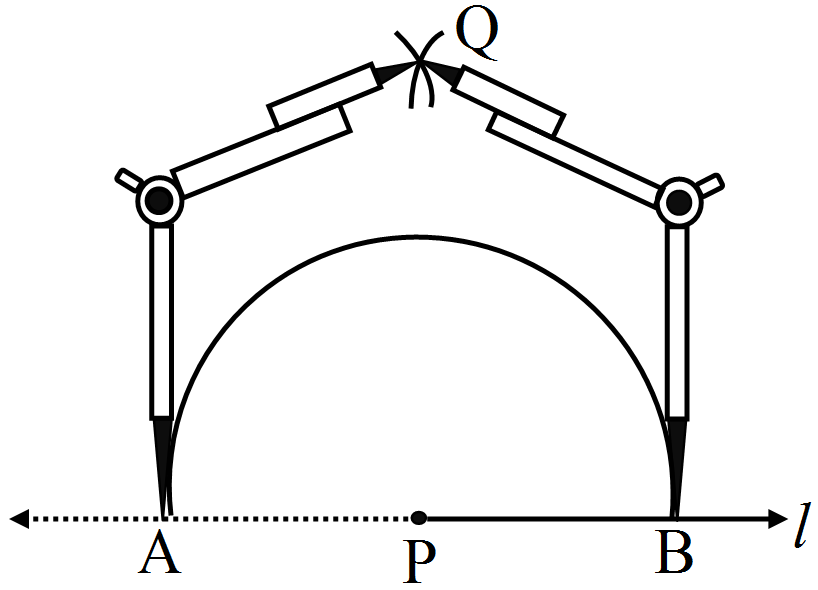
Ruler and Compass:
Step $I:$ Given, a point $P$ on a line $l.$​​​​​​​

Step $II:$ With $P$ as centre and a convenient radius, construct an arc intersecting the line $l$ at two points $A$ and $B.$​​​​​​​

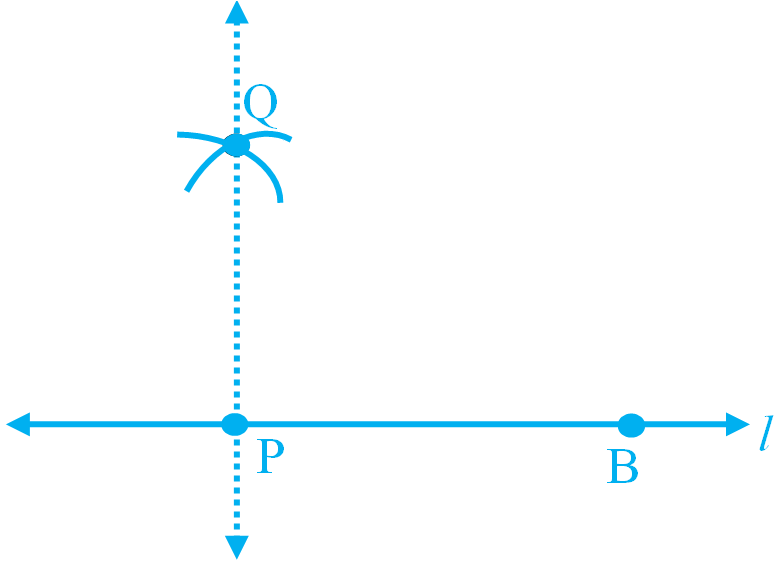
Step $III:$ With $A$ and $B$ as centres and a redius greater than $AP$ construct two arcs, which cut each other at $Q.$​​​​​​​

Step $IV:$ Join $PQ.$ Then, $PQ$ is perpendicular to $l.$​​​​​​​

Hence, we are able to draw one perpendicular line.
 

Need a full question paper?

Generate a complete, print-ready paper with questions like this in minutes — across 16+ boards, with answer keys.

Start Generating Free

Similar questions

Draw $\angle A B C$ os measure $60^{\circ}$ such that $A B=4.5 \ cm$ and $B C=5 \ cm$ and $B C=5 \ cm$. Through $C$ draw a line parallel to $A B$ and through $B$ draw a line parallel to $A C$. Intersecting each other at $D.$ Measure $BD$ and $CD.$
Draw an angle of $50^\circ $ with the help of protractor. Draw a ray bisecting this angle.
Total number of students of a school in different years is shown in the following table:
Year
Number of students
$1996$
$400$
$1998$
$550$
$2000$
$450$
$2002$
$600$
$2006$
$650$
Represent the above data by a pictograph. Prepare another pictograph of students using any other symbol each represents students. Which pictograph do you find more informative?
Simplify: $4\frac{4}{5}\div\Big\{2\frac{1}{5}-\frac{1}{2}\Big(1\frac{1}{4}-\overline{\frac{1}{4}-\frac{1}{5}}\Big)\Big\}$
Find the missing numbers:
(a) 5 glasses of juice shared equally among 4 friends is the same as __________ glasses of juice shared equally among 8 friends. So, $\frac{5}{4}=\frac{?}{8}$
(b) 4 kg of potatoes divided equally in 3 bags is the same as 12 kgs of potatoes divided equally in __________ bags. So, $\frac{4}{3}=\frac{12}{?}$.
(c) 7 rods divided among 5 children is the same as rods divided among children. So, $\frac{7}{5}=$ __________
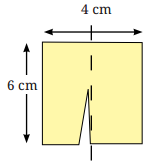
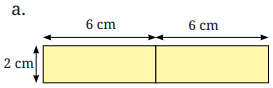
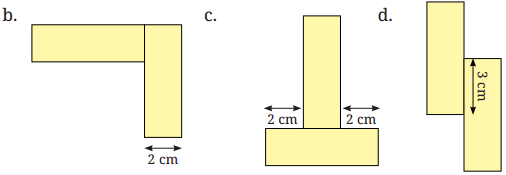
A rectangular paper chit of dimension 6 cm × 4 cm is cut as shown into two equal pieces. These two pieces are joined in different ways.
Image
Image
For example, the arrangement a. has a perimeter of 28 cm.
Find out the length of the boundary (i.e., the perimeter) of each of the other arrangements below.
Image
Arrange the following fractions in ascending order:$\frac{2}{5},\frac{7}{10},\frac{11}{15}\ \text{and}\ \frac{17}{30}$
Draw an angle of $60^\circ $, using a pair of compasses. Bisect it to make an angle of $30^\circ .$
Solve the following equation and verify the answer: $5(x - 1) + 2(x + 3) + 6 = 0$
Find the greatest number that will divide $445, 572$ and $699$, leaving remainders $4, 5, 6$ respectively.