MCQ
Correct relation for triode is
  • $\mu=g_m \times r_p$
  • B
    $\mu=\frac{\frac{g m}{r_p}}{r_p}$
  • C
    $\mu=2 g_m \times r_p$
  • D
    None of these

Answer

Correct option: A.
$\mu=g_m \times r_p$

Need a full question paper?

Generate a complete, print-ready paper with questions like this in minutes — across 16+ boards, with answer keys.

Start Generating Free

Similar questions

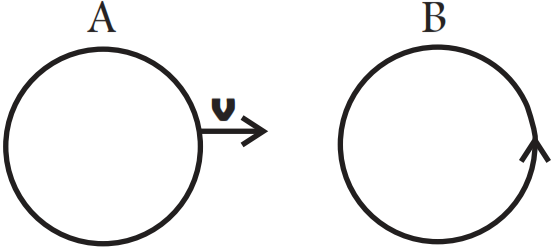
There are two coils A and B as shown in Fig. A current starts flowing in B as shown, when A is moved towards B and stops when A stops moving. The current in A is counterclockwise. B is kept stationary when A moves. We can infer that:
Yellow light is used in single slit diffraction experiment with slit width 0.6 mm. If yellow light is replaced by X-rays then the pattern will reveal (a) That the central maxima is narrower (b) No diffraction pattern(c) More number of fringes (d) Less number of fringes
   
   
An electron is projected with uniform velocity along the axis of a current carrying long solenoid. Which of the following is true?
If a magnet is hanged with its magnetic axis then it stops in(a) Magnetic meridian(b) Geometric meridian(c) Angle of dip(d) None of these
   
   
A manufacturer uses a concave lens instead of a convex lens in a magnifying glass by mistake. What will be the effect on the working of the lens?
Charge is the property associated with matter due to which it produces and experiences.
The magnetic moment $(\mu)$ of a revolving electron around the nucleus varies with principal quantum number n as
A long straight horizontal cable carries a current of 2.5 A in the direction 10° south of west to 10° north of east. The magnetic meridian of the place happens to be 10° west of the geographic meridian. The earth’s magnetic field at the location is 0.33 Gauss, and the angle of dip is zero. Locate the line of neutral points. (Ignore the thickness of the cable).
In hydrogen atom the ratio $(1/137)$ of velocity of electron in first orbit to the velocity of light is called :
When electron changes its orbit from outer to inner energy is: