Questions · Page 1 of 9

M.C.Q (1 Marks)

🎯

Test yourself on this topic

50 questions · timed · auto-graded

MCQ 11 Mark
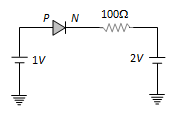
In the following circuit find $I_1$ and $I_2$
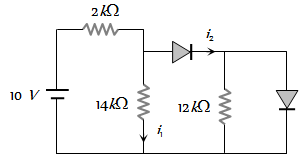
  • A
    $ 0, 0$
  • B
    $ 5 mA, 5 mA$
  • C
    $5 mA, 0$
  • $0, 5 mA$
Answer
Correct option: D.
$0, 5 mA$
$0, 5 mA$
View full question & answer
MCQ 21 Mark
For a triode, at $\mathrm{v}_{\mathrm{g}}=-1$ vort, the following observations were taken $\mathrm{v}_{\mathrm{p}}=75 \mathrm{~V}, \mathrm{I}_{\mathrm{p}}=2 \mathrm{~mA}, \mathrm{~V}_{\mathrm{p}}=100 \mathrm{~V}, \mathrm{I}_{\mathrm{p}}=4 \mathrm{~mA}$ The value of plate resistance will be
  • A
    $25 \ \mathrm{k} \Omega$
  • B
    $20.8 \ \mathrm{k} \Omega$
  • $12.5 \ \mathrm{k} \Omega$
  • D
    $100 \ \mathrm{k} \Omega$
Answer
Correct option: C.
$12.5 \ \mathrm{k} \Omega$
View full question & answer
MCQ 31 Mark
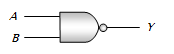
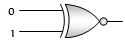
Which gates is represented by this figure
  • $\text{NAND}$ gate
  • B
    $\text{AND}$ gate
  • C
    $\text{NOT}$ gate
  • D
    $\text{OR}$ gate
Answer
Correct option: A.
$\text{NAND}$ gate
$\text{NAND}$ gate
View full question & answer
MCQ 51 Mark
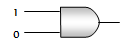
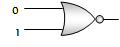
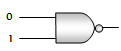
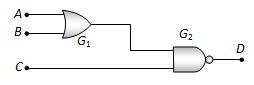
For the given combination of gates, if the logic states of inputs $\text{A, B, C}$ are as follows $A = B = C = 0$ and $A = B = 1, C = 0$ then the logic states of output $D$ are
  • A
    $ 0, 0$
  • B
    $0, 1 $
  • C
    $1, 0$
  • $ 1, 1$
Answer
Correct option: D.
$ 1, 1$
$ 1, 1$
View full question & answer
MCQ 61 Mark
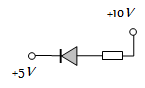
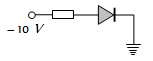
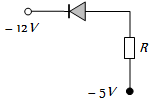
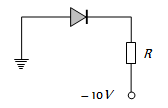
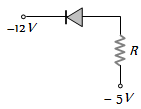
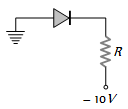
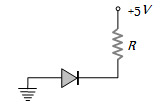
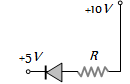
In the given figure, which of the diodes are forward biased ?
1.2.3.  4. 5.
  • A
    $1, 2, 3$
  • $2, 4, 5$
  • C
    $1, 3, 4$
  • D
    $2, 3, 4$
Answer
Correct option: B.
$2, 4, 5$
$2, 4, 5$
View full question & answer
MCQ 71 Mark
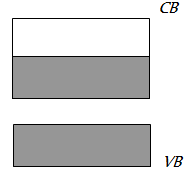
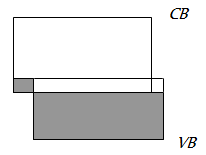
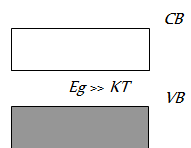
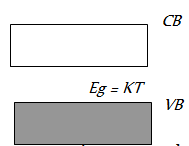
Which of the energy band diagrams shown in the figure corresponds to that of a semiconductor
  • A
     
  • B
  • C
Answer
Correct option: D.
View full question & answer
MCQ 81 Mark
Assertion : $ A P-N$ photodiode is made from a semiconductor for which $E_g = 2.8 eV$. This photo diode will not detect the wavelength of $6000 \ nm.$
Reason    : A $PN$ photodiode detect wavelength $l$ if $\frac{\mathrm{hc}}{\lambda}>\mathrm{E}_{\mathrm{e}}$.
  • A
    If both assertion and reason are true and the reason is the correct explanation of the assertion.
  •  If both assertion and reason are true but reason is not the correct explanation of the assertion.
  • C
     If assertion is true but reason is false.
  • D
     If the assertion and reason both are false.
Answer
Correct option: B.
 If both assertion and reason are true but reason is not the correct explanation of the assertion.
If both assertion and reason are true and the reason is the correct explanation of the assertion.
View full question & answer
Question 91 Mark
The following truth table corresponds to the logic gate
A 0 0 1 1
B 0 1 0 1
X 0 1 1 1
(a) NAND    (b) OR(c) AND(d) XOR
       
Answer
(b) OR
View full question & answer
MCQ 101 Mark
The current through an ideal $PN-$junction shown in the following circuit diagram will be
  • Zero
  • B
    $1\ mA$
  • C
    $10\ mA$
  • D
    $30\ mA$
Answer
Correct option: A.
Zero
Zero
View full question & answer
MCQ 111 Mark
Before the saturation state of a diode at the plate voltages of $400 V$ and $200 V$ respectively the currents are $i_1$ and $i_2$ respectively. The ratio $i_1/i_2$ will be
  • A
     $\sqrt{2 / 4}$
  • B
     $2^{\sqrt{2}}$ 
  • $ 2  $
  • D
    $ 1/2$
Answer
Correct option: C.
$ 2  $
$2$  
View full question & answer
Question 121 Mark
For a given plate-voltage, the plate current in a triode is maximum when the potential of(a) The grid is positive and plate is negative(b) The grid is positive and plate is positive(c) The grid is zero and plate is positive(d) The grid is negative and plate is positive
   
   
Answer
(b) The grid is positive and plate is positive
View full question & answer
MCQ 131 Mark
The relation between $a$ and $b$ parameters of current gains for a transistors is given by
  • A
    $\alpha=\frac{\beta}{1-\beta}$
  • $\alpha=\frac{\beta}{1+\beta}$
  • C
    $\alpha=\frac{1-\beta}{\beta}$
  • D
    $a=\frac{1+\beta}{\beta}$
Answer
Correct option: B.
$\alpha=\frac{\beta}{1+\beta}$
View full question & answer
MCQ 141 Mark
For a transistor, in a common emitter arrangement, the alternating current gain $b$ is given by
  • $\beta=\left(\frac{\Delta \mathrm{I}_{\mathrm{C}}}{\Delta \mathrm{I}_{\mathrm{B}}}\right)_{\mathrm{VC}}$
  • B
    $\beta=\left(\frac{\Delta \mathrm{I}_{\mathrm{B}}}{\Delta \mathrm{I}_{\mathrm{C}}}\right)_{\mathrm{VC}}$
  • C
    $\beta=\left(\frac{\Delta \mathrm{I}_{\mathrm{C}}}{\Delta \mathrm{I}_{\mathrm{E}}}\right)_{\mathrm{VC}}$
  • D
    $\beta=\left(\frac{\Delta \mathrm{I}_{\mathrm{E}}}{\Delta \mathrm{I}_{\mathrm{C}}}\right)_{\mathrm{VC}}$
Answer
Correct option: A.
$\beta=\left(\frac{\Delta \mathrm{I}_{\mathrm{C}}}{\Delta \mathrm{I}_{\mathrm{B}}}\right)_{\mathrm{VC}}$
View full question & answer
Question 151 Mark
Which of these is unipolar transistor(a) Point contact transistor(b) Field effect transistor(c) PNP transistor(d) None of these
   
   
Answer
(b) Field effect transistor
View full question & answer
MCQ 161 Mark
In a transistor configuration $b-$parameter is
  • A
    $\frac{ l _{ b }}{ l _{ c }}$
  • $\frac{ l _{ c }}{ l _{ b }}$
  • C
    $\frac{ l _{ c }}{ l _{ a }}$
  • D
    $\frac{ l _{ a }}{ l _{ c }}$
Answer
Correct option: B.
$\frac{ l _{ c }}{ l _{ b }}$
View full question & answer
Question 171 Mark
In forward bias, the width of potential barrier in a P-N junction diode(a) Increases(b) Decreases(c) Remains constant(d) First increases then decreases
   
   
Answer
(b) Decreases
View full question & answer
Question 181 Mark
The depletion layer in the P-N junction region is caused by(a) Drift of holes(b) Diffusion of charge carriers(c) Migration of impurity ions(d) Drift of electrons
   
   
Answer
(b) Diffusion of charge carriers
View full question & answer
Question 191 Mark
In P-N junction, avalanche current flows in circuit when biasing is(a) Forward(b) Reverse(c) Zero  (d) Excess
       
Answer
(b) Reverse
View full question & answer
Question 201 Mark
In the depletion region of an unbiased P-N junction diode there are (a) Only electrons(b) Only holes(c) Both electrons and holes(d) Only fixed ions
   
   
Answer
(d) Only fixed ions
View full question & answer
Question 211 Mark
If the forward voltage in a semiconductor diode is doubled, the width of the depletion layer will(a) Become half(b) Become one-fourth(c) Remain unchanged(d) Become double
       
Answer
(a) Become half
View full question & answer
Question 221 Mark
The electrical resistance of depletion layer is large because(a) It has no charge carriers(b) It has a large number of charge carriers(c) It contains electrons as charge carriers(d) It has holes as charge carriers


Answer
(a) It has no charge carriers
View full question & answer
Question 231 Mark
The reverse biasing in a PN junction diode(a) Decreases the potential barrier(b) Increases the potential barrier(c) Increases the number of minority charge carriers(d) Increases the number of majority charge carriers


Answer
(b) Increases the potential barrier
View full question & answer
Question 241 Mark
PN-junction diode works as a insulator, if connected(a) To A.C.(b) In forward bias(c) In reverse bias(d) None of these
       
Answer
(c) In reverse bias
View full question & answer
Question 251 Mark
The electrical circuit used to get smooth dc output from a rectifier circuit is called(a) Oscillator(b) Filter(c) Amplifier(d) Logic gates
       
Answer
(b) Filter
View full question & answer
Question 261 Mark
The cut-in voltage for silicon diode is approximately(a) 0.2 V(b) 0.6 V(c) 1.1 V(d) 1.4 V
       
Answer
(b) 0.6 V
View full question & answer
Question 271 Mark
In a junction diode, the holes are due to(a) Protons(b) Neutrons(c) Extra electrons(d) Missing of electrons
       
Answer
(d) Missing of electrons
View full question & answer
Question 281 Mark
A semiconductor device is connected in a series circuit with a battery and a resistance. A current is found to pass through the circuit. If the polarity of the battery is reversed, the current drops almost to zero. The device may be(a) A P-type semiconductor(b) An N-type semiconductor(c) A PN-junction(d) An intrinsic semiconductor
   
   
Answer
(c) A PN-junction
View full question & answer
Question 291 Mark
On increasing the reverse bias to a large value in a PN-junction diode, current(a) Increases slowly(b) Remains fixed(c) Suddenly increases(d) Decreases slowly
       
Answer
(c) Suddenly increases
View full question & answer
Question 301 Mark
Electric current is due to drift of electrons in(a) Metallic conductors(b) Semi-conductors(c) Both (a) and (b)(d) None of these
       
Answer
(c) Both (a) and (b)
View full question & answer
MCQ 311 Mark
If $n_e$ and $v_d$ be the number of electrons and drift velocity in a semiconductor. When the temperature is increased
  • $n_e$ increases and $v_d$ decreases
  • B
    $n_e$ decreases and $v_d$ increases
  • C
    Both $n_e$ and $v_d$ increases
  • D
    Both $n_e$ and $v_d$ decreases
Answer
Correct option: A.
$n_e$ increases and $v_d$ decreases
View full question & answer
Question 321 Mark
A piece of semiconductor is connected in series in an electric circuit. On increasing the temperature, the current in the circuit will(a) Decrease(b) Remain unchanged(c) Increase(d) Stop flowing
       
Answer
(c) Increase
View full question & answer
Question 331 Mark
A hole in a P-type semiconductor is(a) An excess electron(b) A missing electron(c) A missing atom(d) A donor level
   
   
Answer
(b) A missing electron
View full question & answer
Question 341 Mark
In an insulator, the forbidden energy gap between the valence band and conduction band is of the order of       (a) 1 MeV(b) 0.1 MeV(c) 1eV    (d) 5 eV
       
Answer
(d) 5 eV
View full question & answer
Question 351 Mark
Bonding in a germanium crystal (semi- conductor) is(a) Metallic(b) Ionic(c) Vander Waal's type(d) Covalent
       
Answer
(d) Covalent
View full question & answer
MCQ 361 Mark
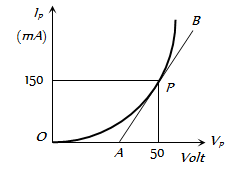
The plate characteristic curve of a diode in space charge limited region is as shown in the figure. The slope of curve at point $P$ is $5.0\ mA/V.$ The static plate resistance of diode will be
  • A
    $111.1W$
  • B
    $222.2W$
  • $333.3W$
  • D
    $444.4W$
Answer
Correct option: C.
$333.3W$
$333.3W$
View full question & answer
MCQ 371 Mark
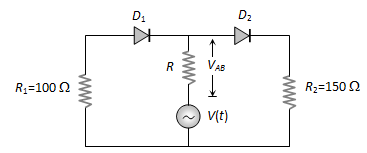
In the circuit given below, $V(t)$ is the sinusoidal voltage source, voltage drop $V_{AB}(t)$ across the  resistance $R$ is
  • A
    Is half wave rectified
  • B
    Is full wave rectified
  • C
    Has the same peak value in the positive and negative half cycles
  • Has different peak values during positive and negative half cycle 
Answer
Correct option: D.
Has different peak values during positive and negative half cycle 
View full question & answer
MCQ 381 Mark
In a semiconductor, the concentration of electrons is $8 \times 10^{12} \mathrm{~cm}^3$ and that of the holes is $5 \times 10^{12} \mathrm{~cm}^3$ The semiconductor  is
  • A
    $P-$type
  • $N-$type
  • C
    Intrinsic
  • D
    $\text{PNP}-$type
Answer
Correct option: B.
$N-$type
$N-$type
View full question & answer
MCQ 391 Mark
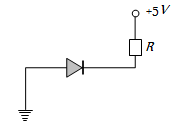
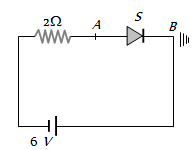
The diode shown in the circuit is a silicon diode. The potential difference between the points $A$ and $B$ will be
  • $6 V$
  • B
    $0.6 V$
  • C
    $0.7 V$
  • D
    $0 V$
Answer
Correct option: A.
$6 V$
$6 V$
View full question & answer
Question 411 Mark
The valence of an impurity added to germanium crystal in order to convert it into a P-type semi conductor is(a) 6 (b) 5(c) 4  (d) 3
       
Answer
(d) 3
View full question & answer
Question 421 Mark
A P-type semiconductor can be obtained by adding (a) Arsenic to pure silicon(b) Gallium to pure silicon(c) Antimony to pure germanium(d) Phosphorous to pure germanium
   
   
Answer
(b) Gallium to pure silicon
View full question & answer
Question 431 Mark
The majority charge carriers in P-type semiconductor are (a) Electrons(b) Protons(c) Holes(d)  Neutrons
       
Answer
(c) Holes
View full question & answer
MCQ 441 Mark
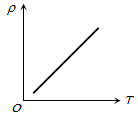
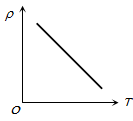
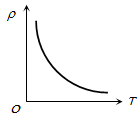
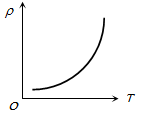
The temperature $(T)$ dependence of resistivity $(r)$ of a semiconductor is represented by
  • A
  • B
  • D
Answer
Correct option: C.
View full question & answer
MCQ 451 Mark
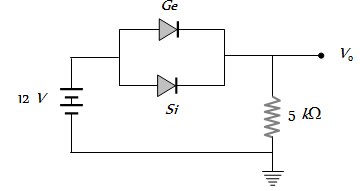
$Ge$ and $Si$ diodes conduct at $0.3 V$ and $0.7 V$ respectively. In the following figure if $Ge$ diode connection are reversed, the valve of $V_0$ changes by
  • A
    $0.2 V$
  • $0.4 V$
  • C
    $0.6 V $
  • D
    $0.8 V$
Answer
Correct option: B.
$0.4 V$
$0.4 V$
View full question & answer
MCQ 461 Mark
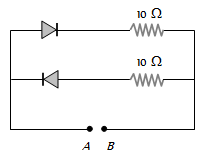
A $2V$ battery is connected across the points $A$ and $B$ as shown in the figure given below. Assuming that the resistance of each diode is zero in forward bias and infinity in reverse bias, the current supplied by the battery when its positive terminal is connected to $A$ is
  • $0.2\ A$
  • B
    $0.4\ A$
  • C
    Zero
  • D
    $0.1\ A$
Answer
Correct option: A.
$0.2\ A$
$0.2\ A$
View full question & answer
Question 471 Mark
A solid that transmits light in visible region and has a very low melting point possesses(a) Metallic bonding(b) Ionic bonding(c) Covalent bonding(d) Vander Waal’s bonding
   
   
Answer
(d) Vander Waal’s bonding
View full question & answer
Question 481 Mark
In P-type semiconductor, there is(a) An excess of one electron(b) Absence of one electron(c) A missing atom(d) A donar level
   
   
Answer
(b) Absence of one electron
View full question & answer
Question 491 Mark
The distance between the body centred atom and a corner atom in sodium (a = 4.225 Å) is(a) 3.66 Å(b) 3.17 Å(c) 2.99 Å  (d) 2.54 Å
       
Answer
(a) 3.66 Å
View full question & answer
Question 501 Mark
What is the coordination number of sodium ions in the case of sodium chloride structure(a) 6 (b) 8(c) 4  (d) 12
       
Answer
(a) 6 
View full question & answer