Question
Coulomb's Law agrees with________?

Answer

  1. Newtons 3rd Law of Motion.
Explanation:
Coulomb's law agrees with Newton's 1st, 2nd and 3rd law of motion. Coulomb's law states that $\text{F}=\text{K}\frac{\text{q}_1\text{q}_2}{\text{r}^2}$ here the two charge particle is similar to the objects of the Newton's 1st law. Newton's 3rd law is same as the two similar charge particles repel to each other. Which coincides with Newton's 3rd law every action there is an equal and opposite reaction.

Need a full question paper?

Generate a complete, print-ready paper with questions like this in minutes — across 16+ boards, with answer keys.
Start Generating Free

Similar questions

Two unequal resistors are connected in series across a battery. Then the:
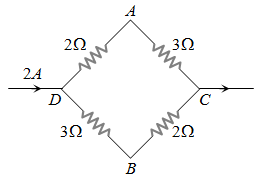
A current of $2 A$ flows in a system of conductors as shown. The potential difference $( \left.V_A-V_B\right)$
will be
If an object is placed 10 cm infront of a concave mirror of focal length 20 cm, the image will be (a) Diminished, upright, virtual(b) Enlarged, upright, virtual(c) Diminished, inverted, real(d) Enlarged, upright, real
   
   
Which of the following is true for photon
Photoelectric effect was discovered by:
Boolean expression for NAND gate is :
A lamp whose resistance is $280 \Omega$ is joined with an ac source of 200 V . The peak value of current flowing in the lamp is :
In two separate set - ups of the Young's double slit experiment, fringes of equal width are observed when lights of wavelengths in the ratio 1 : 2 are used. If the ratio of the slit separation in the two cases is 2 : 1, the ratio of the distances between the plane of the slits and the screen in the two set - ups is(a) 4 : 1(b) 1 : 1(c) 1 : 4(d) 2 : 1
       
Equal potentials are applied on an iron and copper wire of same length. In order to have the same current flow in the two wires, the ratio $r\ ($iron$)\ / r\ ($copper$)$ of their radii must be $($Given that specific resistance of iron $=1.0 \times 10^{-7}$ ohm$-m$ and specific resistance of copper $=1.7 \times 10^{-8}$ ohm$-m)$
The sensitivity of a tangent galvanometer is increased if(a) Number of turn decreases (b) Number of turn increases(c) Field increases(d) None of the above