MCQ
Coulomb’s law is true for:
- AAtomic distances (= 10–11 m).
- BNuclear distances (= 10–15 m).
- CCharged as well as uncharged particles.
- DAll the distances.
Generate a complete, print-ready paper with questions like this in minutes — across 16+ boards, with answer keys.
The logic behind ‘NOR’ gate is that it gives
|
(a) High output when both the inputs are low |
|
(b) Low output when both the inputs are low |
|
(c) High output when both the inputs are high |
|
(d) None of these |
A wire of length L and 3 identical cells of negligible internal resistances are connected in series. Due to current, the temperature of the wire is raised by ∆ T in a time t. A number N of similar cells is now connected in series with a wire of the same material and cross – section but of length 2 L. The temperature of the wire is raised by the same amount ∆ T in the same time t. the value of N is
|
(a) 4 |
(b) 6 |
(c) 8 |
(d) 9 |
Same current i = 2A is flowing in a wire frame as shown in figure. The frame is a combination of two equilateral triangles ACD and CDE of side 1m. It is placed in uniform magnetic field B = 4T acting perpendicular to the plane of frame. The magnitude of magnetic force acting on the frame is

|
(a) 24 N |
(b) Zero |
(c) 16 N |
(d) 8 N |
A piece of fuse wire melts when a current of 15 ampere flows through it. With this current, if it dissipates 22.5 W, the resistance of fuse wire will be
|
(a) Zero |
(b) 10 Ω |
(c) 1 Ω |
(d) 0.10 Ω |
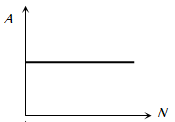
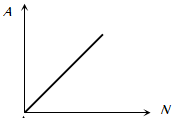
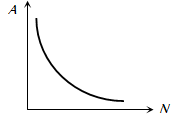
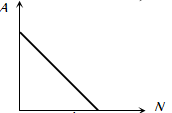
The curve between the activity A of a radioactive sample and the number of active atoms N is
|
(a)
|
(b)
|
(c)
|
(d)
|