Question
$Cu ^{+}$ion is not stable in aqueous solution. Why?

Answer

In aqueous solution $Cu ^{+}$undergoes disproportionation to form a more stable $Cu ^{2+}$ ion.
$2 Cu ^{+}{ }_{(a q)} \longrightarrow Cu ^{2+}{ }_{(a q)}+ Cu _{(s)}$
The higher stability of $Cu ^{2+}$ in aqueous solution may be attributed to its greater negative $\Delta_{h y d} . H ^0$ than that of $Cu ^{+}$. It compensates the second ionisation enthalpy of Cu involved in the formation of $Cu ^{2+}$ ions.

Need a full question paper?

Generate a complete, print-ready paper with questions like this in minutes — across 16+ boards, with answer keys.

Start Generating Free

Similar questions

Match the items of Column I and Column II.
 
Column I
 
Column II
(i)
Diamond.
(a)
Short interval of time.
(ii)
Instantaneous rate.
(b)
Ordinarily rate of conversion is imperceptible.
(iii)
Average rate.
(c)
Long duration of time.
Discuss the physical properties of carboxylic acids in terms of their physical state and boiling point.
Explain decarboxylation reaction of carboxylic acids.
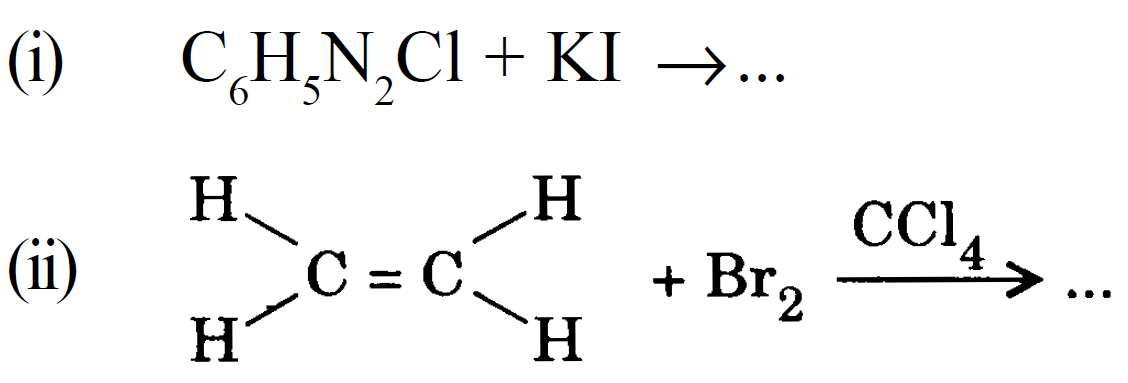
Complete the following reaction equations:
Match the items of Column $I$ and Column $II$
  Column $I$   Column $II$
$(i)$ $S_N1$ reaction $(a)$ vic$-$dibromides
$(ii)$ Chemicals in fire extinguisher $(b)$ gem$-$dihalides
$(iii)$ Bromination of alkenes $(c)$ Racemisation
$(iv)$ Alkylidene halides $(d)$ Saytzeff rule
$(v)$ Elimination of $\ce{HX}$ from alkylhalide $(e)$ Chlorobromocarbons
Explain construction and uses of conductivity cell.
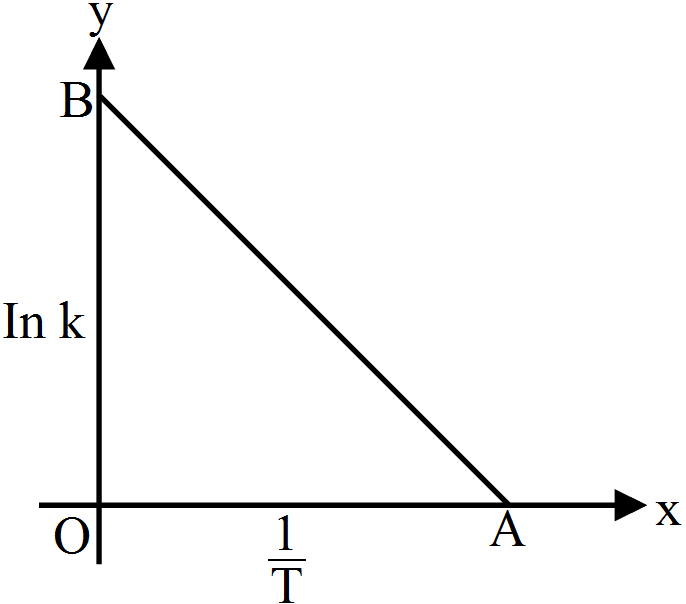
A graph between ln $k$ and $\frac{1}{\text{t}}$ for a reaction is given. Here $k$ is rate constant and $T$ is temperature in Kelvin.If $OA = a$ and $OB = b,$ answer the following:
  1. What is the activation energy $(Ea)$ of the reaction?
  2. What is the frequency factor $(A)$ for the reaction?
The rate of reaction, $\ce{2NO + Cl2 \rightarrow 2NOCl}$ is doubled when concentration of $\ce{Cl2}$ is doubled and it becomes eight times when concentration of both $\ce{NO}$ and $\ce{Cl2}$ are doubled. Deduce the order of the reaction.
Differentiate between conformation and configuration in open chain molecules by giving one example each.
Answer the following question:
Give reasons for the following:
  1. At higher altitudes, people suffer from a disease called anoxia. In this disease, they become weak and cannot think clearly.
  2. When mercuric iodide is added to an aqueous solution of $KI$, the freezing point is raised.