MCQ
Curie temperature is the temperature above which
  • A
    A paramagnetic material becomes ferromagnetic
  • A ferromagnetic material becomes paramagnetic
  • C
    A paramagnetic material becomes diamagnetic
  • D
    A ferromagnetic material becomes diamagnetic

Answer

Correct option: B.
A ferromagnetic material becomes paramagnetic
(b)

Need a full question paper?

Generate a complete, print-ready paper with questions like this in minutes — across 16+ boards, with answer keys.
Start Generating Free

Similar questions

In a double slit arrangement fringes are produced using light of wavelength $4800 \mathring A$. One slit is covered by a thin plate of glass of refractive index $1.4$ and the other with another glass plate of same thickness but of refractive index $1.7.$ By doing so the central bright shifts to original fifth bright fringe from centre. Thickness of glass plate is
A thin lens made of glass of refractive index $\mu=1.5$ has a focal length equal to $12 \mathrm{~cm}$ in air. It is now immersed in water $\left(\mu=\frac{4}{3}\right)$. Its new focal length is
A stone ties to the end of a string $1 m$ long is whirled in a horizontal circle with a constant speed. If the stone makes 22 revolution in 44 seconds, what is the magnitude and direction of acceleration of the stone
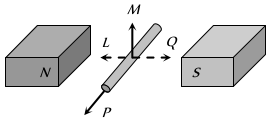
An electric potential difference will be induced between the ends of the conductor shown in the diagram, when the conductor moves in the direction
Image
In Searle's method for finding conductivity of metals, the temperature gradient along the bar
A 60 watt bulb operates on $220 V$ supply. The current flowing through the bulb is
A particle moves in a straight line with retardation proportional to its displacement. lts loss of kinetic energy for any displacement $x$ is proportional to
To remove myopia (short sightedness) a lens of power $0.66\ D$ is required. The distant point of the eye is approximately
In variable state, the rate of flow of heat is controlled by
The energy which an $e^{-}$acquires when accelerated through a potential difference of 1 volt is called