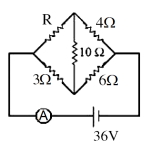
Current measured by the ammeter $(A)$ in the reported circuit when no current flows through $10\,\Omega$ resistance. will be________$A$
JEE MAIN 2022, Diffcult
Download our app for free and get started
Using the condition of a balanced wheat stone bridge,
$\Rightarrow \frac{ R }{3}=\frac{4}{6} \Rightarrow R =2\,\Omega$
So the effective resistance of the circuit is
$R _{\text {eq }}=\frac{6 \times 9}{6+9}=\frac{18}{5}\,\Omega$
$i=\frac{36}{R_{e q}}=10\,A$

Download our appand get started for free
Experience the future of education. Simply download our apps or reach out to us for more information. Let's shape the future of learning together!No signup needed.*
Similar Questions
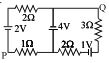
- 1In the circuit shown, what is the potential difference $V_{PQ}$? ................ $V$View Solution
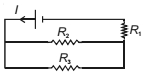
- 2Refer to the circuit shown. What will be the total power dissipation in the circuit if $P$ is the power dissipated in $R_1$ ? It is given that $R_2=4 R_1$ and $R_3=12 R_1$ are .......... $P$View Solution
- 3There are $n$ similar conductors each of resistance $R$. The resultant resistance comes out to be $x$ when connected in parallel. If they are connected in series, the resistance comes out to beView Solution
- 4View SolutionThe resistance of a discharge tube is
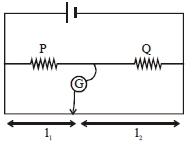
- 5The meter bridge shown is in balanced position with $\frac{\mathrm{P}}{\mathrm{Q}}=\frac{\mathrm{l}_{1}}{\mathrm{l}_{2}}$. If we now litterchange the positions of gavanometer and cell, will the bridge work? If yes, what will be balance condition?View Solution
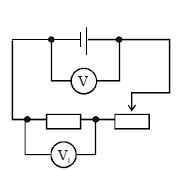
- 6If the rheostat slider were to move from the extreme right to the far left, How will the reading of voltmeter $V_1$ change?View Solution
- 7A piece of copper and another of germanium are cooled from room temperature to $80\, K$. The resistance of :-View Solution
- 8A copper wire of resistance $R$ is cut into ten parts of equal length. Two pieces each are joined in series and then five such combinations are joined in parallel. The new combination will have a resistanceView Solution
- 9Two cities are $150\,\, km$ apart. Electric power is sent from one city to another city through copper wires. The fall of potential per $km$ is $8\,\, volt$ and the average resistance per km is $0.5 \,\,\Omega .$ The power loss in the wire isView Solution
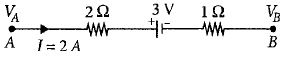
- 10The potential difference $(V_A - V_B)$ between the points $A$ and $B$ in the given figure is ............ $V$View Solution