There are $n$ similar conductors each of resistance $R$. The resultant resistance comes out to be $x$ when connected in parallel. If they are connected in series, the resistance comes out to be
Medium
Download our app for free and get started
(b)In parallel, $x = \frac{R}{n}$ $R = nx$
In series, $R + R + R$ .... $n$ times $=$ $nR = n (nx) = n^2x$

Download our appand get started for free
Experience the future of education. Simply download our apps or reach out to us for more information. Let's shape the future of learning together!No signup needed.*
Similar Questions
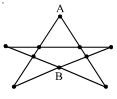
- 1The resistance of all the wires between any two adjacent dots is $R$. Then equivalent resistance between $A$ and $B$ as shown in figure is :View Solution
- 2Electric bulb $50\, W$ - $100\, V$ glowing at full power are to be used in parallel with battery $120\, V$, $10 \,\Omega$. Maximum number of bulbs that can be connected so that they glow in full power isView Solution
- 3A cell of e.m.f. $E$ is connected with an external resistance $R$, then p.d. across cell is $V$. The internal resistance of cell will beView Solution
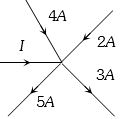
- 4In the given current distribution what is the value of $I$ .............. $A$View Solution
- 5A carbon resistor has colour strips as violet, yellow brown and golden. The resistance is .............. $\Omega$View Solution
- 6A constant electric current $I$ is passed through a straight conductor of length $l$. If $S$ in specific charge of electron then the total momentum of electrons isView Solution
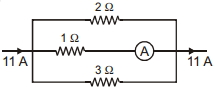
- 7The ammeter reading in the circuit below is .............. $A$View Solution
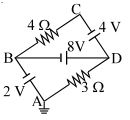
- 8The figure shows a network of resistances in which the point $A$ is earthed. The current through the $4\,\Omega$ resistor isView Solution
- 9Given below are two statementsView Solution
Statement $I:$ The equivalent resistance of resistors in a series combination is smaller than least resistance used in the combination.
Statement $II$ : The resistivity of the material is independent of temperature.
In the light of the above statements, choose the correct answer from the options given below
- 10Which of the following graph represents the variation of resistivity ( $\rho$ ) with temperature $(T)$ for copper $?$View Solution