MCQ
${d \over {dx}}\log \tan \left( {{\pi \over 4} + {x \over 2}} \right) = $
  • A
    $\cos {\rm{ec}}\,x$
  • B
    $ - \cos {\rm{ec}}\,x$
  • $\sec x$
  • D
    $ - \sec x$

Answer

Correct option: C.
$\sec x$
c
(c) $\frac{d}{{dx}}\log \tan \left( {\frac{\pi }{4} + \frac{x}{2}} \right) = \frac{1}{{\tan \left( {\frac{\pi }{4} + \frac{x}{2}} \right)}}{\sec ^2}\left( {\frac{\pi }{4} + \frac{x}{2}} \right).\frac{1}{2}$

$ = \frac{1}{2}.\frac{1}{{\sin \left( {\frac{\pi }{4} + \frac{x}{2}} \right)\cos \left( {\frac{\pi }{4} + \frac{x}{2}} \right)}} = \frac{1}{{\sin \left( {\frac{\pi }{2} + x} \right)}} = \frac{1}{{\cos x}} = \sec x$.

Need a full question paper?

Generate a complete, print-ready paper with questions like this in minutes — across 16+ boards, with answer keys.
Start Generating Free

Similar questions

Let $f:[0,4 \pi] \rightarrow[0, \pi]$ be defined by $f(x)=\cos ^{-1}(\cos x)$. The number of points $x \in[0,4 \pi]$ satisfying the equation $f(x)=\frac{10-x}{10}$ is
A and B are two points and C is any point collinear with A and B. IF AB=10, BC=5, then AC is equal to:
  1. either 15 or 5
  2. necessarily 5
  3. necessarily 16
  4. none of these
If $\text{y}=\Big(1+\frac{1}{\text{x}}\Big)^\text{x},$ then $\frac{\text{dy}}{\text{dx}}=$
  1. $\Big(1+\frac{1}{\text{x}}\Big)^\text{x}\Big(\text{x}+\frac{1}{\text{x}}\Big)-\frac{1}{\text{x}+1}$
  2. $\Big(1+\frac{1}{\text{x}}\Big)^\text{x}\log\Big(1+\frac{1}{\text{x}}\Big)$
  3. $\Big(1+\frac{1}{\text{x}}\Big)^\text{x}\Big\{\log(\text{x}+1)-\frac{\text{x}}{\text{x}+1}\Big\}$
  4. $\Big(1+\frac{1}{\text{x}}\Big)^\text{x}\Big\{\log\Big(\text{x}+\frac{1}{\text{x}}\Big)-\frac{1}{\text{x}+1}\Big\}$
If the value of $x$ satisfying the equation ${\sin ^{ - 1}}\sqrt {1 - {x^2}}  = {\tan ^{ - 1}}\sqrt {\frac{2}{x} - 1} $ is $\frac {a}{b}$ (where $a$ and $b$ are coprime), then the value of $a^2 + b^2$ is
The locus of  a point equidistant from two given points $ a$  and $ b $ is given by
The degree of the differential equation $\left[1+\left(\frac{d y}{d x}\right)^2\right]^3=\left(\frac{d^2 y}{d x^2}\right)^2$ is
If $y = sin^{-1 }\left( {x\sqrt {1\,\, - \,\,x} \,\,\, + \,\,\,\sqrt x \,\,\sqrt {1\, - \,{x^2}} } \right) \&\,\, \frac{{dy}}{{dx}}= \frac{1}{{2\,\sqrt {x\,(1\,\, - \,\,x)} }}+ p$, then $p =$
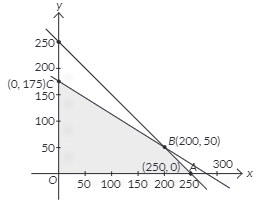
The corner points of the bounded feasible region of an LPP are $O(0,0), A(250,0), B(200,50)$ and $C(0,175)$. If the maximum value of the objective function $Z=2 a x+$ by occurs at the points $A(250,0)$ and $B(200,50)$, then the relation between $a$ and $b$ is:
Image
If A(6, 3, 2), B(5, 1, 4), C(3, −4, 7), D(0, 2, 5) are four points, then projection of CD on AB is:
  1. $-\frac{13}{7}$
  2. $-\frac{13}{7}$
  3. $-\frac{3}{13}$
  4. $-\frac{7}{13}$
Let $R$ be a relation on the set of all natural numbers given by $\alpha b \Leftrightarrow \alpha$ divides $b^2$.

Which of the following properties does $R$ satisfy?

$I.$ Reflexivity   $II.$ Symmetry   $III.$ Transitivity