MCQ
Davission and Germer experiment proved
  • A
    Wave nature of light
  • B
    Particle nature of light
  • C
    Both $(a)$ and $(b)$
  • Neither $(a)$ nor $(b)$

Answer

Correct option: D.
Neither $(a)$ nor $(b)$
d
(d) Davission and Germer proved the wave nature of electron by performing an experiment.

Need a full question paper?

Generate a complete, print-ready paper with questions like this in minutes — across 16+ boards, with answer keys.

Start Generating Free

Similar questions

A particle moving in a straight line covers half the distance with speed of $3 \,m/s$. The other half of the distance is covered in two equal time intervals with speed of $4.5 \,m/s$ and $7.5 \,m/s$ respectively. The average speed of the particle during this motion is...... $\,m/s$
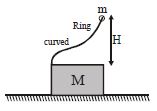
A ring of mass $m$ can freely slide along the massless curved rod as shown. At the lower most point, the curved path becomes vertical. If whole system is released from rest, velocity of ring $(v) $ at lowermost point just before touching the block $M$ (all surfaces are smooth) is
Hubble's law states that the velocity with which milky way is moving away from the earth is proportional to
Three parallel plate capacitors $C _1, C _2$ and $C _3$ each of capacitance $5 \mu F$ are connected as shown in figure. The effective capacitance between points A and B , when the space between the parallel plates of $C _1$ capacitor is filled with a dielectric medium having dielectric constant of 4 , is :
Image
A particle is moving along a straight line with constant acceleration. At the end of tenth  second its velocity becomes $20\, m/s$ and in tenth second it travels a distance of $10\, m$.  Then the acceleration of the particle will be........$m/s^2$
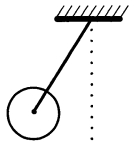
A metal rod of length ' $L$ ' and mass ' $m$ ' is pivoted at one end. A thin disk of mass ' $M$ ' and radius $'R'$ $( < L)$ is attached at its center to the free end of the rod. Consider two ways the disc is attached: (case $A$) The disc is not free to rotate about its center and (case $B$) the disc is free to rotate about its center. The rod-disc system performs $SHM$ in vertical plane after being released from the same displaced position. Which of the following statement$(s)$ is (are) true? $Image$

$(A)$ Restoring torque in case $A =$ Restoring torque in case $B$

$(B)$ Restoring torque in case $A < $ Restoring torque in case $B$

$(C)$ Angular frequency for case $A > $ Angular frequency for case $B$.

$(D)$ Angular frequency for case $A < $ Angular frequency for case $B$.
The coefficient of performance of a refrigerator is $5$ . If the temperature inside freezer is $-20\,^oC$ , the temperature of the surroundings to which it rejects heat is ....... $^oC$
$Assertion :$ The amplitude of an oscillating pendulum decreases gradually with time
$Reason :$ The frequency of the pendulum decreases with time.
A block slides down a smooth inclined plane when released from the top, while another falls freely from the same point
The frequency of the incident light falling on a photosensitive metal plate is doubled, the kinetic energy of the emitted photoelectrons is